
Newton and the Apple: The Story of Gravity"
How a Falling Apple Changed the Way We Understand the Universe

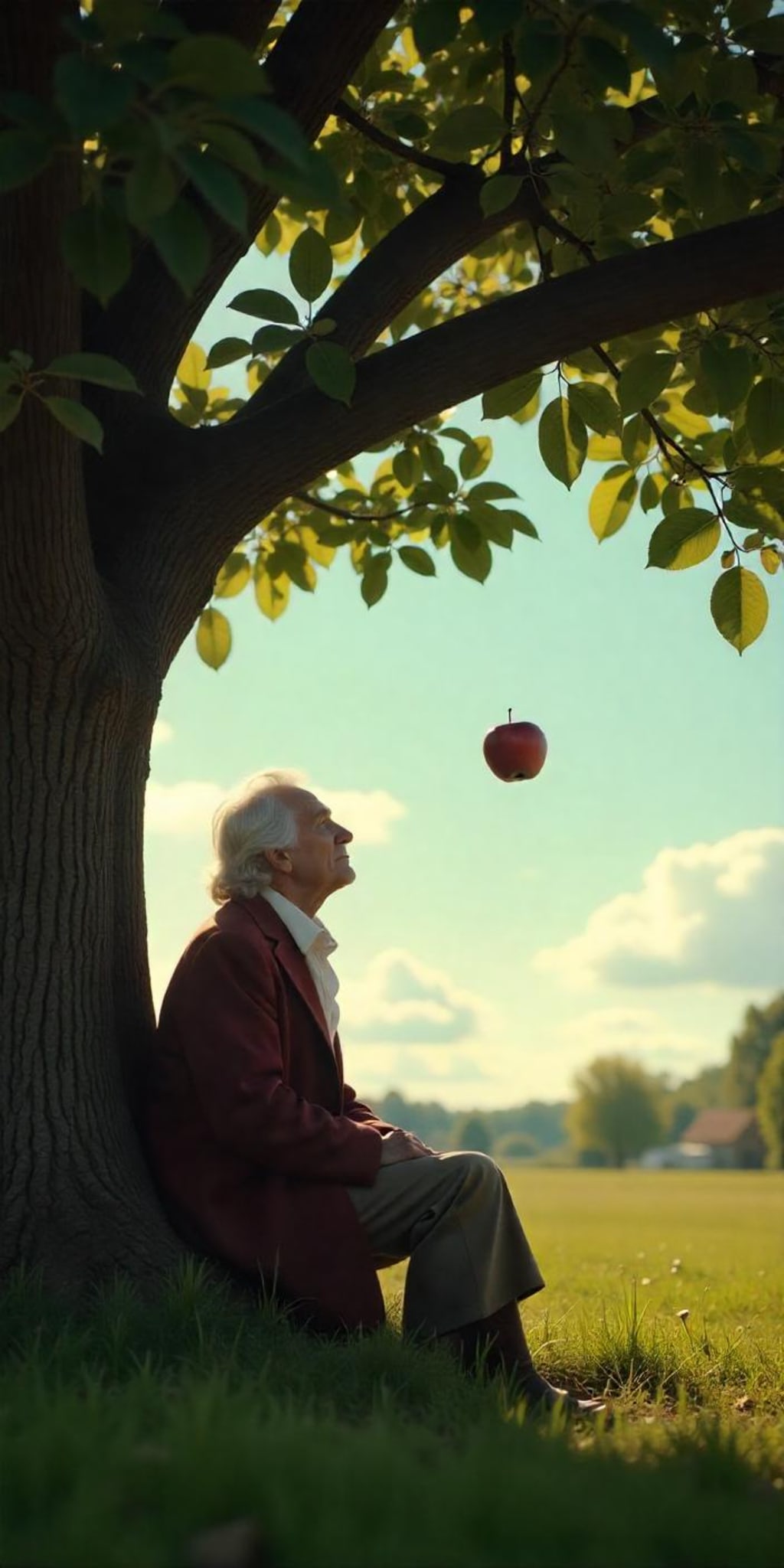
In the quiet countryside of Woolsthorpe, England, a young man named Isaac Newton sat beneath a leafy apple tree. The year was 1666, and the world was in the grip of the Great Plague. Universities were closed, cities were quiet, and people stayed in their homes to avoid the deadly disease. Newton, then a student at Cambridge University, had returned home to the village to wait out the outbreak. Little did he know that this period of isolation would lead him to a discovery that would change the world forever. Newton had always been a curious boy. From an early age, he was fascinated by how things worked. He built miniature windmills, water clocks, and even drew the mechanics of the sky. His love for learning was deep and passionate, and although he struggled socially, he found comfort in the quiet logic of mathematics and the natural world. One warm afternoon, as he sat under the shade of an apple tree, deep in thought, an apple suddenly fell from a branch above him. It landed with a gentle thud near his feet. Newton looked down, not in surprise, but with curiosity. Why did the apple fall straight down? Why not sideways or upward? What invisible force pulled it toward the ground? At first, this might have seemed like a simple question. Everyone knew that things fell—cups, leaves, stones—but no one had ever truly asked why they fell the way they did. People simply accepted it as part of life. But Newton was not like everyone else. He believed that everything must have a reason—an explanation hidden in the laws of nature. He picked up the apple, turned it in his hand, and looked up at the sky. In that quiet moment, a thought occurred to him—could the same force that pulled the apple to the Earth also reach as far as the moon? Could gravity stretch across the vast distances of space? With this question planted in his mind, Newton returned to his small study at home. He began writing, sketching, and calculating. He used mathematics to test his ideas. He thought about how planets moved in the sky, how the moon orbited the Earth, and how objects on Earth behaved when dropped or thrown. Over the next two years, Newton worked tirelessly. He combined the laws of motion with this idea of a pulling force. Slowly, he developed what we now know as the Law of Universal Gravitation. His theory stated that every object in the universe attracts every other object with a force that depends on their masses and the distance between them. This force, he concluded, was gravity. This was a radical idea at the time. Before Newton, people believed that the heavens and the Earth were governed by different sets of rules. Newton’s theory showed that the same force that caused an apple to fall also kept the planets in their orbits. The Earth, the moon, and the stars were all connected by this invisible web of gravity. When he finally published his work in his book Philosophiæ Naturalis Principia Mathematica in 1687, it was met with awe. Scholars and scientists around the world were amazed at the clarity and power of his ideas. Newton’s laws not only explained existing phenomena—they could also predict new ones. The universe suddenly seemed more knowable, more ordered. But the story of the apple didn’t end there. Over time, it became a symbol—a symbol of curiosity, discovery, and the power of asking “why.” While it is still debated whether an apple actually struck Newton’s head or simply fell near him, the moment itself stands as a turning point in scientific history. Newton’s discovery laid the foundation for modern physics. Without his laws of gravity, we wouldn’t understand how satellites orbit the Earth, how tides are influenced by the moon, or how we can send spacecraft to Mars and beyond. His work inspired generations of scientists, including Albert Einstein, who later expanded our understanding of gravity with the theory of relativity. Yet, at its heart, the story of gravity is not just about science. It’s about observation, imagination, and a mind willing to question the ordinary. It reminds us that even the most common events—a falling apple—can reveal extraordinary truths if we look at them closely enough. In today’s world, where technology connects continents and humans reach into space, it's humbling to think that it all began with one curious man and a single apple tree. Newton didn’t set out to change the universe—he simply followed his questions, one step at a time. And so, under the shade of that old apple tree, a simple moment became a spark that lit up the stars.
About the Creator
Enjoyed the story? Support the Creator.
Subscribe for free to receive all their stories in your feed.
Comments
There are no comments for this story
Be the first to respond and start the conversation.