
NCTB Science Class 8 Ch-01 Guide Notes
Chapter:01 , Page:01, 02


Q/A (SUGGESTED)
*Tips: Read aloud twice with writing for better memorization and understanding*
1. The variety of animals depend on what?
Ans: The variety of animals depends on the diversity of the environment.
2. Why does the variety of animals take place?
Ans: Why does the variety of animals take place because of the verity variety of environment and habitat.
3. What is classification?
Ans: A systematic arrangement and arranging group is neccessary to understand the vast animal kingdom. This systematic arrangement and arranging group is known as "classification".
Or in short,
The arrangement that makes the way easy to understand animal kingdom is known as "classification".
4. What is the arrangement called that makes the way easy to understand animal kingdom?
Ans: The arrangement that makes the WAY easy to understand animal kingdom is known as "classification".
5. Why arrangement known as "classification" was even thinked of in case of Animal Kingdom?
Ans: The arrangement known as "classification" was even thinked of in case of Animal Kingdom, BECAUSE the animal kingdom includes a number of complexities, and it's vast in number, which makes it even more harder to understand. So to make the concept of 'Animal Kingdom' in a more understandable and clearer way, the arrangement known as "classification" was thinked of.
( Ques.no '5' must not be memorised. It's for understanding only. If you had understood the full concept of classification, you can skip it.)
*Tips: Read aloud twice with writing for better memorization and understanding*
*Tips: Read aloud twice with writing for better memorization and understanding*
Q/A (SUGGESTED)
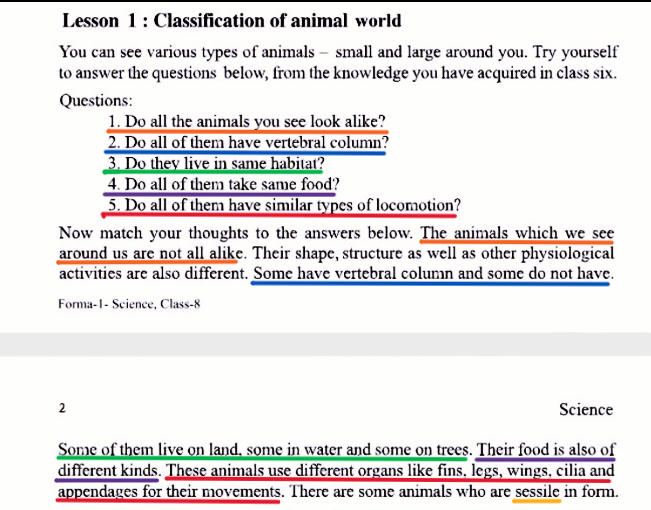
1. Do all the animals we see look alike?
Ans: No, all the animals we see around us don't look alike.Their shape, structure as well as other physiological activities are also different.
2. Do all the animals have vertebral column?
Ans: No, all the animals don't have vertebral column. Some do have and some don't.
3. Do all the animals live in same habitat?
Ans: No, not all the animals live in same habitat. Some of them live in water and some of them on land and trees.
4. Do all the animals take same food?
Ans: No, all the animals don't take same food. Their food varies of different kinds.
5. What is "locomotion"?
Ans: Any way a body moves itself is known as "locomotion". For instance,
- Humans walk, run or crawl - That's locomotion
- Birds fly — that's locomotion.
- Fish swim — that's locomotion.
- Even when a snake slithers — that's too locomotion.
6. Do all the animals have similar type of locomotion?
Ans: No, not all the animals have similar type of locomotion. For instance,
- Humans have organs like hands and legs to enable them to walk, run or crawl.
- Birds have organs like wings on both side of them to fly.
- Fish has organs like fins to help them swim.
- Very tiny organisms (like Paramecium) use tiny hair structure to move known as "cilia".
7. What is "cilia"?
Ans: "cilia" is tiny hair structure of very small living creatures (like Paramecium) to help them to move.
8. What is "sessile"?
Ans: "sessile" is the opposite of locomotion. While locomotion means ANY WAY to Move, "sessile" means to not move. In other words, to be stuck in a fix location or place is known as "sessile". There are also some animals who are "sessile" in form.
*Remember: Don't try to memorize in the very moment. Answers are little broaden and expanded to make you understand more easily. And whereas some questions may be silly as everyone knows that, i suggest writing it down. It might help to write your answers more effectively in other questions.*
*Tips: Read aloud twice with writing for better memorization and understanding*
About the Creator
ur_studyGuide
Hi Everyone! Here I will be willing to post NCTB Class 8 Guide notes from for students for passing exams to students to top exams. Good luck!
Enjoyed the story? Support the Creator.
Subscribe for free to receive all their stories in your feed.
Comments
There are no comments for this story
Be the first to respond and start the conversation.