
NCTB BGST Class-8 Chap-01 Guide Notes
Chapter:01 page :02 , 03




Q/A (SUGGESTED)
1) How the rule of the Sen came to an end?
Ans: The rule of the Sen came to an end at the hands of external Muslims forces. Sen dynasty ended with the advent of Bakhtiar Khilji who had introduced Muslim rule in Bengal.
2) How Bakhtiar Khilji introduced Muslim rule in Bengal?
Ans: Bakhtiar Khilji introduced Muslim rule in Bengal through defeating Lakshman Sen.
3) Who is Bakhtiar Khilji?
Ans: Bakhtiar Khilji is the Turkish General, whose name expands for Ikhtiar Uddin Mohammad Bin Bakhtiar Khilji,who had come from abroad in search of fortune, and introduced the Muslim rule in Bengal through defeating Lakshman Sen.
4) Why Bakhtiar Khilji came from abroad to Bengal?
Ans: Bakhtiar Khilji came from abroad to Bengal in search of fortune.
5) The Nadiya region was under reign and control of Bakhtiar Khilji for how long / for how many years?
Ans: The Nadiya region was under reign and control of Bakhtiar Khilji for '2' years from 1204 to 1206 AD.
6) The Nadiya region consisted of which parts of Bengal?
Ans: The Nadiya region consisted of the west of Bengal and some parts of the Northern Bengal , which was under reign of Bakhtiar Khilji from 1204 AD to 1206 AD.
7) When Muslim rule was spread in Bengal?
Ans: Muslim rule was introduced by Bakhtiar Khilji through defeating Lakshman Sen, of the Sen Dynasty; and reigned the Nadiya region for 2 years, from 1204-1206 AD which included the west and some parts of Northern Bengal. But then it was wide spread in whole Bengal from 1206-1338 AD, for over a century.
*Read aloud while writing them. It'll help to keep basic things and understandings in mind.*
Q/A (SUGGESTED)
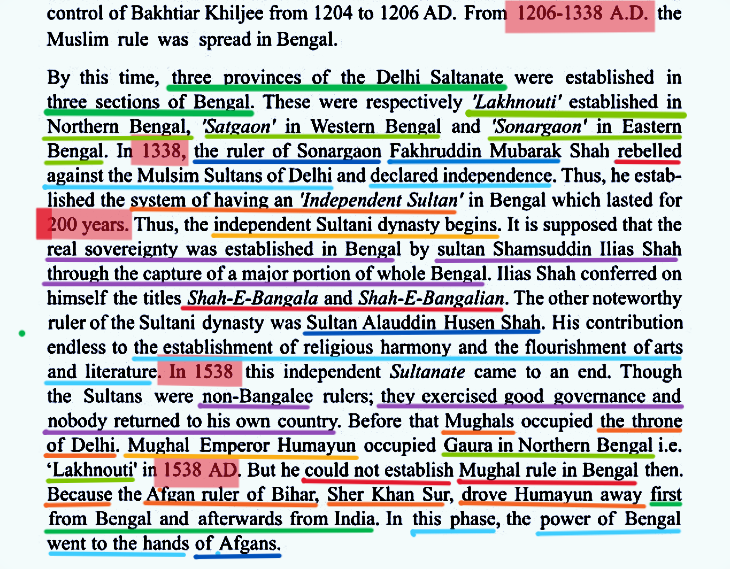
1) When the three provinces of the Delhi Sultanate were established?
Ans: From AROUND 1206-1338 AD, during the spread of Muslim rule in Bengal, the three provinces of the Delhi Sultanate were established in '3' sections in Bengal.
2) What were the three provinces of the Delhi Sultanate in Bengal?
Ans: The three provinces of the Delhi Sultanate in Bengal are:
Sonargaon in Eastern Bengal
Satgaon in Western Bengal
and, Lakhnouti in Northern Bengal
3) Who was the ruler of Eastern Bengal province, 'Sonargaon'?
Ans: Fakhruddin Mubarak Shah was the ruler of Eastern Bengal province, 'Sonargaon'.
4) When the ruler of Eastern Bengal province(Sonargaon), Fakhriddin Mubarak Shah rebelled against the Muslims Sultans of Delhi and declared independence?
Ans: The ruler of Eastern Bengal province (Sonargaon), Fakhriddin Mubarak Shah rebelled against the Muslims Sultans of Delhi and declared independence in 1338 AD.
5) The ruler of which part of Bengal province rebelled against the Muslim sultans of Delhi and declared independence in 1338 AD?
Ans: The ruler of Eastern Bengal province (Sonargaon), Fakhruddin Mubarak Shah rebelled against the Muslims Sultans of Delhi and declared independence in 1338 AD.
6) Against whom the ruler of Eastern Bengal province (Sonargaon), Fakhriddin Mubarak Shah rebelled and declared independence in 1338 AD?
Ans: The ruler of Eastern Bengal province(Sonargaon), Fakhriddin Mubarak Shah rebelled against the Muslims Sultans of Delhi and declared independence in 1338 AD.
7) Which ruler against the Muslims Sultans of Delhi and declared independence in 1338 AD?
Ans: The ruler of Eastern Bengal province(Sonargaon), Fakhriddin Mubarak Shah rebelled against the Muslims Sultans of Delhi and declared independence in 1338 AD.
8) When the independent Sultani Dynasy began in the history of Bengal?
Ans: The independent Sultani Dynasy began in the history of Bengal in 1338 AD.
9) Who established the system of having 'Independent Sultan' in Bengal which lasted for 200 years ( for two centuries)?
Ans: The ruler of Eastern Bengal province (Sonargaon), Fakhriddin Mubarak Shah established the system of having 'Independent Sultan' in Bengal which lasted for 200 years ( two centuries).
10) The system of having 'Independent Sultan' in Bengal, established by the ruler of Eastern Bengal province (Sonargaon), Fakhriddin Mubarak Shah lasted for how many years / centuries?
Ans: The system of having 'Independent Sultan' in Bengal, established by the ruler of Eastern Bengal province (Sonargaon), Fakhriddin Mubarak Shah lasted for 200 years / for two centuries.
11) When the 'Independant Sultanate' came to an end?
Ans: The 'Independant Sultanate' came to an end in 1538.
12) Which title was conferred on Shamsuddin illias Shah by himself ?
Ans: Shamsuddin illias Shah was conferred the titles 'Shah-E-Bangala' and 'Shah-E-Bangalian'.
13) On whom the titles 'Shah-E-Bangala' and 'Shah-E-Bangalian' was conferred on?
Ans: Shamsuddin illias Shah was conferred the titles 'Shah-E-Bangala' and 'Shah-E-Bangalian'.
14) Who is Sultan Alauddin Husen Shah?
Ans: Sultan Alauddin Husen Shah is a noteworthy ruler of Sultani Dynasty who had endless contributions to the establishment of religious harmony and the flourishment of arts and literature.
15) What is the name of a noteworthy ruler of Sultani Dynasty who had endless contributions to the establishment of religious harmony and the flourishment of arts and literature mentioned i the textbook?
Ans: Sultan Alauddin Husen Shah is the name of a noteworthy ruler of Sultani Dynasty who had endless contributions to the establishment of religious harmony and the flourishment of arts and literature.
16) Name three rulers of Sultani Dynasty.
Ans: The name of three rulers of Sultani Dynasty are given below:
Shamsuddin illias Shah
Sultan Alauddin Husen Shah
Fakruddin Mubarak Shah (ruler of Eastern Bengal)
17) Who occupied the throne of Delhi before the sultan rulers?
Ans: The Mughal occupied the throne of Delhi before the Sultan rulers.
18) Mughal Emperor Humayun occupied the Gaura in Lakhnouti (northern Bengal) in which in which year?
Ans: Mughal Emperor Humayun occupied the Gaura in Lakhnouti (northern Bengal) in 1538 AD.
19) Which Mughal Emperor Humayun occupied the Gaura in Lakhnouti (northern Bengal) in 1538 AD?
Ans: Mughal Emperor Humayun occupied the Gaura in Lakhnouti (northern Bengal) in 1538 AD.
20) Mughal Emperor Humayun occupied which region in 1538 AD?
Ans: Mughal Emperor Humayun occupied the Gaura in Lakhnouti (northern Bengal) in 1538 AD.
21) Why Mughal Emperor Humayun could not establish Mughal rule in Bengal in 1538 AD?
Ans: Mughal Emperor Humayun could not establish Mughal rule in Bengal in 1538 AD because The Afghan ruler of Bihan, Sher Khan Sur drove him away; First from Bengal and afterwards from India.
22) Due to which ruler, Mughal Emperor Humayun was driven away from Bengal and India and thus could not establish Mughal rule in 1538 AD?
Ans: Due to Afghan ruler of Bihan, Sher Khan Sur, Mughal Emperor Humayun was driven away from Bengal and India and thus could not establish Mughal rule in 1538 AD.
23) For Afghan ruler of Bihan, Sher Khan Sur, Mughal Emperor Humayun was driven away from which region due to which he could not establish Mughal rule in 1538 AD?
Ans: Due to Afghan ruler of Bihan, Sher Khan Sur, Mughal Emperor Humayun was driven away from Bengal and India and thus could not establish Mughal rule in 1538 AD.
24) Who is Sher Khan Sur?
Ans: Sher Khan Sur is the Afghan ruler of Bihar who drove away the Mughal Emperor Humayun from Bengal and India and for which as a result Mughal rule couldn't be established in 1538 AD.
About the Creator
ur_studyGuide
Hi Everyone! Here I will be willing to post NCTB Class 8 Guide notes from for students for passing exams to students to top exams. Good luck!
Enjoyed the story? Support the Creator.
Subscribe for free to receive all their stories in your feed.
Comments
There are no comments for this story
Be the first to respond and start the conversation.