
NASA’s Perseverance Finds 'Building Blocks of Life' in 10 Different Martian Rock Samples
Building Blocks of Life
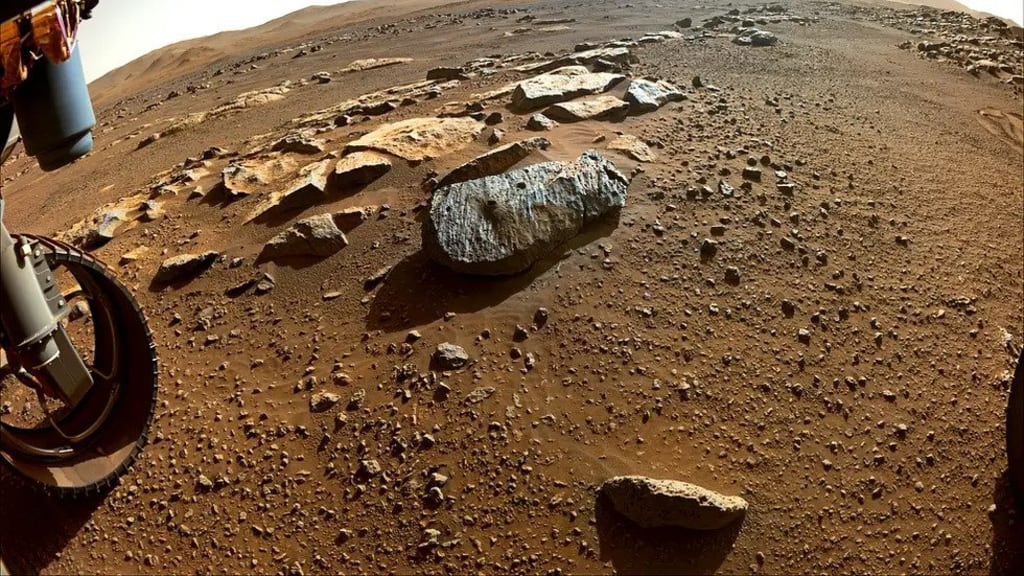
NASA's Persistence Finds 'Building Blocks of Life' in 10 Different Martian Stone Examples
Two openings are apparent in the stone, nicknamed "Rochette," from which NASA's Tirelessness meanderer got its most memorable center examples.
It takes a lot of creative mind and cheek to take a gander at a dusty old planet like Mars — without any similarity to consciousness — and think: hello, this spot could make a respectable base for people to choose! However, with no lack for both of those things, our researchers have been attempting to produce sufficient proof to help the hypothesis that life our planet's neighbor once flaunted huge lakes and presumably even existence of the microbial assortment.
What's more, NASA's Persistence wanderer, which is in the third year of its singular campaign across Mars' Jezero pit, has risked upon natural atoms that could flag the presence of "key structure blocks forever" on the Red Planet.
Considered a zone with "high potential for past tenability as the site of an old lake bowl with different minerals," the Jezero hole has proactively offered a few convincing signs about the planet's enthusiastic past. Be that as it may, the latest revelation, found inside Martian stone examples, has astrobiologists shivering with energy.
Natural mixtures comprise of carbon, and can incorporate different components like hydrogen, oxygen, nitrogen, phosphorus and sulfur. A wide range of classes of natural particles happening in various examples in space were found inside the Máaz and Séítah developments on Mars.
This new revelation proposed that these examples could have started from different minerals and systems of arrangement — and a large portion of them appeared to be associated with minerals connected to water. Furthermore, researchers have recommended that the particles found in the Martian minerals allude to their conceivable job in natural blend, transport or conservation.
Excitingly, researchers additionally feel that the newfound atoms could uncover synthetic species that are yet to be distinguished by people.
While such atoms are normally considered building blocks of life, analysts recognize that they can be made by processes not connected with life. Furthermore, to convincingly demonstrate that life is the wellspring of organics or conceivable biosignatures, they should preclude any non-natural wellspring of beginning.
The researchers found proof of various classes of natural particles. These happened in various examples in space inside Máaz and Séítah, recommending they could have begun from various minerals and systems of arrangement. These natural mixtures for the most part seemed associated with minerals connected to water.
"Seeing that the conceivable natural signs vary as far as type, number of location and dissemination between the two units of the pit floor was amazing and invigorating," Sharma said. "That opens the chance of various development, protection or transportation systems across the hole and, all the more extensively, the outer layer of Mars."
The researchers focused on SHERLOC data from Máaz and Séítah, two rock formations on the Jezero Crater floor. When ultraviolet light from SHERLOC illuminates organic compounds, they can glow much like material beneath a blacklight. The fingerprint of wavelengths in the glow from a molecule can help identify it.
Sharma and her colleagues found signs of organic molecules in all 10 targets that Perseverance drilled into at Máaz and Séítah, covering a span of time from at least about 2.3 billion to 2.6 billion years ago. These "point to the possibility that building blocks of life could have been present for a long time on the surface of Mars, in more than one place," Sharma said.
To reveal more insight into these speculations, work is in progress to bring these strange rocks back home. Further examination will be directed when the Martian examples are gotten back to Earth.
About the Creator
Enjoyed the story? Support the Creator.
Subscribe for free to receive all their stories in your feed.
Comments
There are no comments for this story
Be the first to respond and start the conversation.