
Mystery Puzzle Book Ideas for Adults: The Categories I Didn't Expect to Find
A search for puzzle books turned into a deeper look at mystery, detective, and code-breaking formats
I was sitting on my couch last Tuesday with my laptop balanced on a pillow because the battery was dying and the charger was across the room. I had promised my mom I'd find her something for her birthday. She does word searches every morning with her coffee. Has for years. Same routine. Coffee, word search, toast, more coffee. I figured I'd just hop on Amazon and grab one of the best word search books and call it done. I had twenty minutes before I had to leave for work. How hard could it be.
I typed in best word search books and the screen filled up instantly. Thousands of results. Giant print word search books for people who can't see small letters anymore. Large print versions that were basically the same thing with a different cover photo of flowers. Themed books for every topic you could think of. Dogs. Birds. States. Bible verses. Medical terminology for nurses.
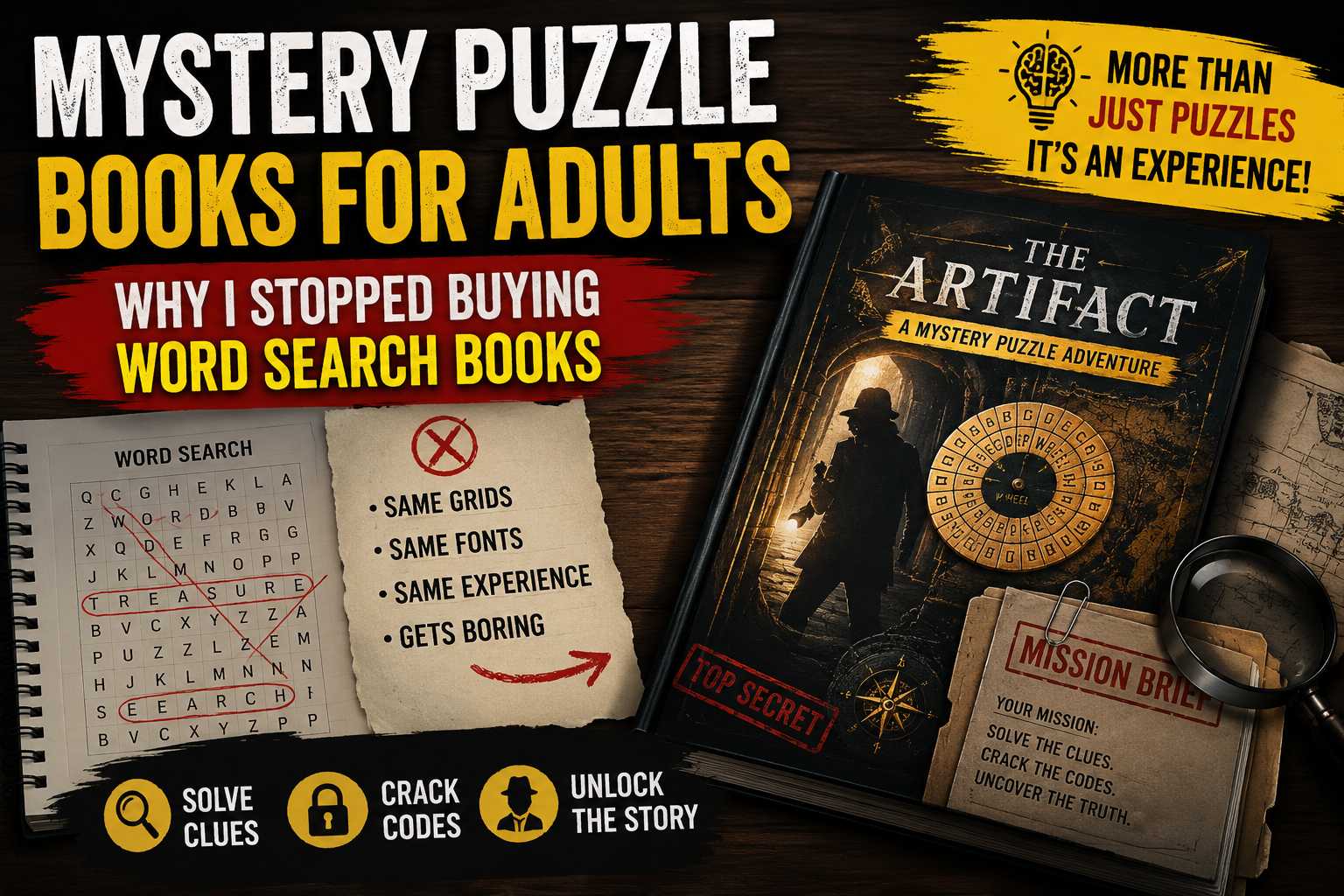
I scrolled for ten minutes and something started bothering me. They all looked the same. Not identical. But close. Same grid layouts. Same fonts. Same white backgrounds with a thin border. Some had spiral binding in the photo. Some didn't. But open any of them and it was the same experience. A list of words on the left. A grid of letters on the right. Circle the words. Move to the next page. Repeat a hundred and fifty times.
I started clicking through the reviews on the bestselling ones. Four stars. Four and a half. People saying exactly what you'd expect. Good for passing time. Nice large print. My mom loves these. Nothing wrong with any of it. Word search books work. They sell.
People buy them by the truckload. My own mom was proof of that. She didn't care about fancy covers or clever themes. She just wanted the words and the grid and the quiet twenty minutes in the morning where nobody asked her for anything. I get it. I really do. There's something almost meditative about it. Your brain locks onto a pattern and everything else fades out. No stress. No decisions. Just find the word and move on. It's reliable. Like an old car that always starts.
But I kept scrolling. And I noticed the newer releases. Books uploaded in the last three months with zero reviews. Covers that looked like they were made in five minutes. Titles like Word Search for Adults and Word Search Book for Seniors and Ultimate Word Search Challenge. Just keywords strung together. Hoping the algorithm would pick them up. And buried in those results were the same books over and over. Same interiors.
Different covers. Different authors who were probably the same person using a pen name generator. The market was full. Stuffed. Not in a way that stops sales. The top sellers still sold. But the bottom was a graveyard of books that nobody would ever buy. I started feeling like I was looking at a conveyor belt. A machine that prints the same thing forever and ever and calls it new because the cover has a different shade of blue.
I got curious about the broader puzzle book world. If word searches were this repetitive, what about the rest? I searched sudoku books. Same thing. Millions of them. Every difficulty level. Every size. Every holiday edition with a Santa hat on the cover. The interiors were identical grids. Number one through nine. Solve it. Next page. I checked fill-in puzzle books. The ones where you fit words into a grid using letter counts.
Same layout every time. Same fonts. Same experience from book one to book one thousand. I looked at i spy books. Those visual search puzzles where you hunt for hidden objects in a cluttered picture. Tons of them. Software-generated in bulk. Upload a hundred pages of random objects scattered around and call it a book. Crossword books too. Clue. Grid. Answer key. Clue. Grid. Answer key. Even maze books. Start at the arrow. Find the exit. Next maze. Same maze with slightly different walls.
It wasn't that any of these books were bad. They weren't. A good word search book does exactly what it promises. It gives you words to find. That's the deal. But I started wondering why some puzzle books felt like products and others felt like experiences. My mom had been doing word searches for fifteen years. She couldn't tell you the name of a single book she finished. They all blended together. But I remembered puzzle books from my own childhood that I still thought about.
One was a mystery book where you solved codes to catch a thief. Another had spy missions where each puzzle unlocked the next clue. I remembered those. Not because they were harder. But because they made me feel something. Like I was inside the book instead of just passing time in front of it.
That distinction started eating at me. Why do readers remember some puzzle books and forget others? I don't mean forget like they throw them away. I mean forget like the book never existed in their memory at all.
My mom probably did three hundred word search books in the last decade. Ask her about any of them and she'd shrug. But ask her about the one mystery book I had as a kid and she'd probably remember me sitting at the kitchen table with a pencil behind my ear trying to crack a cipher. The engagement was different. The context was different. It wasn't just a puzzle on a page. It was a puzzle that mattered to a story.
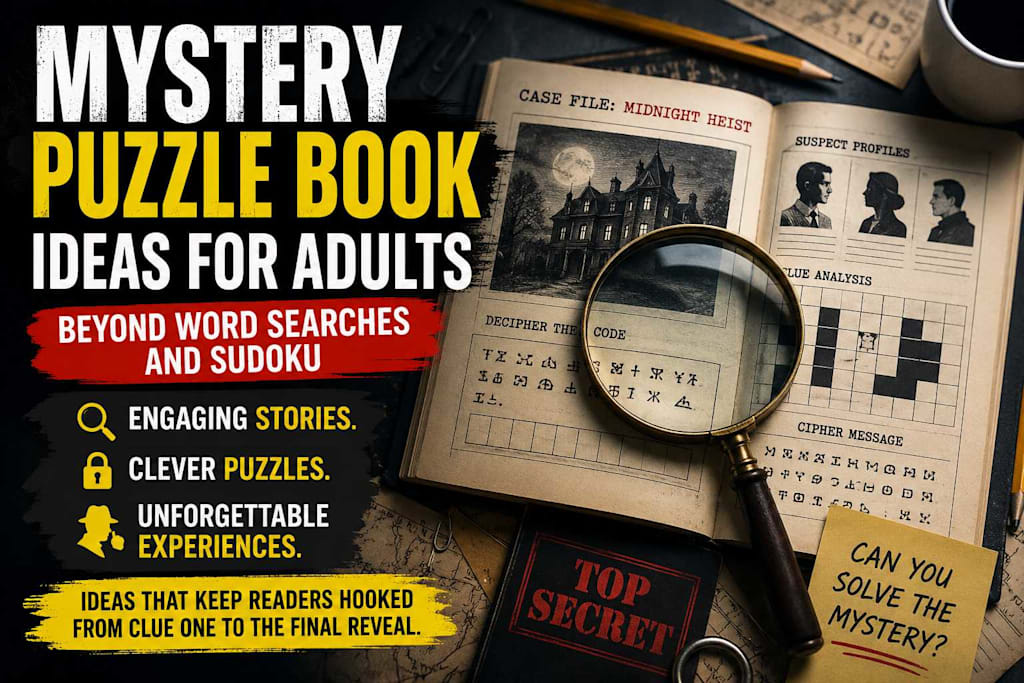
I started looking deeper into puzzle categories that tried to do more than fill a grid. Mystery activity books. I found one where kids solved a case about a stolen painting. Each page had a different type of clue. A fingerprint matching exercise. A witness statement with contradictions to spot. A map with a hidden route. It built. It progressed.
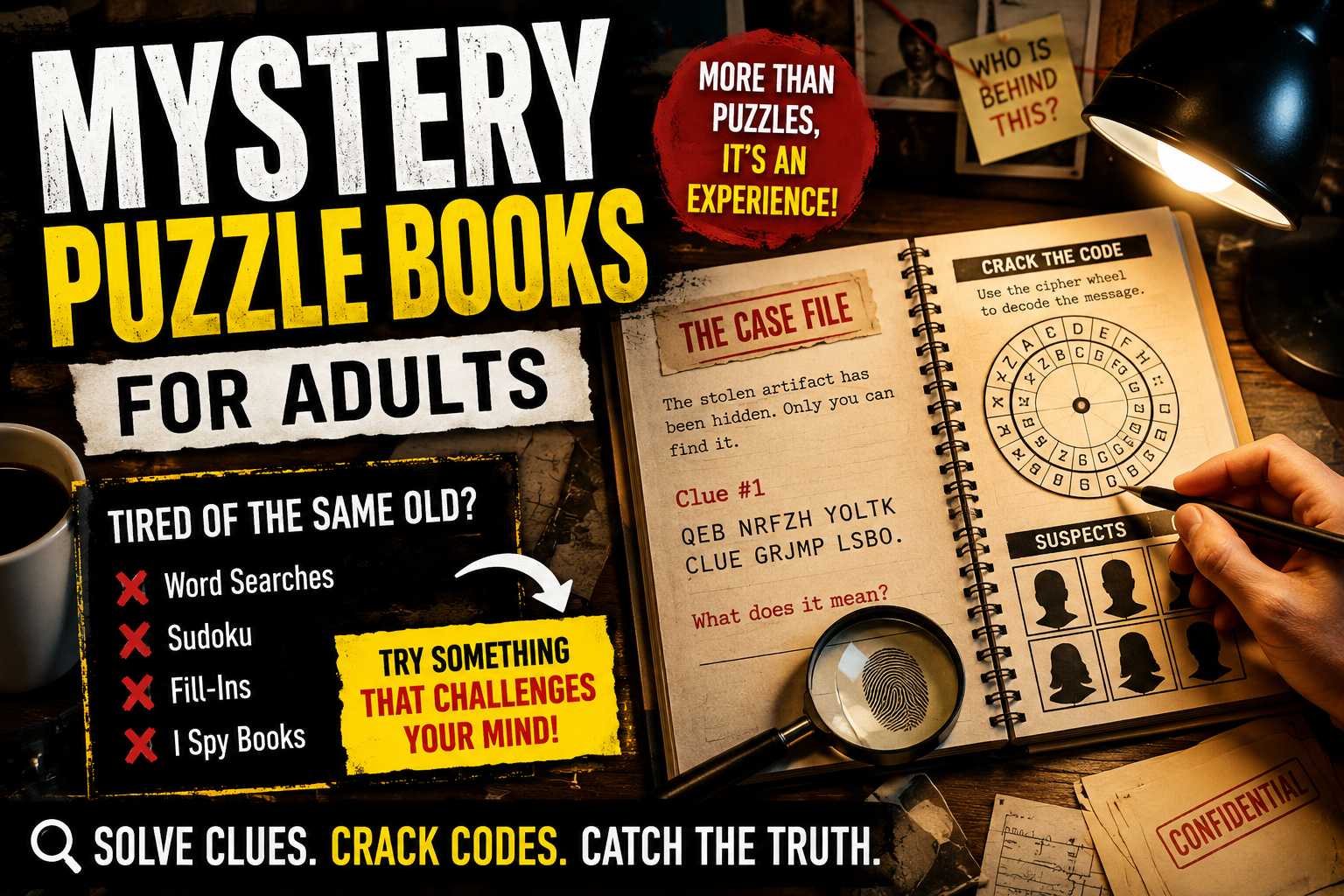
The kid wasn't just passing time. They were moving through something. Detective activity books worked the same way. Suspect profiles. Evidence lists. Timelines to reconstruct. The puzzle had a reason to exist beyond itself. It served the story. That felt completely different from a standalone word search on page forty-seven that had no connection to the word search on page forty-eight.
I ordered a few of these books to see them in person. A spy puzzle book arrived first. It had a decoder wheel printed on the inside cover. The kid had to cut it out and use it to decipher messages hidden throughout the book. That was genius. It turned the book into a tool. An object you interacted with beyond just reading and writing. The puzzles weren't just on the pages. They were between the pages and the reader. Code breaker books did something similar. One I found taught kids three different cipher methods in the first ten pages.
Then the rest of the book used those methods in escalating combinations. By the end the kid was decoding messages that used all three ciphers layered together. That was teaching. Real teaching disguised as a game. Not a worksheet. Not homework. Something you wanted to finish because finishing meant you cracked the final code.
The reviews on these books hit different too. Parents wrote paragraphs. My daughter spent three hours on this and wouldn't put it down. My son asked if there was a second one. Bought this for my classroom and the kids fought over it. That wasn't the usual cute book or nice pictures. That was real engagement. Real memory. Real attachment to the product. And I started seeing why. Traditional puzzle books ask nothing of the reader beyond basic attention. Find the word. Fill the grid. Spot the object.
There's no stakes. No progression. No reason to turn the next page except that the next page exists. But mystery and spy and detective formats create stakes. You need to finish this clue to find the next one. You need to solve this code to read the secret message. The reader becomes necessary. The book doesn't work without them. That's a completely different relationship between product and person.
I started thinking about the publishing side. How do people actually make these books? I assumed there was software for everything. And there is. But it's all the same stuff. Word search generators. Sudoku makers. Fill-in puzzle creators. I spy layout tools. Maze generators. Crossword builders. All the traditional formats. All the crowded categories. Nothing for building a mystery narrative across fifty pages. Nothing for creating a spy mission where each puzzle feeds into the next. Nothing for code breaker books that teach methods and then test them in combination.
I found some generic activity book templates that mixed different puzzle types but they were just grab bags. A maze here. A word search there. A crossword on page ten. No story. No thread. No reason for those specific puzzles to exist in that specific order. It was like throwing random food on a plate and calling it a meal.
I spent a week digging through forums and demo videos and free trials that expired before I figured out how to use them. Most of it was garbage. Overpriced templates that were just reskinned versions of the same five puzzles. Software designed for graphic designers who already knew what they were doing.
Nothing that understood what I was actually looking for. I wanted something that thought in stories. Something that understood a mystery activity book needs clues that connect. A detective activity book needs red herrings and real evidence and a solution that makes sense when you look back. A spy puzzle book needs gadgets and secret codes and mission briefs that sound official enough for a kid to buy into the fantasy. That's not a generic puzzle tool. That's a different category entirely.
While researching how publishers create code-breaking and detective-style puzzle books, one of the resources I came across was because it focused on mystery and spy-themed puzzle creation rather than traditional puzzle formats. I'm not reviewing it. I'm not saying it's the answer to everything.
I'm just saying it was one of the few things I found that wasn't another word search generator pretending to be new. It had actual cipher layouts. Secret message templates. Mission brief structures. Spy ID card designs. Stuff that matched what I was seeing in the successful books. Most tools just repackage the same five puzzles and call it an activity book. This at least looked like it understood the category I was actually interested in.
I kept looking beyond that one find because that's what I do. I don't commit to anything until I've exhausted every other option and then circled back out of exhaustion. I found more mystery activity books and read their bad reviews. That's where the gold is. Parents saying the mystery was too easy and their kid solved it in fifteen minutes.
That the clues didn't connect and the ending felt random. That the book was too short for the price. Those complaints gave me a roadmap. Detective activity books need a coherent case from start to finish. Spy puzzle books need escalating difficulty so the kid doesn't get bored after the first three pages. Code breaker books need to teach the method before testing it. Not just dump a hard puzzle on page one and put the answer key in the back like a lazy teacher handing out a test they didn't prepare.
The more I looked, the more I saw the gap. Traditional puzzle books are saturated because they're easy to make. A word search generator spits out a hundred puzzles in an hour. Sudoku software fills a book in twenty minutes. Upload it. Price it at five ninety-nine. Hope for the best. That's the model. And it works for volume publishers who don't care about any individual book. But the mystery and spy and detective categories require something else.
They require thinking. Planning. A narrative arc. Cohesion. You can't just generate fifty random puzzles and call it a spy book. The kid will know. Kids always know. They can smell filler from a mile away. They know when you stopped caring on page thirty and just copy-pasted the same template with different words. And they put the book down. And they don't ask for the next one. And they forget it existed.
I thought about my mom again. Her word search books. Her morning routine. She doesn't need a story. She doesn't need progression. She needs the grid and the quiet. And there's nothing wrong with that. Word search books will always sell because they serve that need perfectly.
Large print word search books will always have a market because people's eyes get worse and they still want their morning ritual. Best puzzle books will always include the classics because the classics work. I'm not here to say any of that is wrong or dying or useless. It's not. It's steady. It's reliable. It's the backbone of the puzzle book industry.
But I'm also seeing something else happening. Parents are buying fewer generic puzzle books for their kids. They're looking for something that holds attention longer. Teachers want books that feel educational without being boring worksheets. Grandparents want to buy a gift that the kid actually opens instead of tossing in a drawer. The market is shifting. Slowly.
Quietly. Not in a dramatic way where word searches disappear overnight. But in a real way where the books that get talked about and shared and requested again are the ones that made the kid feel like a detective for an afternoon. Like a spy on a mission. Like a code breaker who just saved the day by deciphering the final message.
I never found my mom's birthday gift that Tuesday. I got distracted. I spent two hours down a rabbit hole of puzzle book research and ended up ordering her a regular large print word search book anyway because that's what she likes and I'm not going to force my new obsession on her morning routine.
But I kept thinking about it. About why some books disappear into the pile and others become the book a kid carries around until the spine cracks. About why the puzzle market feels so full of the same thing and so empty of the thing that actually excites people.
I don't have an answer. I'm not an expert. I'm just someone who went looking for the best word search books and ended up somewhere else entirely. I found categories that feel alive. Formats that create memories. Books that readers finish and then ask for more. That's rare in publishing. That's worth watching. I don't know if I'll ever make one of these books myself.
I have notes on my phone. Sketches of a spy mission where kids decode messages to find a hidden base. Nothing fancy. But connected. Every page matters. Not random. Not filler. Maybe I'll do it. Maybe I won't. But I'm glad I looked past the first page of results. Glad I kept scrolling until the sameness annoyed me enough to look somewhere else.
The best puzzle books might not be the ones with the most reviews or the lowest price. They might be the ones you don't even know to search for yet. The mystery activity books. The detective cases. The spy missions and code breaker challenges. The books that turn a kid into someone else for an hour. I didn't know those categories existed when I started. I was just trying to buy my mom a birthday present. And now I'm sitting here months later still thinking about puzzle books.
Still wondering what makes one forgettable and another one unforgettable. Still watching this corner of the market to see what happens next. Sometimes you go looking for one thing and the search itself becomes the interesting part. That's what happened to me. I went looking for the best word search books. And I found a much more interesting question instead.
About the Creator
Brooks Ghost Max
I'm just a running shoe geek with a serious addiction to foam. My current obsession? The Brooks Ghost Max. I spend my days analyzing stack heights and heel drops to help you decide if that $150 price tag is actually worth it.
Enjoyed the story? Support the Creator.
Subscribe for free to receive all their stories in your feed.
Comments
There are no comments for this story
Be the first to respond and start the conversation.