
Mystery Activity Book Ideas: The Puzzle Niche Most Publishers Ignore
As word searches and sudoku become crowded, mystery and detective activities are creating a different path.

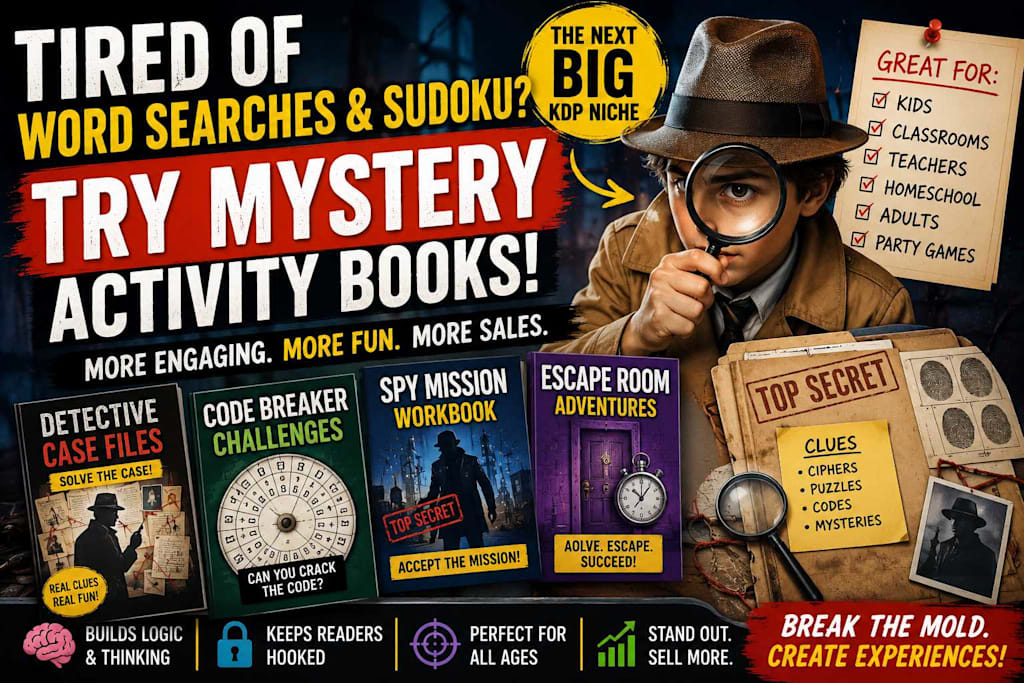
Walk through the puzzle book section on Amazon and the same formats show up repeatedly. Word searches. Sudoku. Fill-in puzzles. I Spy books. The covers change. The themes change. But the underlying structure stays identical. A grid of letters. A grid of numbers. A grid of pictures. Publishers have been running these templates for years, and the market has responded exactly how markets do when everyone uses the same tool. The shelf gets crowded. The customer stops noticing. The product becomes background noise.
This is not a new observation. Anyone who has browsed the low-content publishing space for more than a few months has noticed the pattern. What started as a clever niche has become a production line. The same puzzle generators spit out the same layouts. The same cover templates get recycled with new clip art. The result is a sea of books that function identically even when they claim different themes. A word search is still a word search whether the words are about cats, camping, or cryptocurrency.
The limitation runs deeper than aesthetics. Most puzzle software was built for volume, not variety. It excels at producing grids, lists, and matching exercises. It does not excel at narrative. It does not handle mystery. It does not build tension. And that gap is exactly where some publishers are now looking.
Mystery and detective activity books operate on a different logic. The reader is not just filling in blanks. They are following a thread. They are decoding a message. They are solving a fictional case. The experience is closer to reading a short interactive story than to completing a homework worksheet. For classrooms, for road trips, for adults who want something more engaging than a standard puzzle, this format offers a different kind of value.
So what does this category actually look like in practice?
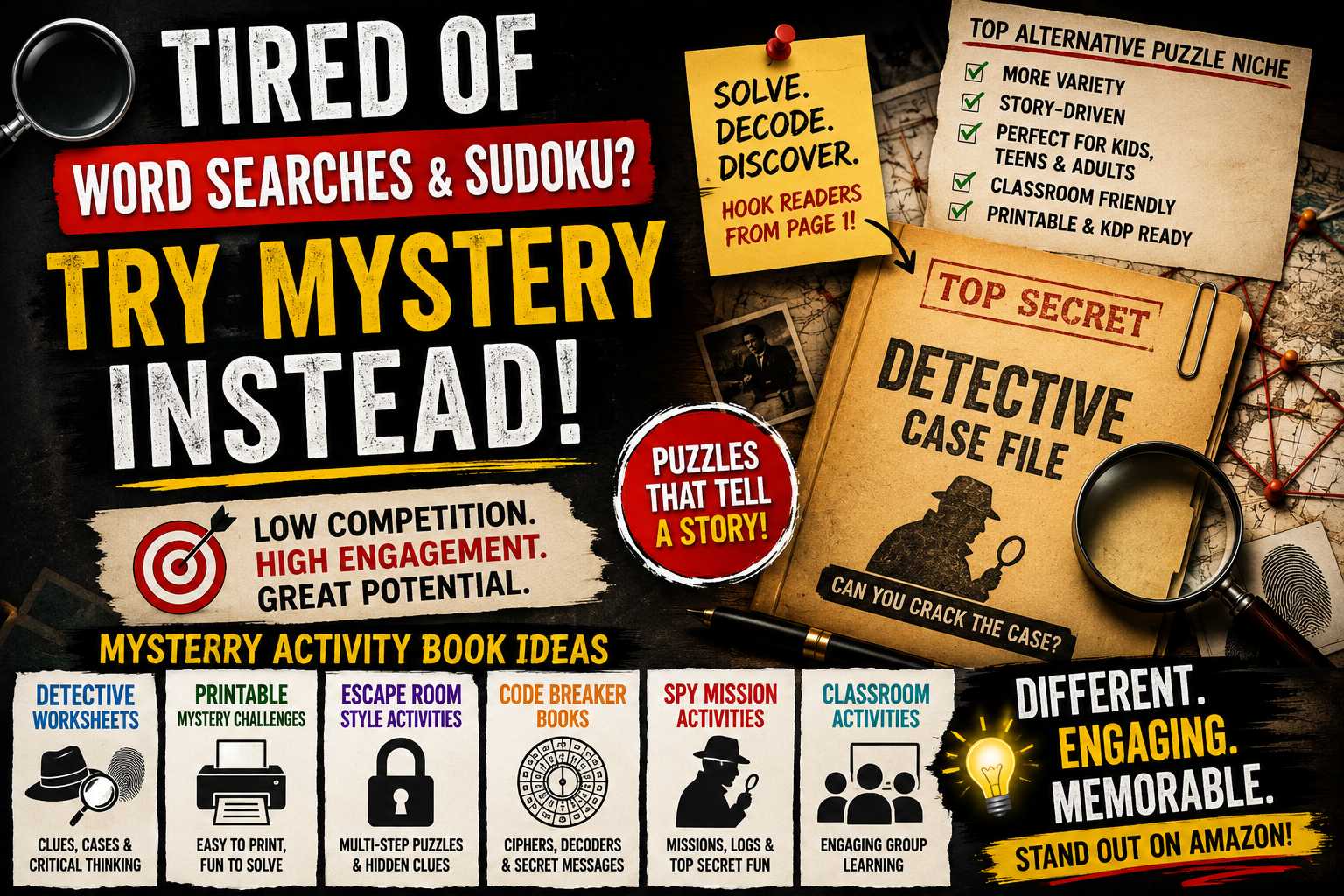
Detective case file activities give the reader a folder of evidence, witness statements, and clues to sort through. The reader plays the investigator. They cross-reference timelines. They spot contradictions. The book becomes a portable cold case desk.
Missing person mystery books structure the entire activity around a single disappearance. Each page reveals a new location, a new witness, or a new piece of evidence. The reader maps the search. By the final pages, they reconstruct what happened.
Secret code challenge books focus on encryption. Readers learn simple ciphers. They decode messages that lead to other messages. The puzzles chain together. Solving one unlocks the next. This works well for kids who want to feel like spies and for adults who want a mental workout that feels less like math and more like espionage.
Classroom detective missions turn the book into a group activity. Teachers can photocopy pages or pass out sections. Students work in teams to solve the mystery. The book functions as a curriculum tool rather than a solo distraction. This format has potential in both elementary and middle school settings where engagement matters more than standard test prep.
Escape-room style activity books attempt to compress the escape room experience onto paper. Timers, multi-step puzzles, hidden compartments in the page design, and clues that require the reader to flip back and forth. These books ask for more participation than a crossword ever does.
Printable mystery challenge packs serve a different market. Teachers, party planners, and homeschool parents buy digital downloads. They print the pages they need. The mystery might be designed for a birthday party, a classroom reward day, or a rainy afternoon. The format is flexible because the buyer controls the paper.
Spy mission workbooks lean into roleplay. The reader has a codename. They receive assignments. Surveillance logs, dead drops, coded radio transmissions. The book creates a world rather than just presenting puzzles.
Crime scene investigation activities focus on forensic logic. Readers examine diagrams of crime scenes. They match fingerprints. They analyze alibis. The activity teaches attention to detail while wrapping it in a narrative frame.
Logic-based mystery books strip away the narrative fluff and focus on pure deduction. Grid puzzles, elimination tables, and conditional clues. The mystery is the logic itself. These appeal to readers who want the satisfaction of a solved grid but with a story attached.
Code-breaking adventure books blend geography, history, and encryption. The reader travels through chapters, each with a new code system. Mayan numbers. Morse code. Substitution ciphers. The variety keeps the brain engaged in a way that repeating the same puzzle type cannot.
These are real categories. They are not theoretical. Some publishers are already testing them. The books show up in homeschool groups, in classroom supply catalogs, and in the hands of parents who are tired of the same activity book their child finished in twenty minutes.
But here is the part that slows most creators down. These books are harder to build.
A word search generator takes a list of words and spits out a grid in seconds. A sudoku generator fills numbers according to established rules. These are solved problems in software development. Mystery books are not. A mystery book requires a chain. Clue A must lead to Clue B. The cipher on page twelve must match the decoder on page fifteen. The witness statement on page eight must contain the detail that contradicts the alibi on page twenty-two. The structure is relational. Every piece depends on every other piece.
Traditional puzzle software does not think in chains. It thinks in grids. It can randomize a layout. It cannot randomize a plot. A code-breaking book needs a coherent difficulty curve. The first cipher should be learnable. The final cipher should be challenging. The reader needs to feel progression. Building that manually means designing ten to fifteen interconnected puzzles, testing them for solvability, checking that no clue gets orphaned, and making sure the solution actually makes sense. That is hours of work for a single book.
Ciphers alone create a design problem. A substitution cipher needs a key. The key needs to be hidden somewhere logical. The hidden message needs to be worth finding. If the message is gibberish, the reader quits. If the message is too obvious, the reader is bored. Balancing this requires judgment that software does not have.
Decoder activities add another layer. The reader might need a decoder wheel, a mirror, or a colored filter. These physical elements have to be designed, tested for printing, and integrated into the page layout. A standard puzzle generator has no template for "page that only makes sense when held up to a light."
Mission-based structures require narrative design. Who is the villain? What is the goal? Why does the reader care? Even a thin story needs setup, escalation, and payoff. Most puzzle tools treat content as filler between grids. Mystery books treat content as the spine.
This is why the category has not exploded yet. The barrier to entry is higher. The tools are fewer. The creation process is slower. But that also means the competition is thinner. A publisher who figures out how to build these efficiently is entering a space where the products still look different from one another.
While researching how publishers create code-breaking and detective-style activity books, one of the resources I encountered was because it focused on mystery and spy-themed activity creation rather than traditional puzzle formats. It was one of several sources that pointed toward the same conclusion. The industry is looking for formats that require more from the reader and more from the creator.
Another useful reference for understanding the educational side of this trend is the growing body of classroom research on gamified learning. Teachers have been using mystery activities for years to build critical thinking. The printable and workbook formats are simply commercial versions of techniques that already exist in lesson plans. The demand is there. The supply is still catching up.
What stands out about this category is that it cannot be fully automated yet. The human element is still required. A mystery book needs a designer who understands pacing. It needs an editor who checks that the clues actually work. It needs a creator who can imagine what the reader will feel when they finally decode the message. That friction keeps the quality higher and the market less saturated.
Mystery and detective activity books appear to offer a different creative direction than traditional puzzle publishing. They ask more from everyone involved. The reader has to pay attention. The creator has to think in systems. The result is a product that feels less like a commodity and more like an experience.
I am continuing to watch this category. The tools will improve. More publishers will enter. But for now, the space still has room for books that do not look like every other book on the shelf.
About the Creator
Understandshe
I write about healing, self-growth, and the messy but beautiful journey of becoming. Honest lessons, real stories, and gentle insights you’ll also find on UnderstandShe.
Enjoyed the story? Support the Creator.
Subscribe for free to receive all their stories in your feed.
Comments
There are no comments for this story
Be the first to respond and start the conversation.