
My Child Can Identify Letters But Not Sounds? Here's Why (And What Actually Helps)
Letter Recognition vs Letter Sounds vs Phonics vs Blending

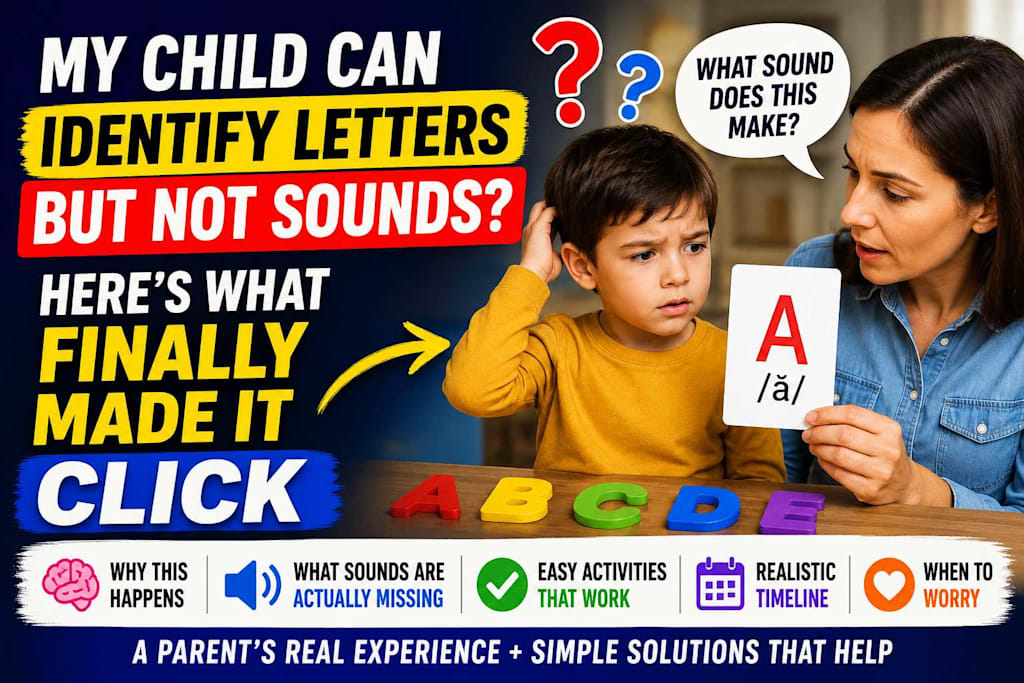
My son could point to every letter on the fridge magnets by the time he was four. "A, B, C, D..." he would sing. We bought alphabet puzzles, flashcards, and an app that cheered every time he tapped the right letter. We thought we were ahead of the game.
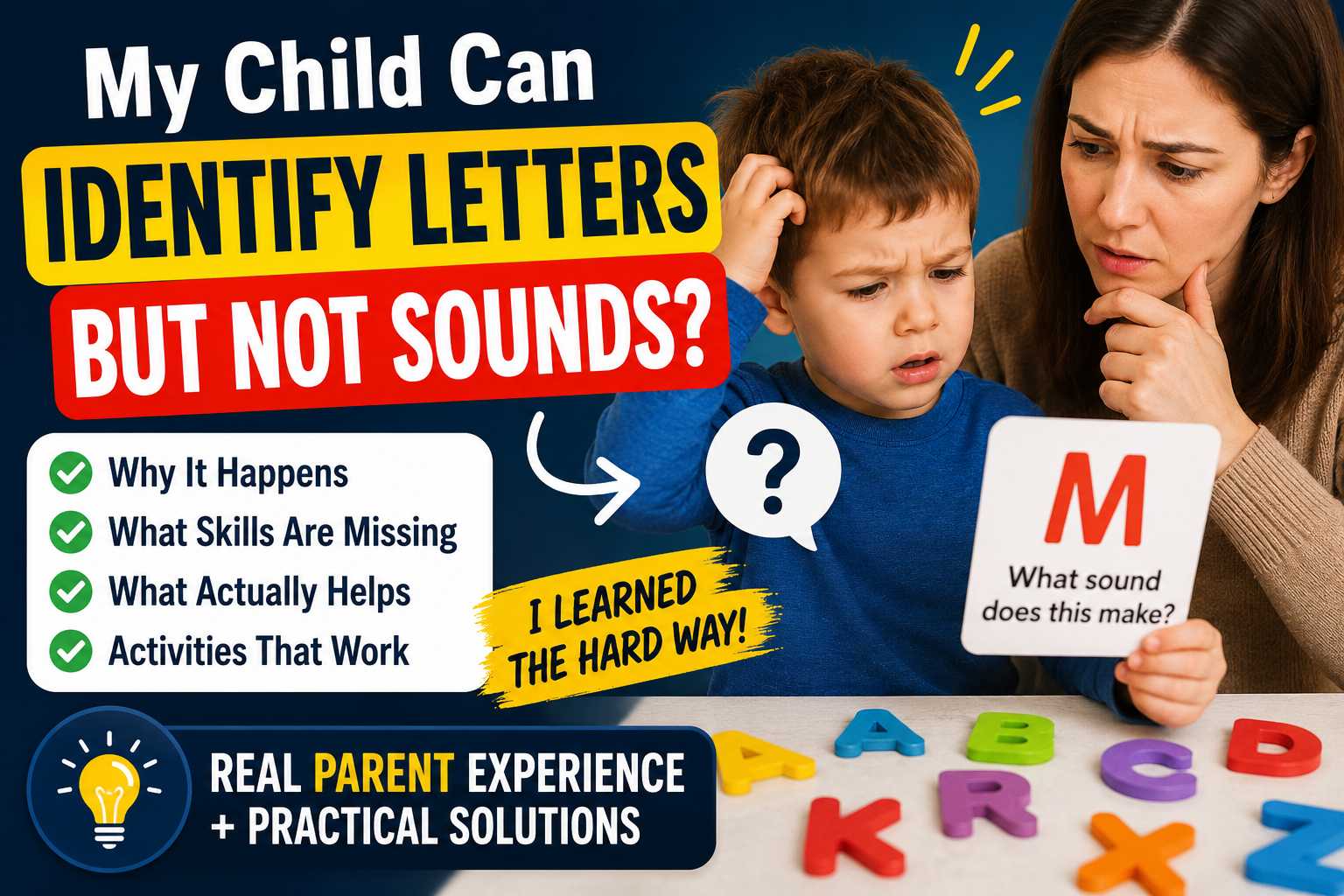
Then one afternoon I pointed to the letter M and asked, "What sound does this make?"
He looked at me like I had asked him something impossible. "M?" he said. "That's M. Like in the song."
Silence. Then he pointed to the letter N instead, probably hoping I would move on.
That was the moment I realized we had been practicing the wrong skill all along.
The Parent Worry That Creeps In
If you are reading this because you typed "my child can identify letters but not sounds" into Google at 11 PM while your kid sleeps, I get it. You notice your child can name every letter in a book and sing the alphabet song backwards. But when it comes to sounding out a simple word like "cat," they freeze.
You start wondering if something is wrong. You scroll through parenting forums and see other kids blending sounds at age three. The anxiety builds because reading feels like the gateway to everything else, and your child is standing at the door without the key.
Here is the truth that took me months to accept: this is normal. More than normal, it is expected.
Why This Happens
Letter recognition and letter sounds are two completely different skills. When your child sees the letter B and says "bee," they are doing visual recognition. They have memorized a shape and attached a name to it. But when you ask them what sound B makes, you are asking them to connect that visual symbol to a physical mouth movement and an auditory sound they produce themselves.
That connection is not automatic. It has to be built deliberately.
Think of it like this: knowing the names of all the tools in a toolbox does not mean you know how to use them. Your child has memorized the labels. Now they need to learn what each tool actually does.
Reading Does Not Develop in One Straight Line
Before I started researching this, I assumed reading was a ladder. You learn letters, then sounds, then words, then sentences. But reading development is more like a web. Different skills grow at different rates.
The typical stages start with emergent pre-reading, where children recognize letters and some familiar words. That is where most preschoolers and kindergarteners live. The next stage, early reading, is where phonics and decoding enter the picture, usually around ages five to seven. So if your four or five-year-old knows letters but not sounds yet, they are not behind. They are right on schedule.
Some kids race through these stages. Some take their time. Some plateau for months in one area while secretly building strength in another. The brain is doing its own work on its own timeline.
The Six Skills Parents Confuse (And I Did Too)
When I started trying to help my son, I kept running into terms that sounded interchangeable. They are not.
Letter recognition is the ability to see a letter and know what it is called. My son had this down cold.
Letter names are what we sing in the alphabet song. A is "ay," B is "bee," C is "see." These are labels, not tools for reading.
Letter sounds are the actual phonemes each letter represents. B says /b/. C says /k/ or /s/. These are the building blocks of decoding words.
Phonemic awareness is the ability to hear, identify, and manipulate individual sounds in spoken words. It is an auditory skill that happens without any letters involved. Can your child tell you what sound starts the word "dog"? That is phonemic awareness.
Phonics is the system that connects those phonemes to written letters. It is the bridge between hearing sounds and seeing them on a page.
Blending is the skill of pushing those individual sounds together to form a whole word. /c/ /a/ /t/ becomes "cat." This is where a lot of kids get stuck even after they know their letter sounds.
Your child can ace letter recognition and still be years away from blending. These skills stack on top of each other, but they do not automatically trigger the next one.
The Big Misconception That Trips Up Almost Every Parent
I thought that because my son knew the alphabet, reading would naturally follow. Like if you memorize the names of all the countries, you should automatically be able to speak every language. It sounds ridiculous when you say it out loud, but that is exactly what we expect from kids when we celebrate alphabet mastery like it is the finish line.
Memorizing the alphabet is a memory task. Reading is a decoding task. They use different cognitive processes. One does not guarantee the other.
Another trap is teaching letter names before letter sounds. In the United States, we are obsessed with the alphabet song. Toys, apps, and preschools drill letter names into kids before they ever hear about phonemes. But research shows that letter names can actually confuse the process. If a child sees C-A-T and thinks "see-ay-tee," they cannot blend that into a word. The sounds /k/ /a/ /t/ blend into "cat." The names do not.
Some structured literacy approaches now teach letter sounds first, or teach them alongside names from the start. That makes more sense, but most parents do not know this until they are already deep into the alphabet song routine.
What Actually Works at Home
Once I stopped panicking and started paying attention to what my son could actually do, I changed my approach. Here are the activities that moved the needle for us.
Start with sound games that have nothing to do with letters. I would say, "I spy something that starts with /b/." He would look around and eventually shout "ball" or "banana." This builds phonemic awareness without any visual symbols involved. It is pure ear training. We did this in the car, at the grocery store, while waiting for the bus. No flashcards, no pressure.
When we did introduce letter sounds, I stopped using the letter names entirely. I would hold up the letter B and say, "This says /b/. Not bee. /b/." I had him feel his lips vibrate when he made the sound. We practiced just a few letters at a time, not the whole alphabet. Two or three new sounds per week was our max.
We used a simple blending game with his toy cars. I would line up three cars and say each sound as I pushed a car forward. /m/ /a/ /p/. Then I would shove them all together fast and say "map." He thought it was a racing game. He did not realize he was learning to blend.
Writing helped more than I expected. When he tried to spell words by sounding them out, even if he got them wrong, his brain was doing the hard work of connecting sounds to symbols. "Frend" instead of "friend" was not a failure. It was proof that the alphabetic principle was clicking into place.
We kept sessions short. Ten to fifteen minutes max. Short, daily practice beats marathon sessions once a week.
Mistakes I Made (So You Don't Have To)
I added an extra vowel sound to consonants without realizing it. I would say "buh" instead of /b/. "Cuh" instead of /k/. That extra schwa sound made blending nearly impossible for him. When he tried to blend /buh/ /a/ /tuh/, he got something that sounded nothing like "bat." I had to relearn the pure sounds myself before I could teach them correctly.
I also jumped to written words too soon. I thought if he knew a few letter sounds, we should start sounding out words on paper. But oral blending needs to come first. If a child cannot hear /c/ /a/ /t/ and know it is "cat" without any letters in front of them, putting letters on the page just adds visual confusion to an auditory problem.
Another mistake was correcting every error immediately. I would interrupt him mid-word to fix a sound, and his confidence crumbled. I learned to let small mistakes slide during story time and save corrections for dedicated practice sessions.
I also compared him to other kids. I know every parent does this, but it is poison. Every child develops on their own timeline. Some kids blend sounds at four. Some do not click until six or seven. Both are within the normal range.
What to Expect (And When to Worry)
If your child is four or five and knows letters but not sounds, that is completely typical. Most kids in preschool and early kindergarten are still in the emergent literacy stage. They are collecting pieces of the puzzle, and the sound-letter connection is one of the later pieces to fall into place.
By around age five to seven, most children enter the early reading stage where phonics and decoding become the focus. If your child is in this range and still struggling to connect letters to sounds after consistent, gentle practice, it might be worth paying closer attention.
If your child is seven or older and shows no progress with letter-sound correspondence after several months of regular practice, that is a signal to seek evaluation. Not because something is necessarily wrong, but because early intervention matters. A reading specialist or educational psychologist can assess for phonological processing issues, auditory processing delays, or dyslexia.
Trust your gut. If your child's frustration is extreme, if they avoid anything related to sounds, if they seem to hear words differently than you say them, those are worth investigating. But if they are simply slow to connect letters to sounds while otherwise engaged and progressing, time and patience are usually the best tools.
How I Learned to Think About Structured Learning
While trying to understand how educators organize reading skills into a logical sequence, I ended up reading an educational guide that broke down the progression in much more detail. You can find it at. It helped me see why certain skills need to come before others, and why skipping steps creates gaps that show up later. I had been jumping around randomly, teaching whatever letter caught my son's interest that day. Seeing the actual sequence made me realize I needed a plan, not just enthusiasm.
The guide talked about the alphabetic principle, the idea that written letters systematically represent spoken sounds. That sounds obvious to an adult reader, but it is not obvious to a child. They have to learn that the squiggles on a page are not just pictures or symbols to memorize. They are a code that maps directly to the words coming out of their mouth. That realization changed how I approached every practice session.
After understanding the basics, I became curious about how different structured programs approached these skills, so I compared several of them before forming my own opinion. I read through a few different reviews and breakdowns, including one at. Some programs emphasized phonemic awareness first. Some dove straight into phonics. Some used multisensory techniques that involved movement and touch. What struck me was how many different roads lead to the same destination, and how the best approach is usually the one that fits your specific child's temperament and learning style.
The Realistic Timeline Nobody Tells You
If you start today with consistent, short daily practice, you should see small shifts within a few weeks. Maybe your child starts noticing that words begin with sounds, not just shapes.
Within two to three months, most children who practice daily can connect at least some letters to their sounds reliably. They might not know the whole alphabet phonetically, but they will have a handful of letters that feel automatic.
Blending usually comes after letter-sound knowledge is solid. Expect another month or two of practice before your child can smoothly push three sounds together into a word. Some kids get it faster. Some need more time. The key is building the skills in the right order so each step supports the next.
What I Would Tell Myself a Year Ago
Stop measuring your child against the alphabet song. Stop thinking that knowing letters means reading is next. Stop panicking because your friend's kid is sounding out words and yours is not.
Your child is not broken. They are not behind. They are learning a complex system that took humans thousands of years to invent, and they are trying to master it before they have fully mastered the language they speak.
The best thing you can do is make sound play a normal part of your day. Talk about what words start with. Rhyme ridiculous words at the dinner table. Let your child spell things wrong when they write. Read to them every night without turning it into a lesson. The foundation for reading is built in thousands of tiny, unremarkable moments, not in flashcard drills.
When my son finally sounded out his first word on his own, it was not during a structured lesson. It was on a cereal box at breakfast. He looked at the word "milk," pointed to each letter, and said /m/ /i/ /l/ /k/. Then he looked at me with this expression of pure shock, like he had just discovered he had superpowers.
He did not discover superpowers. He discovered that the code works. And once a child knows the code works, they want to use it everywhere.
That is the moment you are building toward. Not perfect phonics. Not early reading glory. Just the click. The moment your child realizes that letters are not just shapes to memorize. They are keys that unlock words. And words unlock everything else.
About the Creator
Understandshe
I write about healing, self-growth, and the messy but beautiful journey of becoming. Honest lessons, real stories, and gentle insights you’ll also find on UnderstandShe.
Enjoyed the story? Support the Creator.
Subscribe for free to receive all their stories in your feed.
Comments
There are no comments for this story
Be the first to respond and start the conversation.