
My 6 Year Old Can't Recognize Letters or Numbers: What I Learned Before Assuming Something Was Wrong
I spent days trying to understand why my six-year-old struggled with letter and number recognition. Here's what I learned about learning milestones, common mistakes, and when a structured approach may help.

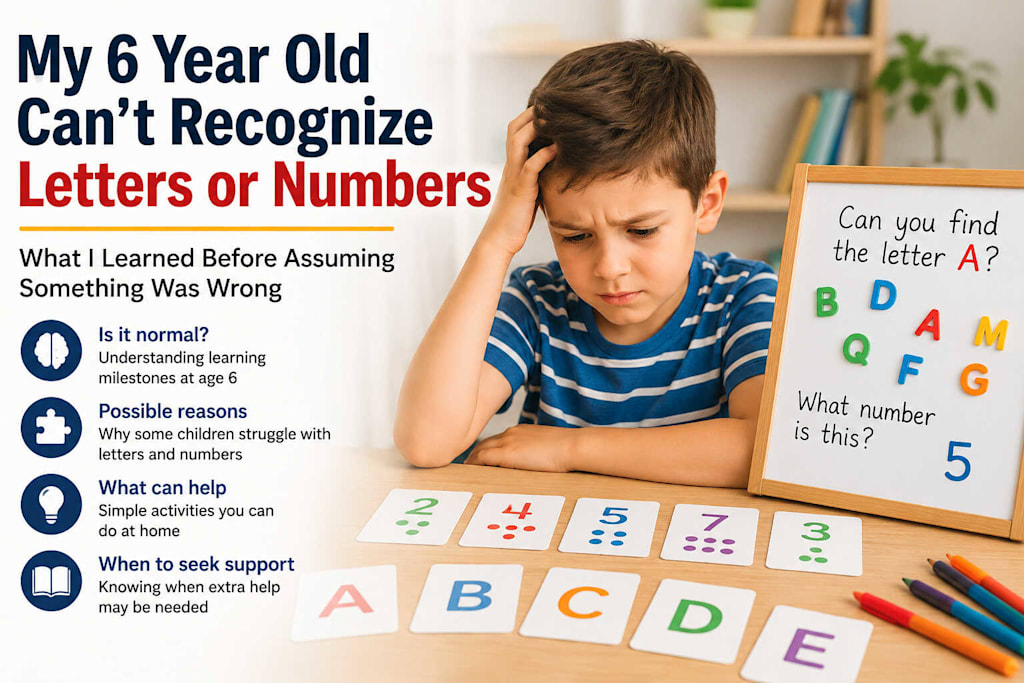
I was folding laundry when my wife called me into the kitchen. My son had a worksheet in front of him. Just a line of letters. Nothing fancy. She pointed at a "G" and asked him what it was. He looked at it. Looked at her. Looked back at the paper. Then he shrugged. Not a playful shrug. The kind of shrug that says "I don't know and I know I'm supposed to know and that makes me want to disappear."
He was 6. First grade. Three months into the school year. And he could not tell you what a "G" was.
I stood there holding a towel and I felt something I didn't expect. Not worry. I had been worried for a while. This was worse. This was the moment I realized we weren't just "a little behind." We were in a different place entirely. The other kids in his class were sounding out words. My kid couldn't name half the alphabet. The gap wasn't closing. It was getting wider every week.
Why This Feels Different At Six
When your kid is four and doesn't know letters, nobody blinks. When they're five, people say "oh, they'll get there." But six is a hard stop. School is real. There are reading groups. There are kids who bring home little books and read them to their parents at night. My son brought home worksheets he couldn't do. Notes from the teacher saying "please practice at home." Homework that ended in tears. Not dramatic tears. Quiet tears. The kind where he just puts his head down and stops trying.
The thing about six is that your kid knows. They know they're not keeping up. They see the other kids raise their hands. They see the books get harder. They feel it. My son started saying he was "too tired" to read. He started asking if he could skip homework. He started finding reasons to leave the room whenever I pulled out a book. He was six years old and already building an escape route from anything that felt like failure.
I wasn't panicking because my child learned differently. I started worrying because school had already started and everyone else seemed further ahead. That is a completely different feeling. It's not about development. It's about watching your kid get left behind in real time.
Is It Always A Sign Something Is Wrong?
I spent a lot of nights googling "6 year old can't recognize letters and numbers" and getting two kinds of answers. One side says it's totally normal, kids develop at different rates, don't worry. The other side lists every learning disability known to man. Neither side helped. I didn't need reassurance or a diagnosis. I needed to know what to do tomorrow.
Here's what I figured out. Sometimes a six-year-old doesn't recognize letters because they're not ready. Their brain is working on other things. Spatial reasoning. Social skills. Emotional regulation. The part that processes symbols just hasn't switched on yet. That doesn't mean something is wrong. It means the timeline is different.
But sometimes there IS something going on. Vision issues. Processing delays. Dyslexia. Auditory problems. The symbols aren't connecting because something in the chain is blocked. I don't know which one my son was. I'm not a doctor. I couldn't tell if he needed patience or intervention. So I did what most parents do. I waited too long, then I panicked, then I tried everything at once.
What I Realized I Was Focusing On Instead Of Learning
I thought more was better. More flashcards. More worksheets. More apps. More time at the table. I turned our living room into a classroom and I turned myself into a teacher nobody wanted. Every night after dinner we'd sit down and "practice." I'd hold up a letter. He'd guess wrong. I'd correct him. He'd guess wrong again. I'd try to hide my frustration. He'd try to hide his. Neither of us was fooling anyone.
I was focusing on performance, not learning. I wanted him to get it right so I could feel like we were making progress. He wanted to get it right so I'd stop looking disappointed. We were both performing. Neither of us was actually teaching or learning anything.
I also realized I was comparing him to every other kid I knew. My nephew who was reading at four. The neighbor's daughter who loved worksheets. My own memories of school. None of that had anything to do with my son. But I couldn't stop doing it. Every time he struggled, I felt like I was watching a race where my kid was still tying his shoes and everyone else was at the finish line.
Small Changes That Made More Sense
The first thing I dropped was the flashcards. They weren't working and they were making him hate letters. Instead, I bought a pack of magnetic letters and stuck them on the fridge. I didn't quiz him. I didn't even mention them. I just put them there. He started moving them around. Making trains. Sticking them to the cookie sheet. After about a week, he asked me what one of them was. Just one. I told him. Then I walked away. No follow-up question. No "okay, now find another one." Just the answer, given casually, like he had asked what kind of bird was in the tree.
I started pointing out letters in the real world. The "P" on the parking sign. The "S" on the stop sign. The numbers on our house. The price tags at the grocery store. I didn't make it a lesson. I just said it out loud. "That's a 7." No expectation that he'd repeat it. No test later. Just putting the information in the air and letting him grab it when he was ready.
The biggest change was me shutting up about reading levels. I stopped asking his teacher where he ranked. I stopped mentioning his cousin who read chapter books. I stopped talking about "catching up." I just started paying attention to what he actually liked. He liked building things. He liked Legos. So we built letters out of Legos. He liked drawing in the steam on the bathroom mirror. So we drew numbers there. I stopped trying to make him sit at a table and learn. I started letting him move and touch and build.
It was slower. Way slower. Some days he recognized three new letters and I felt like we'd won. Other days he forgot ones he'd known yesterday. But the difference was he wasn't avoiding it anymore. He wasn't scared of it. That was the first real progress we'd made in months.
When Structure Started Making More Sense Than Guessing
After a while, my scattered approach started feeling chaotic even to me. I was doing a little of this, a little of that. Some days were good. Some days I had no idea what to teach next. I was making it up as I went and I was running out of ideas. I needed a framework. Not because I wanted to stop being involved. Because I wanted to stop guessing.
I started looking at structured reading programs. Not because I thought a program would magically fix everything. Because I was tired of standing in front of my kid with no plan. I wanted someone to tell me what came first, what came second, what to do when he got stuck. I looked at a bunch of different options online. Some were too babyish. Some were too fast. Some assumed he already knew things he didn't know.
While comparing different structured reading programs, Reading Head Start was one of the options I spent time evaluating. The lesson structure appeared designed for parents who wanted a step-by-step approach instead of guessing what to teach next. What caught my attention was that it seemed to break phonics down into very small pieces. No expectation that a six-year-old would sit still for an hour. No overwhelming worksheets. Just short sessions that built on each other.
I liked that it was visual and sound-based. My son learned better when he could hear the letter sound and see something move than when he stared at a static symbol on paper. The program seemed to get that. It didn't look like a textbook. It looked like something built for a kid who was already frustrated with traditional methods.
But I had reservations. Any program that costs money makes me pause. There are so many free resources out there. Worksheets. YouTube videos. Library books. I wondered if paying for something was necessary or if I just hadn't been patient enough with the free stuff. I also knew that no program works if the parent turns it into another source of pressure. I was still learning how to help without hovering. How to guide without pushing.
I spent some time reading through this breakdown of how Reading Head Start approaches early reading skills It explained the phonics sequence in a way that felt less like a sales pitch and more like an actual guide. I also looked at this year's honest parent feedback on the program which mentioned both what worked and what didn't. I always trust that more than reviews that all sound identical.
I didn't sign up immediately. I bookmarked it. I came back to it. I thought about whether my son was ready for something structured or if we needed more time with the casual approach first. I still haven't decided for sure. But having a real option on the table felt better than continuing to wing it.
Looking At Different Reading Programs
There are a lot of reading programs out there. Some are app-based with games and cartoons. Some are workbook-based where you sit side by side. Some require a tutor. Some are parent-led. The right one depends on your kid's personality, your schedule, and your budget. I learned that the hard way. I tried one app that was too fast. It assumed he already knew letter sounds and jumped straight to blending. He wasn't there. It just made him feel worse.
Another program I looked at required twenty minutes of focused parent-child time every single day. That sounds reasonable until you're doing it. After school, after homework, after dinner, when both of you are tired and cranky, twenty minutes feels like an hour. We tried it for three days and both of us were miserable.
What I realized is that the best program is the one your kid will actually do. Consistently. Without a fight. If that's an app with a cartoon dog, fine. If that's a workbook you do on weekends, fine. The tool matters less than the habit. But the tool does matter if it's so poorly designed that it confuses more than it teaches. A bad program can make a struggling kid feel broken. A good program can make them feel like they're finally getting somewhere.
Final Thoughts
My son is not reading chapter books. He is not flying through worksheets. He still mixes up b and d. He still hesitates when he sees a number he hasn't looked at in a while. But he can recognize most of the alphabet now. He can identify numbers one through ten without panic. He doesn't run out of the room when I pull out a book. That doesn't sound like much. It is everything.
If you are in the middle of this right now, I want to tell you something directly. Your six-year-old not recognizing letters or numbers does not mean you failed. It does not mean they failed. It does not mean they will never read, never do math, never catch up. It means they are on a different timeline. And timelines at six years old are not destiny.
Some kids sprint out of the gate and then stall in third grade. Some kids can't read a word at six and then something clicks at seven and they never look back. The early numbers don't predict the later story. What predicts the later story is whether your kid still believes they can learn. Whether they still feel safe trying. Whether they know that not knowing something today doesn't mean they won't know it tomorrow.
Protecting their confidence matters more than pushing their progress. Every time my kid felt stupid because he couldn't name a letter, we lost more than we gained. Learning happens in a brain that feels safe, not in a brain that feels judged. If your kid is avoiding books, avoiding worksheets, avoiding anything that smells like practice, that is data. That is their body telling you the current approach isn't working. Not that they aren't capable. That the approach is wrong.
The mistakes that make learning harder are usually the ones that look like good parenting. Flashcards every night. Worksheets because the teacher sent a note. Pushing through tears because "we have to get this done." I did all of that. It came from love. It landed like pressure. The real work is backing off enough that they can step forward on their own.
School has started. The other kids might be further ahead on paper. But your kid is not a paper. They are a whole person figuring something out in their own way, on their own schedule. The best thing you can do is walk beside them without dragging them.
They will get there. Not on your timeline. On theirs. And when it clicks, and it will click, you will look back at this worried version of yourself and wish you could have told them to relax a little sooner.
About the Creator
Understandshe
I write about healing, self-growth, and the messy but beautiful journey of becoming. Honest lessons, real stories, and gentle insights you’ll also find on UnderstandShe.
Enjoyed the story? Support the Creator.
Subscribe for free to receive all their stories in your feed.
Comments
There are no comments for this story
Be the first to respond and start the conversation.