
My 5-Year-Old Still Doesn't Recognize Letters: Is It Normal or Should I Worry?
Why some 5-year-olds still struggle with letter recognition, what actually helps at home, when to seek extra support, and what I learned after weeks of worrying.

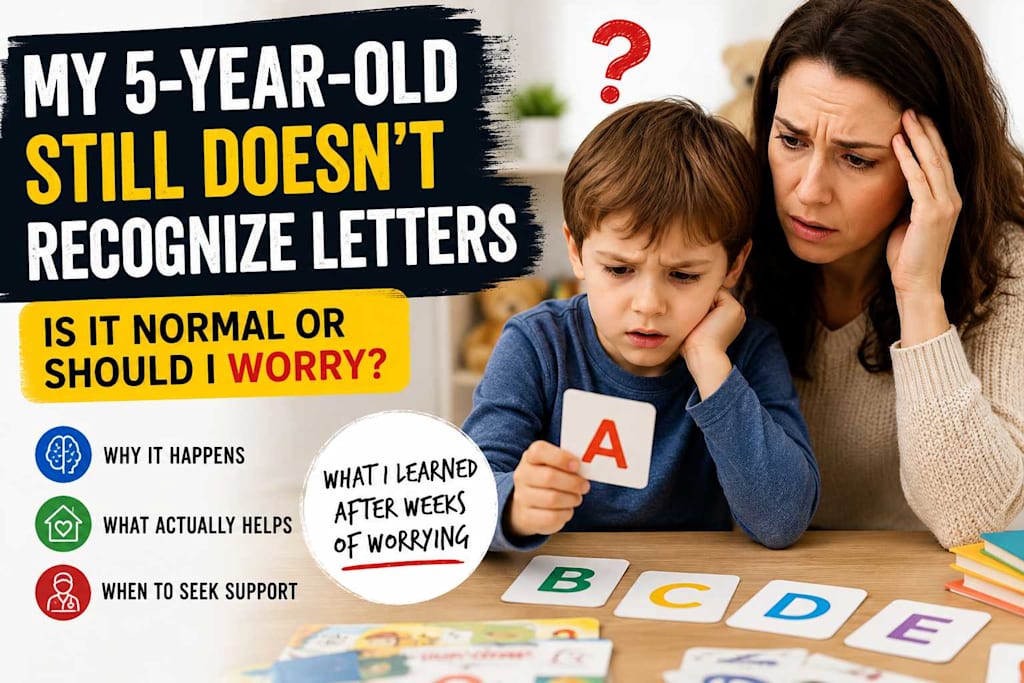
My son sat at the kitchen table one night in January, looking at a set of magnetic letters I'd stuck to a cookie sheet. I pointed to the red A and asked what letter it was. He stared at it like it was a random shape. I moved to the B. Nothing. C. Nothing. I went through all twenty-six and he got zero right.
I smiled and said "that's okay" but my stomach dropped. He was five. We'd been singing the ABC song since he was two. We had alphabet books. We watched those letter shows. I sat there after he went to bed and typed into Google: "5 year old still doesn't recognize letters." Then I typed "5 year old can't remember letters." Then "should a 5 year old recognize letters." I read until 1 AM. Some sites said he was fine. Others said he was behind. A preschool teacher had mentioned at pickup a few weeks earlier that he "wasn't quite there yet with his letters." I replayed that comment in my head about fifty times that night.
Is This Actually Normal?
I spent the next morning calling a friend whose daughter had started reading at four. She said her kid just picked it up. That made me feel worse. Then I called another friend, a second-grade teacher, and she told me something different. She said in her classroom, some kids show up knowing every letter and some know almost none. She said kindergarten is designed for that spread. The expectation isn't that every child arrives pre-trained.
Most five-year-olds develop unevenly. Some kids memorize every dinosaur name but can't tell a B from a D. Some recognize every letter in their own name but nowhere else. The brain doesn't grow on a single schedule. "Normal letter recognition at age five" is a wide range, not a deadline. If your child is five and doesn't know letters, you're not alone. I found that out after reading parent forums for two hours. Hundreds of posts. Same fear. Same kitchen table moment.
Why the ABC Song Didn't Teach My Son Anything
Here's what I didn't understand until I read more. The alphabet song is a memory task. It's sequencing. My son could sing the whole thing start to finish without a mistake. But that song has nothing to do with looking at a squiggle on a page and knowing it represents a sound. Singing A-B-C-D is like memorizing a phone number. It doesn't mean you understand what a phone is.
Letter recognition means visual identification. Seeing a shape and naming it. That's a completely different skill from reciting a sequence. My son's brain had stored the song in one place and the visual symbols in another, and those two places hadn't connected. The alphabet song vs letter recognition is a real gap that a lot of parents miss. I missed it for three years.
Why Kids Forget Letters Overnight
This part actually helped me stop panicking. A five-year-old's working memory holds about two to three items at a time. The prefrontal cortex, the part that handles focus and retention, is still developing. It won't be mature until the mid-twenties. So when I showed my son the letter A on Monday and he seemed to get it, then by Wednesday he was staring at it blankly again, that wasn't failure. That was a brain doing exactly what a five-year-old brain does.
Researchers say a child needs fifteen to twenty meaningful exposures to a letter before it becomes automatic. Not fifteen times in one afternoon. Spread out. In different contexts. With different fonts and colors. I'd been doing the opposite. Flashcard blast on Saturday morning, then nothing for a week. That scattershot approach doesn't build the neural pathways that stick. The brain needs repeated, spaced, meaningful encounters. Not drilling. Not cramming.
Names, Signs, and Meaning: What the Brain Actually Remembers
The first letter my son ever reliably identified was the first letter of his own name. Not because I taught it more. Because it mattered to him. His name is his identity. The brain prioritizes information that carries emotional weight. That's why environmental print works so much better than flashcards. The McDonald's M. The stop sign S. The Target T. Those letters exist in a context that means something.
I started noticing that my son could point out the S on the Stop sign near our house. He didn't know it was "the letter S." He knew it was "the sign that means stop." But the visual symbol was in his brain, attached to meaning. That's what letter recognition actually needs. Context. Purpose. Emotional significance. A flashcard in a vacuum is just a shape. A letter on a sign that means "we're home" is a memory.
What Is Structured Literacy, Really?
After a few weeks of reading, I kept running into the term "structured literacy." I thought it was a curriculum you buy. It's not. It's an approach. Structured literacy means teaching reading in a specific, explicit, cumulative order. It recognizes that the brain has two main processors for reading: the phonological processor, which handles sounds, and the orthographic processor, which handles written symbols. Some kids build those connections naturally through exposure. Others need them built step by step, explicitly, with no gaps.
Neural pathways for reading don't exist at birth. They have to be formed. For some children, those pathways form through storytime and casual conversation. For others, the brain needs a more deliberate construction process. Structured literacy is that construction process. It teaches letter-sound relationships in a specific sequence, building from simple to complex, making sure each layer is solid before adding the next. It's not about pushing kids faster. It's about making sure the foundation exists.
How Reading Programs Actually Sequence Letters
Once I understood what structured literacy was, I had a new question. How are structured lessons actually organized from week to week? I found an educational breakdown while researching curriculum sequencing. The Reading Head Start educational guide explains that different programs teach letters in different orders based on different logic. Some teach by frequency, starting with the letters that appear most often in English words. Some group by visual similarity, teaching letters that look different from each other so kids don't confuse them. Some start with continuous sounds like M and S because they're easier to blend than stop sounds like B and T.
The guide also made something clear I'd never thought about. Teaching letters in alphabetical order makes no pedagogical sense. A-B-C-D is just a song sequence. It has nothing to do with how the brain learns to read. Structured programs choose sequences based on sound patterns, visual distinction, and blending difficulty. That was a real shift in how I thought about teaching my son.
What One Parent's Experience Taught Me
After reading about curriculum design, I got curious about what this actually looks like in a real home. I wanted to see how one parent actually experienced a structured reading program at home. I came across a Reading Head Start review where a parent described their daily routine. Ten minutes a day. Not an hour on Saturday. Ten minutes, every day, game-based, no worksheets. The parent mentioned their child resisted at first, then started pointing out letters on their own after a few weeks.
What stuck with me wasn't the program itself. It was the consistency. That parent didn't do anything dramatic. They just didn't stop. The review reinforced something I'd already read in the research: short, daily, low-pressure exposure beats occasional intense sessions. The brain needs frequency, not intensity. I didn't need to become a reading teacher. I needed to become consistent.
Letter Names, Sounds, and the Three-Step Gap
This was the biggest lightbulb moment for me. Letter naming, letter-sound knowledge, and connecting sound to print are three separate skills. My son was stuck at step one. He couldn't name the letter B. So worrying about whether he knew B says "buh" was pointless. He didn't even recognize the symbol yet.
A lot of parents, including me, rush to sounds. We think letter recognition means "knows the letter and its sound." It doesn't. Recognition is just seeing the shape and knowing its name. That's step one. Step two is knowing the sound. Step three is seeing the letter in a word and connecting that sound to read the word. I was trying to teach step three before step one existed. No wonder nothing stuck.
When Should You Actually Worry?
I don't want to pretend there's nothing to watch for. Some struggles are normal. Some patterns suggest getting extra support early. Red flags include: your child can't rhyme by five, can't break a simple word into sounds, mispronounces familiar words consistently, has a strong family history of reading difficulties, or shows confusion with left/right, before/after, or sequencing tasks in general.
These aren't reasons to panic. They're reasons to be proactive. Early screening doesn't label a child. It catches gaps while the brain is still highly plastic. The earlier support starts, the less ground there is to make up. If you see these patterns, talk to your pediatrician or request a screening through your school district. Don't wait for kindergarten to "fix it." Kindergarten is a starting point, not a diagnostic tool.
What I Stopped Doing
I stopped the flashcards. Flashcards without a system create anxiety for everyone. The kid feels tested. The parent feels disappointed. Nothing good happens at that table.
I stopped quizzing. "What letter is this?" is a terrible question when the answer is nothing. It creates negative associations with letters. The brain starts avoiding the thing that leads to failure.
I stopped comparing him to other kids. Every child I saw reading early was a data point of one. It meant nothing about my son's trajectory.
I stopped checking readiness checklists. Checklists are averages, not mandates. They're compiled from thousands of kids, each developing differently. Being below average on one skill at five is not a diagnosis. It's a snapshot.
What I Started Doing Instead
I started pointing out letters in the environment without asking anything back. At the grocery store, I'd say "look, the cereal box has a big K" and keep walking. No quiz. No expectation. Just exposure.
I wrote his name on the fridge in big letters and pointed to it casually when I walked by. Not every time. Just sometimes.
I put bath letters in the tub and let him play. No instruction. If he held up the M and said "this is the one from McDonald's," I said "yeah it is." That was it.
We traced letters in chalk on the driveway. We made letters out of pretzel sticks. I pointed to words when I read books, not to teach, just to show that the black marks corresponded to what I was saying.
I made sure he saw letters in different fonts, sizes, and colors. Generalization matters. A child who only recognizes a red Times New Roman A on a flashcard doesn't really know the letter A. They know one specific picture.
The Drive to the Park
Three weeks after I stopped trying to teach him, we were driving to the park. My son pointed out the window and said "that's the S from the stop sign." I kept my voice normal and said "yeah, good eye." Inside, I wanted to cheer. But I didn't. He'd been absorbing everything. All those casual mentions, all those environmental moments, all that low-pressure exposure. His brain had been doing the work even when I couldn't see it.
I stopped forcing. I started trusting the process. Kindergarten is a starting point, not a deadline. My child isn't broken. I didn't fail him. His brain is doing what brains do, on its own schedule, building pathways I can't see yet. The letters will come. They always do, when the brain is ready and the pressure is off.
About the Creator
Understandshe
I write about healing, self-growth, and the messy but beautiful journey of becoming. Honest lessons, real stories, and gentle insights you’ll also find on UnderstandShe.
Enjoyed the story? Support the Creator.
Subscribe for free to receive all their stories in your feed.
Comments
There are no comments for this story
Be the first to respond and start the conversation.