
My 4-Year-Old Can't Recognize Letters: Is It Normal? What Actually Helped at Home
Why some preschoolers struggle with letter recognition, what most parents misunderstand, when to worry, and the simple daily changes that made learning feel natural again.

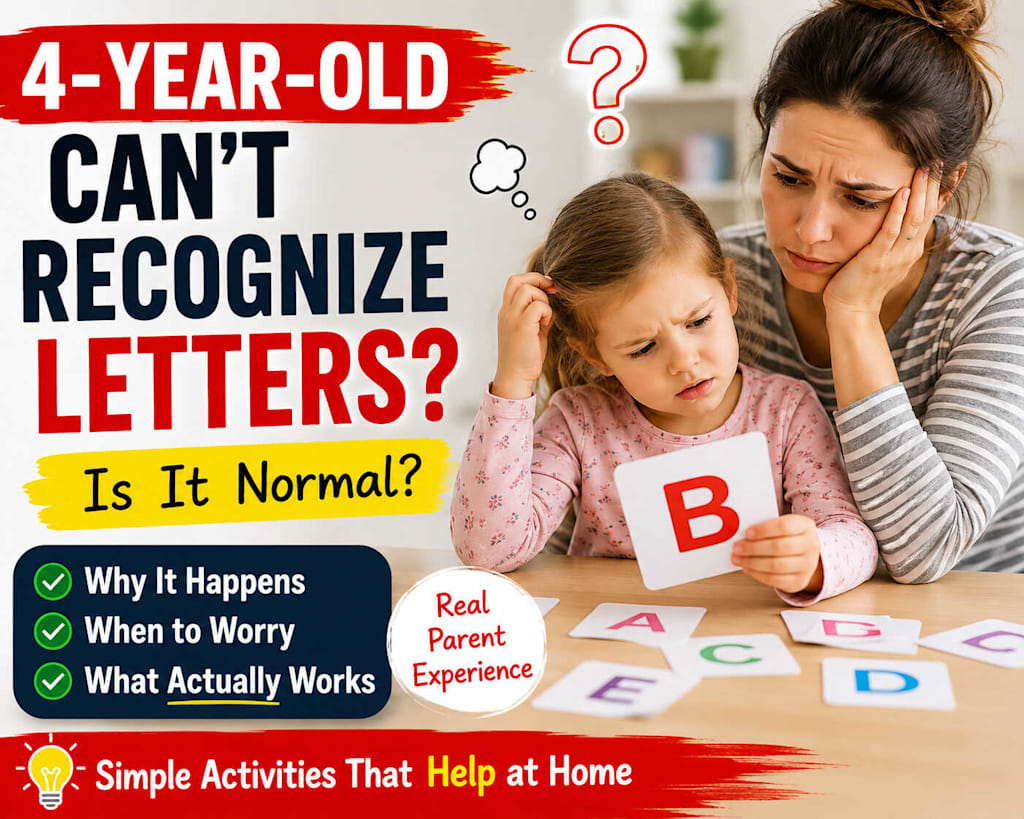
I sat at the kitchen table with my daughter last Tuesday. She is four and a half. I pointed to the letter "B" on a flashcard I bought from the dollar store. She stared at it. Then she looked at me. Then she said "D." This was the third time this week. I put the card down and went to the other room so she wouldn't see my face.
I had been trying for months. Alphabet songs. YouTube videos. Apps with colorful animals. She could sing the ABCs perfectly. But put a letter in front of her and she drew a blank. Or she guessed. Sometimes she got "A" right because it was the first one. Sometimes "M" because it looked like the McDonald's sign. Everything else was a coin flip.
I started Googling. "4 year old can't recognize letters." Then "preschool letter recognition problems." Then "dyslexia signs 4 year old." Each search made my stomach tighter. Some sites said relax, every child develops differently. Others said early intervention is critical. I didn't know which one was talking to me.
Is This Even Normal?
Yes. It usually is.
Most four-year-olds are still figuring out how symbols work. The human brain does not treat letters as special until it has a reason to. A circle with a line through it means nothing to a child until someone connects it to a sound, a word, a name. That connection takes time. It takes exposure. It takes a brain that is ready.
Kindergarten teachers see this every September. Some kids walk in knowing every letter. Some know half. Some know their own name and nothing else. By the end of the year, most of them are in the same place. The gap closes because five and six-year-old brains are wired to close it.
So why does your four-year-old struggle while the neighbor's kid reads street signs? Because four is a wide age. Some four-year-olds are basically still three. Some are almost five. Visual memory develops unevenly. Working memory develops unevenly. Attention spans are all over the map. Your child is not broken. Their brain is doing what it does on its own schedule.
Why They Forget Letters They Knew Yesterday
This one drove me crazy. Last Wednesday she knew "S." She pointed it out on a cereal box. Thursday morning I showed her the same letter on a worksheet. Nothing. Blank stare. Like we had never talked about it.
I learned why. Memory for young children is not a file cabinet. It is more like a chalkboard in the rain. Yesterday's writing might still be visible, or it might be washed away. For a letter to stick, a child needs to encounter it in multiple contexts. The "S" on the cereal box was connected to the picture, the color, the kitchen light, the moment. The "S" on the worksheet was a black shape on white paper. Her brain did not recognize it as the same thing.
This is why flashcards alone often fail. A flashcard is one context. One flat image. A brain that age needs letters in the wild. On signs. In books. In their own name. On the fridge with magnets. The more places a letter lives, the more likely the brain will keep it.
Why the Alphabet Song Doesn't Teach Recognition
My daughter could sing the alphabet forward and backward. She would sing it while brushing her teeth. But singing is auditory memory. It is a sequence of sounds, like a nursery rhyme. Recognizing a letter visually is a completely different skill. It involves visual processing, symbol association, and memory retrieval.
Think of it this way. You can sing "Twinkle Twinkle Little Star" without being able to read sheet music. The alphabet song is the same. It teaches order. It does not teach symbols. When parents realize this, the guilt starts to lift. You didn't fail because you sang instead of flashcarded. You just used one tool when you needed several.
Why Their Own Name Comes First
Every parent notices this. The first letter a child usually recognizes is the one that starts their name. Not because it is easier. Because it matters. That letter is connected to their identity. It shows up on their cubby at preschool. On their artwork. On their birthday cake. The brain prioritizes what has meaning.
This is a clue for home practice. Instead of trying to teach all twenty-six letters at once, start with the ones that matter to your child. The letters in their name. The letters in "MOM" and "DAD." The letters on their favorite cereal box. When a letter has a purpose, the brain holds onto it tighter.
Why Drilling Can Backfire
I tried the flashcard routine for two weeks. Ten letters a day. Repeat until she got them right. She started avoiding me when I pulled out the cards. She would ask for water. She would suddenly need to poop. Anything to escape.
Pressure creates cortisol. Cortisol blocks the exact memory pathways you are trying to build. A frustrated child is not learning. A child who feels watched and judged is not learning. They are performing. And performance anxiety in a four-year-old looks like forgetting.
Short sessions work better. Five to ten minutes. Stop while it still feels fun. The goal is not to get through the whole alphabet. The goal is for your child to want to do it again tomorrow.
What Actually Works at Home
I stopped the flashcards. I started paying attention to what she actually noticed.
She loved the magnetic letters on our fridge. She would move them around while I cooked dinner. I started asking her to find the "M" for milk. Not as a test. Just as part of making dinner. She found it half the time. The other half she didn't care because she was busy building a tower with the magnets.
We started writing with sidewalk chalk. Big letters. She would walk on them. Trace them with her toe. The movement helped. Something about using her whole body made the shape stick better than staring at a card.
I pointed out letters on road signs while driving. "Look, that says STOP. S-T-O-P." She didn't always look. But sometimes she did. And when she did, it was her choice. That mattered.
Bath time became letter time. Foam letters on the wall. She would stick them up. I would name them. No pressure to remember. Just exposure. The more she saw them, the more familiar they became.
When Should You Actually Worry?
Most four-year-olds who struggle with letters are fine. But some signs deserve a conversation with your pediatrician or a speech-language pathologist.
If your child cannot recognize any letters by age five. If they seem unable to distinguish between shapes that are not even close. If they avoid all print, cover their eyes when you show books, or become genuinely distressed. If they have significant speech delays alongside the letter confusion. If they cannot remember simple routines or instructions that other kids their age handle easily.
These are not guarantees of a problem. They are reasons to ask questions. Early evaluation is not about labeling your child. It is about ruling things out or getting support early if support helps.
What Structured Literacy Actually Means
I kept seeing the term "structured literacy" in my research. It sounded like a program you buy. It is not. It is an approach. It means teaching reading in a logical order. Sounds first. Then letters. Then blending. Then words. Then books. No guessing. No skipping steps.
This is different from the way many of us learned. Many parents were taught to look at the picture and guess the word. To use context clues. Structured literacy says no. Teach the code. Teach the relationship between sounds and symbols directly. It is slower at first. But it builds a foundation that does not collapse later.
I wanted to understand how these lessons were actually organized from one stage to the next. I found a detailed breakdown of curriculum sequencing and lesson structure while researching different approaches. The Reading Head Start educational guide walks through how a structured phonics program builds from basic sounds to connected text over forty weeks. It helped me see why some programs delay certain skills and why the order matters more than I thought.
Why Different Programs Teach Letters in Different Orders
This surprised me. Not every program starts with A, B, C. Some start with the letters that are easiest to hear and say. S, M, A, T. These sounds are continuous. You can stretch them out. "Sssssss." That makes blending easier later. Other programs start with the letters in the child's name. Others follow a visual pattern. Straight lines first. Then curves.
There is no single right order. But there is a wrong way: teaching all twenty-six at once with no system. A child's working memory can only hold so many new symbols. Three to five letters at a time is plenty. Master those. Then add more.
I kept wondering how these different approaches compared in real homes. I read a parent's detailed experience comparing structured reading programs and what worked for her four-year-old who stared at the word "cat" like it was math. Her honest analysis of Reading Head Start breaks down the daily lesson flow, the printable materials, the time commitment, and what actually happens when a non-teacher parent sits down at the kitchen table. It is not a sales pitch. It is a real parent saying what helped and what frustrated her.
What Progress Actually Looks Like
It does not look like a straight line. Some days she knows six letters. The next day she knows four. Then she spots an "E" on a license plate at the grocery store and screams it like she won a prize. That is progress. It is messy. It is uneven.
Real progress is not reciting the alphabet. It is noticing print in the environment. It is asking "what does that say?" It is pretending to read a book by telling the story from the pictures. These are pre-reading behaviors. They matter as much as letter names.
What I Stopped Doing
I stopped comparing her to other kids at preschool pickup. I stopped counting how many letters she knew. I stopped turning every car ride into a quiz. I stopped feeling like her brain was my project to fix.
I started trusting that exposure plus time plus low pressure equals readiness. Not always on my schedule. But it happens.
The Bottom Line
If your four-year-old cannot recognize letters, you are not alone. You did not break anything. The alphabet is an abstract symbol system that human brains invented thousands of years ago. Expecting every four-year-old to master it on demand is like expecting them to do algebra. Some can. Most will get there when they are ready.
Keep the letters around. Keep them playful. Keep sessions short. Watch for real warning signs but do not invent them out of anxiety. Trust kindergarten. Trust time. And trust that a child who feels safe and unpressured learns faster than one who feels tested.
About the Creator
Understandshe
I write about healing, self-growth, and the messy but beautiful journey of becoming. Honest lessons, real stories, and gentle insights you’ll also find on UnderstandShe.
Enjoyed the story? Support the Creator.
Subscribe for free to receive all their stories in your feed.
Comments
There are no comments for this story
Be the first to respond and start the conversation.