
Microsoft’s Majorana 1 Chip
A Quantum Leap Toward Scalable Quantum Computing

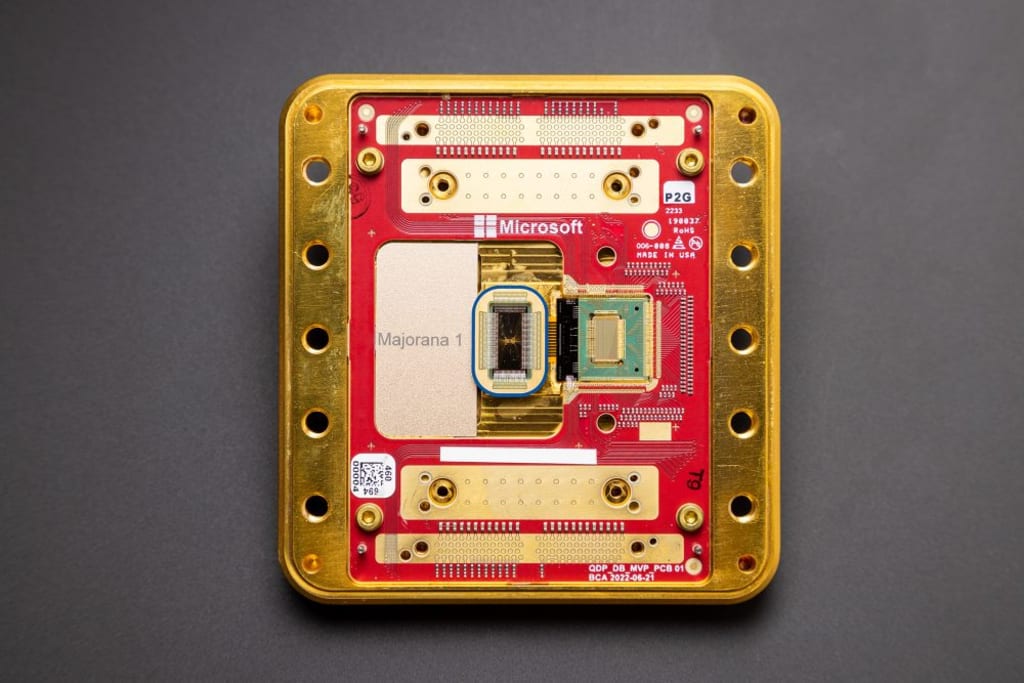
In a move that promises to redefine the future of computing, Microsoft has unveiled the Majorana 1 chip—the world’s first quantum processor powered by a breakthrough Topological Core architecture. Announced in February 2025, this chip represents the culmination of nearly two decades of research into topological qubits and the elusive Majorana particles. With the potential to scale from its current 8-qubit prototype to a staggering one million qubits on a chip that fits in the palm of your hand, Majorana 1 could accelerate quantum computing applications from theory to industrial practice in just a few years, not decades.
Breaking New Ground with Topological Qubits:
Traditional quantum computing faces significant hurdles due to qubit instability and the need for extensive error correction. Most existing architectures—relying on superconducting circuits or trapped ions—suffer from decoherence and noise, often requiring thousands of qubits to perform a single meaningful calculation. Microsoft’s solution is to leverage topological qubits based on Majorana zero modes. These exotic quasiparticles, predicted as far back as the 1930s by physicist Ettore Majorana, exhibit natural error resistance by encoding information in a way that is protected against local disturbances.
The Majorana 1 chip achieves this using an innovative material class called a topoconductor—a hybrid of indium arsenide and aluminum. By fabricating this material atom by atom, Microsoft engineers have created a unique state of matter—one that isn’t solid, liquid, or gas, but a topological state with intrinsic stability. This new material not only supports the formation of Majorana zero modes but also enables the chip’s digital control through microwave-based readout techniques, simplifying error correction and control of qubits dramatically
How It Works:
Fabrication and Measurement
The Majorana 1 chip is fabricated in Microsoft’s labs using a unique process that deposits materials atom by atom. In this chip, superconducting nanowires are cooled to near absolute zero and tuned with magnetic fields to coax the formation of Majorana Zero Modes (MZMs) at the wire ends. These MZMs carry the quantum information by storing it in their fermion parity—a property that indicates whether the number of electrons is even or odd.
To read the state of these qubits, the chip uses digital control techniques. Digital switches couple both ends of a nanowire to a tiny semiconductor quantum dot. When microwaves are applied, the reflection signal from the dot changes depending on the qubit’s state, allowing for highly precise single-shot measurements. This digital approach to qubit control simplifies operations compared to traditional analog methods, a critical advantage for scaling up the number of qubits.
Implications for Industry and Society:
The potential applications of a million-qubit quantum computer are vast:
Drug Discovery & Materials Science: Quantum computers can simulate complex molecular interactions that are intractable for classical machines, potentially leading to breakthroughs in new drug formulations and materials with self-healing properties.
Cryptography: As quantum computing advances, current encryption methods could become obsolete. However, the same technology also offers pathways to develop quantum-resistant cryptography.
Environmental & Industrial Applications: From breaking down microplastics to optimizing energy systems, scalable quantum computers could address some of the most challenging problems facing society.
Agriculture: Improved crop yields and sustainable practices by modeling environmental conditions and nutrient cycles with unprecedented accuracy.
Scientific Research: Enhanced ability to solve fundamental questions in physics and chemistry, potentially leading to breakthroughs in energy production and material sciences.
Microsoft’s vision extends beyond research labs. By integrating Majorana 1 into its Azure Quantum ecosystem, the company plans to offer access to this technology for researchers and developers, fostering a new era of innovation across various industries
Skepticism and the Road Ahead:
Despite the excitement, the Majorana 1 announcement has not been without its detractors. Some experts in the field remain cautious, noting that while the theoretical underpinnings are sound, practical demonstrations of large-scale quantum computations remain to be seen. Historical challenges—including previous retractions of research papers—underscore the difficulty of reliably generating and measuring Majorana zero modes. Critics argue that until more tangible computational evidence is provided, the full promise of this technology remains to be proven
Nonetheless, the progress made with Majorana 1 marks a significant milestone. With Microsoft’s roadmap and partnerships with agencies like DARPA, there is renewed optimism that these hurdles will be overcome, ultimately leading to fault-tolerant quantum computers that can solve real-world problems.
Conclusion:
Microsoft’s Majorana 1 chip is more than just a new quantum processor—it is a bold leap toward scalable, reliable quantum computing. By harnessing the power of topological qubits through innovative materials and digital control methods, Microsoft is laying the groundwork for a future where quantum computers could transform industries ranging from healthcare to environmental science. While challenges remain, the breakthroughs achieved with Majorana 1 offer a promising glimpse into a quantum future that might arrive sooner than many had imagined.
Stay tuned as we follow the journey of Majorana 1 and the evolution of quantum computing technology—where each new breakthrough brings us one step closer to solving some of the world’s most complex problems.
About the Creator
Md. Sohag Ali
My name is Sohag, a B.Sc in CSE graduate from Varendra University, is an internet researcher passionate about food and technology.
Enjoyed the story? Support the Creator.
Subscribe for free to receive all their stories in your feed.
Comments
There are no comments for this story
Be the first to respond and start the conversation.