
Mastering the Fundamentals: Exploring Data Structures and Algorithms(part-1)
Data structure and algorithm
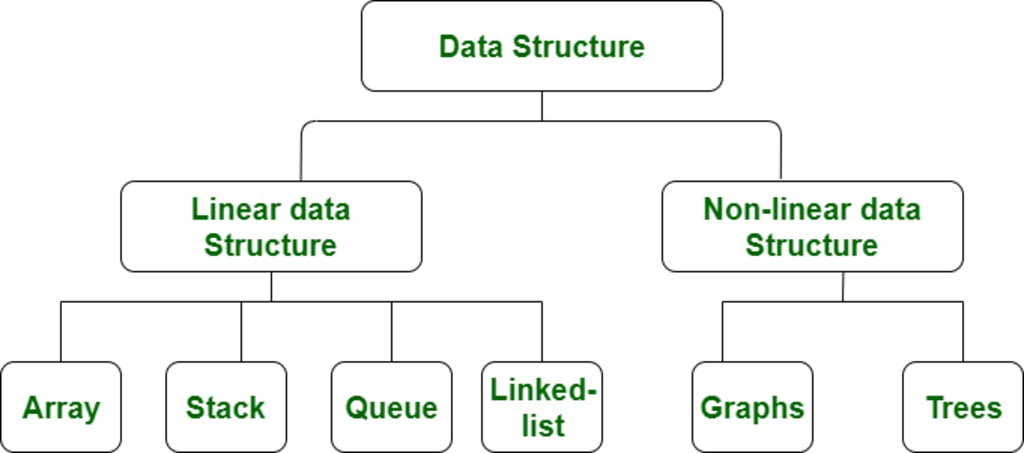
Mastering the Fundamentals: Exploring Data Structures and Algorithms(part-1)
I. Introduction
Importance of data structures and algorithms in software development
1. Efficient Problem Solving: Data structures and algorithms provide systematic approaches to efficiently solve complex problems in software development. They enable developers to organize and manipulate data in ways that lead to optimal algorithmic solutions, improving performance and scalability.
2. Resource Utilization: Properly designed data structures and algorithms help optimize the utilization of system resources such as memory and processing power. By selecting the right data structures and implementing efficient algorithms, developers can minimize time and space complexities, resulting in faster and more efficient software execution.
3. Code Reusability: Data structures and algorithms serve as fundamental building blocks that can be reused across different software projects. Once developers understand and implement common data structures and algorithms, they can leverage this knowledge to create reusable code components, saving development time and promoting the creation of robust and maintainable software.
4. Scalability and Performance: As data size and complexity increase, the choice of data structures and algorithms becomes critical for maintaining software performance and scalability. Well-designed data structures and algorithms ensure that software can handle large data sets and perform operations quickly, regardless of data growth.
5. Algorithmic Thinking and Problem-Solving Skills: Learning data structures and algorithms develops algorithmic thinking and problem-solving skills in developers. They learn to break down complex problems into manageable components, analyze time and space requirements, and design efficient solutions. These skills are transferable to various domains and are valuable for career advancement and tackling new challenges in software development.
II. Understanding Data Structures
A. Definition and significance of data structures
Data structures are the organization and storage formats for data, enabling efficient access, manipulation, and management in software development.
Data structures are significant as they provide the foundation for organizing and managing data, allowing for efficient access, manipulation, and optimization of algorithms and software performance.
B. Array: Overview, advantages, and limitations
Arrays are fixed-size data structures that store elements of the same type, accessed using an index, allowing efficient random access . Advantages and limitations of array are mentioned below
1. Random Access: Arrays allow for constant-time random access to elements based on their index, making it efficient to retrieve or modify elements at any position.
2. Efficient Memory Utilization: Arrays allocate contiguous memory blocks, resulting in efficient memory utilization. This enables faster memory access and reduces memory overhead compared to dynamically allocated data structures.
3. Simple and Intuitive: Arrays have a straightforward and intuitive structure, making them easy to understand and implement. They provide a natural way to represent and work with collections of elements.
4. Efficient Iteration: Arrays facilitate efficient iteration through elements using simple loop constructs. This makes it convenient to process each element sequentially without the need for complex traversal logic.
5. Cache Locality: Due to their contiguous memory layout, arrays exhibit good cache locality. This means that accessing elements in nearby memory locations can be faster due to caching mechanisms, leading to improved performance.
6. Indexing Flexibility: Arrays provide flexibility in indexing, as elements can be accessed using both positive and negative indices. Negative indices allow for convenient access to elements from the end of the array, simplifying certain programming tasks.
It's Important to note that arrays also have limitations, such as fixed size and expensive insertions or deletions, but their advantages make them a powerful and commonly used data structure in many programming scenarios.
C. Linked List: Singly linked list, doubly linked list, and circular linked list
A singly linked list is a linear data structure where each node contains a value and a reference to the next node.
A doubly linked list is a data structure where each node contains references to both the previous and next nodes.
A circular linked list is a data structure where the last node points back to the first node, forming a circular structure.
D. Stack: LIFO (Last-In, First-Out) principle and operations
A stack is a linear data structure that follows the Last-In-First-Out (LIFO) principle. It supports two main operations: push (adding an element to the top) and pop (removing the top element). It is commonly used for function calls, expression evaluation, and managing program memory.
The main operations in a stack are:
1. Push: Adds an element to the top of the stack.
2. Pop: Removes and returns the top element from the stack.
3. Peek or Top: Retrieves the value of the top element without removing it.
4. IsEmpty: Checks if the stack is empty.
5. Size: Returns the number of elements in the stack.
6. Clear: Removes all elements from the stack, making it empty.
These operations allow for managing the stack’s contents and accessing elements based on the Last-In-First-Out (LIFO) principle.
E. Queue: FIFO (First-In, First-Out) principle and operations
A queue is a linear data structure that follows the First-In-First-Out (FIFO) principle. The main operations in a queue are:
1. Enqueue: Adds an element to the back of the queue.
2. Dequeue: Removes and returns the element from the front of the queue.
3. Front or Peek: Retrieves the value of the element at the front of the queue without removing it.
4. IsEmpty: Checks if the queue is empty.
5. Size: Returns the number of elements in the queue.
6. Clear: Removes all elements from the queue, making it empty.
Queues are commonly used in scenarios where elements need to be processed in the same order they were added, such as task scheduling, process management, and handling requests.
F. Tree: Binary tree, BST (Binary Search Tree), and balanced trees
A tree is a hierarchical data structure composed of nodes. It consists of a root node that has zero or more child nodes, each of which may have their own child nodes. The nodes in a tree are connected by edges.
Key concepts in a tree structure:
1. Root: The topmost node of the tree from which all other nodes descend.
2. Parent: A node that has child nodes connected to it.
3. Child: A node that is connected to a parent node.
4. Sibling: Nodes that share the same parent.
5. Leaf: A node that has no children.
6. Depth: The length of the path from the root to a specific node.
7. Height: The length of the longest path from a node to its leaf nodes.
Types of trees:
1. Binary Tree: A tree where each node has at most two children, referred to as the left child and the right child.
2. Binary Search Tree (BST): A binary tree where the values in the left subtree are smaller than the node’s value, and the values in the right subtree are greater.
3. Balanced Tree: A tree where the heights of the left and right subtrees of any node differ by at most a certain balance factor. Examples include AVL trees and Red-Black trees.
4. B-tree: A self-balancing tree data structure that maintains sorted data and allows efficient search, insertion, and deletion operations.
5. Trie: A tree-like structure used for efficient retrieval of keys or words based on their prefixes. Commonly used in dictionary implementations and autocomplete features.
Trees are widely used in various applications, such as organizing hierarchical data, representing file systems, implementing search algorithms, and creating efficient data structures like heaps and priority queues. They provide a flexible and efficient way to store and retrieve data in a hierarchical manner.
About the Creator
Enjoyed the story? Support the Creator.
Subscribe for free to receive all their stories in your feed.
Comments
There are no comments for this story
Be the first to respond and start the conversation.