
Jimmy Learns Why Half the Potatoes Vanished
A mystery involving potatoes that apparently reproduced overnight

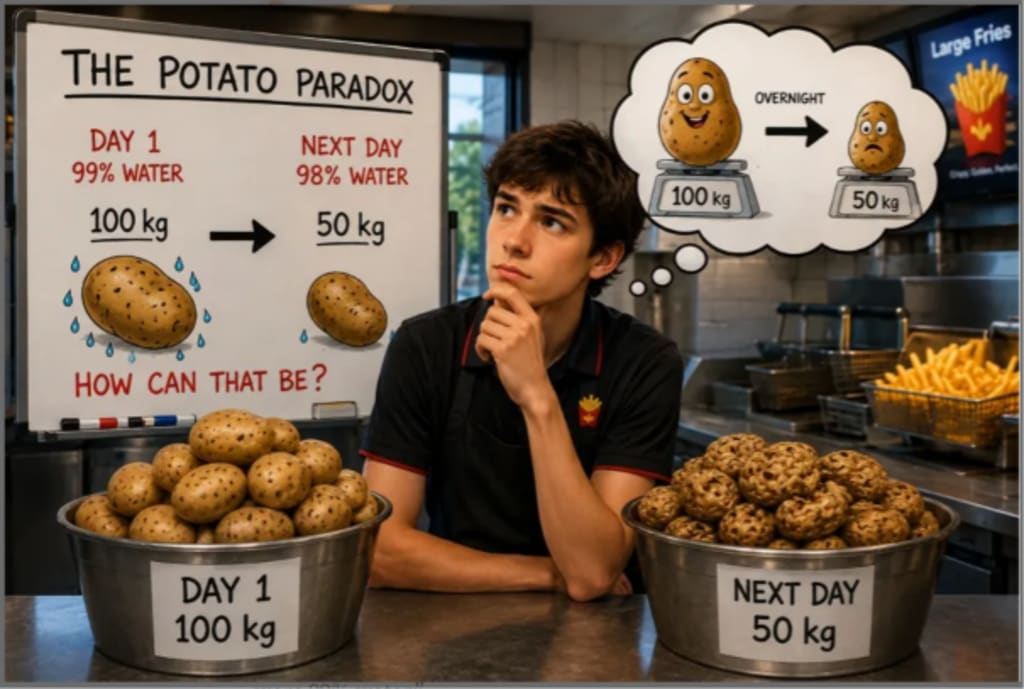
Jimmy looked agitated as he entered the classroom.
“Sir, I think the manager at the burger shop I work at was scammed.”
“What do you mean?” I replied.
“He says we lost half the potatoes overnight.”
“Lost?”
“Yes. He said the bag of fresh potatoes originally weighed 100 kilograms and were 99% water.”
There was immediate interest.
“Is he accusing you?” Simon asked.
Jimmy shook his head emphatically.
“And this morning,” Jimmy continued his story, “he said the potatoes are now 98% water and weigh just 50 kilograms.”
“That makes no sense,” Simon commented.
I looked at Jimmy.
“Jimmy, you know that half a bag of potatoes simply can’t evaporate into thin air.”
“That’s exactly what I told my boss,” Jimmy replied.
“What did he say?”
“He said for me not to worry about it. That it’s only the potato paradox.”
I smiled and walked to the board.
“Perhaps your manager understands mathematics better than you do.”
Jimmy looked offended.
“He runs a deep fryer, sir.”
I wrote:
100 kg potatoes 99% water
“The potatoes were left overnight and dried slightly,” I commenced.
I then wrote:
Next day: 98% water
Jimmy grinned.
“That’s hardly any change.”
“That is what makes this interesting,” I replied.
“If the potatoes are 99% water, what percentage is actual potato matter?”
“1%,” said Miriam.
“And 1% of 100 kilograms is?”
“1 kilogram,” Andrew announced.
“Good,” I replied. “The potatoes contain 99 kilograms of water and 1 kilogram of solid potato.”
“So far .. so good,” Jimmy noted.
“The next day, the potatoes are 98% water,” I stated, pointing to the board.
Jimmy’s eyes lit up.
“That’s easy. If they’re now 98% water, 2% must be solid potato.”
“So far .. so correct,” I teased him.
“And 2% of 100 kilograms is 2 kilograms,” he concluded.
Several students nodded cautiously.
I stared at Jimmy.
“Are you saying that the weight of the solid parts of the potatoes doubled from 1 kilogram to 2 kilograms,” I asked.
Jimmy was befuddled.
“Well, potatoes reproduce overnight,” was all he could offer at short notice.
The class burst into laughter.
“The solid part can’t increase,” I explained. “Only water can evaporate. The actual potato matter must still be 1 kilogram.”
“So the total weight shrinks until 1 kilogram becomes 2% of the whole,” Jimmy realised.
“Exactly.”
It was now Jimmy’s moment.
“That means the total weight must be 50 kilograms!” he exclaimed.
I nodded and clapped briefly in acknowledgement of a correct analysis.
“Potatoes lose only a little water percentage-wise, but because the dry matter doubles from 1% to 2% of the total, the overall mass must halve.”
As an employee who prepares hot chips, Jimmy was betrayed by mathematics.
“And that means a 1% water loss destroys half the fries?”
“Not half the fries,” I corrected. “Half the total weight.”
Jimmy’s eyes suddenly widened.
“Sir… this is brilliant.”
That was a dangerous starter.
“If potatoes lose half their weight when they get old, then my boss should only buy old potatoes.”
The class looked puzzled.
“They’d weigh half as much,” Jimmy continued. “My boss pays half price and gets more potatoes for the same weight.”
“Yes,” I admitted.
Jimmy looked triumphant.
“So older potatoes are better value.”
“Not necessarily,” I replied. “They will be smaller and contain less water.”
Jimmy shrugged.
“But for fries, isn’t that actually useful?”
He had a point.
“Possibly,” I admitted. “Slightly drier potatoes may cook better.”
“My manager isn’t losing potatoes after all,” Jimmy stated.
“No,” I sighed. “He may actually be improving them.”
Jimmy was happy now.
“I knew today was going to be ground breaking potato mathematics.”
About the Creator
George Dimitriadis
Retired mathematics teacher from Melbourne, Australia. I write humorous classroom stories featuring Jimmy, a student who questions mathematical conventions, as well as personal reflections on life, nostalgia and everyday absurdities.
Enjoyed the story? Support the Creator.
Subscribe for free to receive all their stories in your feed.
Comments
There are no comments for this story
Be the first to respond and start the conversation.