
Jimmy Discovers How to Guarantee a Lottery Win
Jimmy has a dream, two betting systems, a successful father, and a plan to buy every possible lottery combination. What could possibly go wrong?

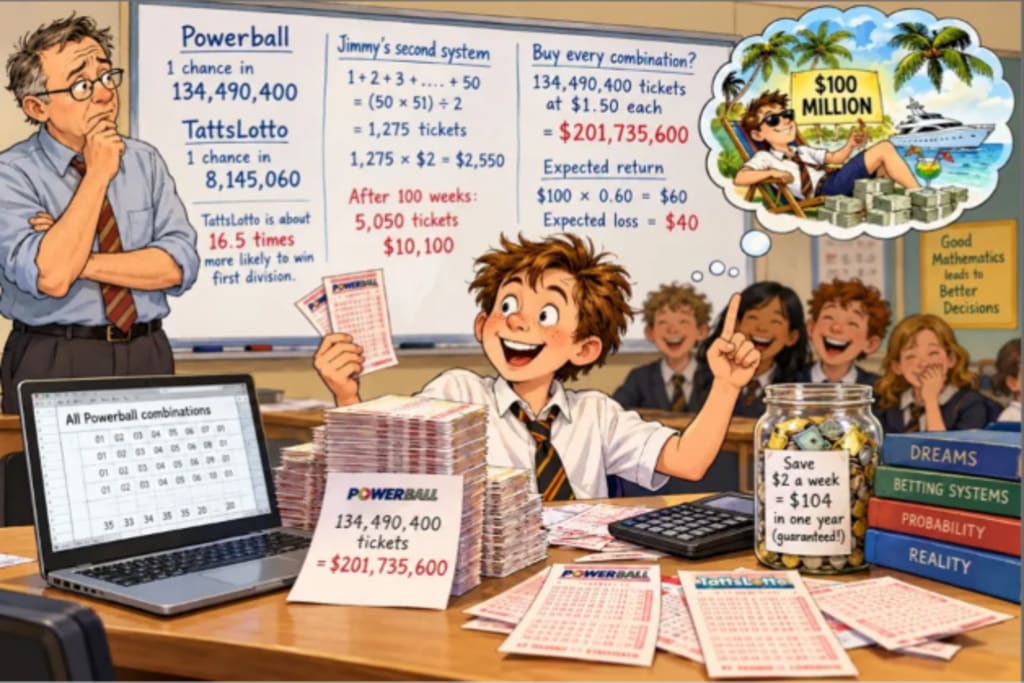
Everybody Wants to Be a Millionaire
It was Monday morning, and I had made the mistake of mentioning the previous week’s $100 million Powerball jackpot.
“One person won the entire amount,” I told the class. “Apparently, millions of Australians bought tickets.”
Jimmy’s hand shot up.
“Sir, I’ve decided to become a millionaire.”
“Have you found employment, Jimmy?”
“No, sir. Something much easier.”
“I hesitated to ask.”
“The lottery.”
“Jimmy, do you know how unlikely it is to win first division?”
“Not exactly, sir. But I know someone who wins.”
“Who?”
“My dad.”
“Your father won the lottery?”
“Twice, sir.”
The class fell silent.
“Twice?”
“Yes. Two weeks in a row.”
“How much did he win?”
“Eleven dollars the first week and fourteen dollars the second.”
I waited.
Jimmy looked pleased with himself.
“That’s twenty-five dollars altogether, sir.”
“Very impressive. How long has your father been playing?”
“About two years.”
“And how much has he spent during those two years?”
Jimmy examined the ceiling.
“Quite a lot, I suppose.”
“More than twenty-five dollars?”
“Probably.”
“Considerably more?”
He sighed.
“Yes, sir.”
“So your father hasn’t actually made a profit?”
“Not yet.”
“Not yet?”
“He says he’s due for a big win.”
“Jimmy, does the lottery know how long your father has been waiting?”
“No, sir.”
“Then why should it reward him for his patience?”
Jimmy thought about this.
“Good customer service?”
The Numbers Came to Him in a Dream
“Anyway,” Jimmy continued, “I’ve got something Dad hasn’t.”
“A job?”
“A dream, sir.”
“Do you mean an ambition?” I asked.
“No. An actual dream. Last night I dreamt about six numbers. I remember them perfectly.”
“Which six?”
“Four, seven, eleven, nineteen, twenty-three and thirty-two.”
“Why those numbers?”
“Because they were in my dream.”
“And that makes them more likely to win?”
“Why else would I dream about them?”
“Perhaps you were thinking about the lottery before going to sleep.”
Jimmy looked offended.
“Sir, you make it sound as though my brain was simply making things up.”
“It has been known to happen.”
“But what if the dream was a prediction?”
“Then we’d need to test whether your dreams predict anything reliably. You could write down your predictions before each draw and compare them with the results.”
Jimmy considered this.
“That sounds like a lot of work.”
“More work than buying a lottery ticket?”
“Much more.”
“Besides,” I added, “Powerball requires seven main numbers and a Powerball number. Your dream only gave you six.”
Jimmy looked alarmed.
“You mean my dream was incomplete?”
“Apparently.”
He shook his head.
“Even my subconscious is cutting corners.”
Jimmy’s First Brilliant System
“Never mind, sir. I’ve developed a mathematical system.”
This was rarely a reassuring announcement.
“Go on.”
“I looked at all the winning numbers from previous draws. I found the numbers that have appeared most often.”
“And?”
“I’ll use the most frequent ones every week.”
“Why?”
“Because they’re the most successful numbers.”
“Jimmy, suppose a fair coin has landed heads seven times in a row. What is the probability of heads on the next toss?”
“One-half.”
“Does the coin remember the previous seven tosses?”
“No.”
“Does it feel obliged to produce tails?”
“No.”
“Then why would a lottery ball remember how many times it has appeared in previous draws?”
Jimmy frowned.
“Perhaps the popular numbers are more experienced.”
“Experienced?”
“They’ve had more practice at winning.”
There followed laughter from students.
“Jimmy, the balls don’t learn. Provided the draw is fair, previous results don’t make particular numbers more likely in the next draw.”
“So the numbers that have appeared least often are just as likely?”
“Yes.”
“And what about the ones that have never appeared together?”
“Just as likely as any other particular combination.”
I wrote two sets of six numbers on the board.
1, 2, 3, 4, 5, 6
7, 14, 19, 26, 35, 42
“Suppose these are entries in a fair six-number lottery. Which combination is more likely to win?”
“The second one, obviously.”
“Why?”
“Because the first one looks ridiculous.”
“But both combinations have exactly the same probability.”
Jimmy stared at the board.
“Sir, are you telling me that the lottery doesn’t recognise ridiculous numbers?”
“Correct.”
“Then it’s not nearly as intelligent as I thought.”
Jimmy’s Second Brilliant System
“Actually, sir, I have another system. This one is guaranteed to improve my chances.”
“I’m listening.”
“Every week I lose, I buy one extra ticket the following week.”
“Explain.”
“The first week I buy one ticket. If I lose, I buy two the next week. If I lose again, I buy three. Then four, five, six, and so on.”
“And what happens when you finally win?”
“I recover all my losses!”
“Do you?”
“Of course. I’ll have more tickets, so I’ll have a better chance.”
“You will have more chances if you buy different combinations, but you’ll also be spending more money. And a win doesn’t necessarily pay enough to recover your losses.”
“That’s an investment, sir.”
“An investment in what?”
“My future winnings.”
I turned to the board.
“Let’s examine your system. To keep the arithmetic simple, suppose each ticket costs two dollars. How much would you spend if you kept losing for ten weeks?”
Jimmy started calculating.
The class joined in.
One ticket in the first week, two in the second, three in the third, and so on.
The total number of tickets would be
1 + 2 + 3 + … + 10 = 55 tickets
55 × $2 = $110
At two dollars each, that would cost $110.
“That’s not too bad,” Jimmy said.
“Now suppose you continue losing for fifty weeks.”
Jimmy began writing again.
1 + 2 + 3 + … + 50 = (50 × 51) ÷ 2 = 1,275 tickets
1,275 × $2 = $2,550
“At two dollars per ticket, that’s $2,550.”
Jimmy stared at the board.
“Perhaps I should stop after forty-nine weeks.”
“And after one hundred weeks?”
He reluctantly applied the same formula.
1 + 2 + 3 + … + 100 = (100 × 101) ÷ 2 = 5,050 tickets
5,050 × $2 = $10,100
“That’s $10,100,” I said.
Jimmy looked horrified.
“For lottery tickets?”
“Your lottery tickets.”
“Sir, I think my system needs a spending limit.”
“That would be an improvement.”
“But if I keep buying more tickets, surely I’m getting closer to winning?”
“You’re buying additional chances, Jimmy. But each new draw is independent of the previous ones. Your past losses don’t make a win more likely in the next draw.”
“So I could keep losing?”
“Yes.”
“Even though I’m using mathematics?”
“Especially if you’re using mathematics to justify spending more than you can afford.”
Jimmy put down his pen.
“I preferred my dream.”
Somebody Has to Win
Simon raised his hand.
“Sir, if millions of people buy tickets, surely somebody has to win?”
“Not necessarily. A lottery can have no first-division winner. It depends on whether anyone holds the winning combination.”
“But somebody won the hundred million dollars,” he said.
“Yes. Someone did.”
Jimmy seized his opportunity.
“Exactly! Somebody has to be the winner, and that somebody could be me.”
“It could be you, Jimmy. But that doesn’t make it likely.”
I wrote a number on the board.
134,490,400
“For Australian Powerball, a single standard game has one chance in 134,490,400 of winning first division.”
Jimmy studied the number.
“That’s quite a few.”
“Indeed.”
“But not impossible.”
“No. Not impossible.”
“Then there’s still hope.”
“There is a difference between something being possible and something being a sensible financial decision.”
Jimmy was quiet for a moment.
“Sir, if the prize is a hundred million dollars, isn’t the ticket worth buying?”
“Not automatically. You must consider the probability, the ticket price, smaller prizes, the possibility of sharing the jackpot and how much you can afford to lose.”
Jimmy frowned.
“So a hundred-million-dollar prize doesn’t mean every ticket is worth a hundred million dollars?”
“Certainly not.”
“That’s disappointing advertising.”
Jimmy Discovers a Better Lottery
“Sir, I’ve been thinking.”
“That usually worries me, Jimmy.”
“Why don’t I forget Powerball and play TattsLotto instead?”
“Why TattsLotto?”
“Because I’ve heard it’s easier to win.”
“That’s true. Let’s compare the odds.”
I wrote on the board:
TattsLotto: 1 chance in 8,145,060
Powerball: 1 chance in 134,490,400
Jimmy stared at the numbers.
“Sir, TattsLotto is much better!”
“How much better?”
He reached for his calculator.
134,490,400 ÷ 8,145,060 ≈ 16.5 showed on his screen.
“About sixteen and a half times!”
“Correct.”
Jimmy beamed.
“Then I’ve finally found a sensible way to become a millionaire.”
“Jimmy, suppose you have sixteen and a half times almost nothing. What do you have?”
He thought for a moment.
“Sixteen and a half times more than almost nothing?”
“Technically, yes. But still almost nothing.”
Jimmy looked again at the board.
“So TattsLotto gives me a much better chance of winning?”
“Yes.”
“But I still have more than eight million chances of losing for every one chance of winning?”
“Approximately, if you’re describing the odds against winning.”
Jimmy sighed.
“Sir, mathematics has a terrible habit of making good news sound bad.”
“It’s trying to give you the whole picture.”
“Then I think I preferred the smaller picture.”
“Which one?”
“The one where Dad won eleven dollars.”
Jimmy Guarantees a Lottery Win
Jimmy was unusually quiet.
I should have known better than to interpret this as a sign of understanding.
“Sir, I’ve solved the problem.”
“Which problem, Jimmy?”
“How to guarantee winning Powerball.”
“I’m listening.”
“You said there are 134,490,400 possible combinations.”
“Correct.”
“So all I have to do is buy 134,490,400 different entries. One for every combination.”
I stopped.
For once, Jimmy had made a mathematically sound observation.
“Yes, Jimmy. If you purchased every possible combination for a single draw, one of your entries would certainly win first division.”
Jimmy jumped to his feet.
“I KNEW IT!”
“Sit down, Jimmy.”
“But sir, I’ve beaten the lottery!”
“Not quite. How much will your tickets cost?”
Jimmy looked puzzled.
“Does that matter if I’m guaranteed to win?”
“Rather a lot, actually. Let’s suppose each entry costs $1.”
I wrote on the board:
134,490,400 × $1 = $134,490,400
Jimmy stared at the answer.
“Sir, you’re making it sound expensive.”
“It is expensive.”
“But I haven’t got that much money.”
“Then your system has encountered its first difficulty.”
Jimmy thought for a moment.
“Not necessarily, sir. I’ll form a syndicate.”
“A syndicate?”
“Yes. Everyone contributes money, we buy all the combinations, and then we share the winnings.”
“Excellent. How many members will your syndicate have?”
“A million.”
“Then each member would have to contribute approximately $134.49.”
“That’s manageable!”
“And if the jackpot is $100 million?”
Jimmy smiled.
“We win!”
“How much does each member receive from the jackpot?”
He reached for his calculator.
“One hundred dollars.”
“And how much did each contribute?”
“About one hundred and thirty four dollars.”
There was a long silence.
Jimmy looked at the board.
“Sir, are you saying we could guarantee a win and still lose money?”
“Precisely. The first-division prize alone would be less than half your outlay.”
“But we won!”
“Yes.”
“And we’re poorer?”
“On those figures, yes, if we consider only the first-division prize.”
Jimmy shook his head.
“That’s a very disappointing definition of winning.”
“Of course, your other entries would also collect lower-division prizes. We’d need to include those to calculate the exact result.”
Jimmy waved his hand.
“Don’t complicate things with more winnings, sir. I’m already having enough trouble with the first one.”
I continued.
“There’s another problem. How would you organise the purchase of more than 134 million distinct entries before the draw?”
Jimmy considered this.
“Online?”
“And how would you make certain there were no duplicate combinations?”
“A spreadsheet.”
“And how would you persuade a million people to contribute?”
“Advertising.”
“And who would administer the syndicate?”
Jimmy paused.
“You, sir?”
“Absolutely not.”
He sighed.
“Sir, every time I solve a mathematical problem, you introduce a financial one.”
“That’s because the two are not always the same.”
But I’ve Done All the Mathematics!
Jimmy sat back in his chair.
Then he raised his hand once more.
“Sir, perhaps I should wait until the jackpot reaches $300 million.”
“And what if somebody else also wins first division?”
Jimmy looked puzzled.
“What do you mean, somebody else?”
“Another person might have purchased the winning combination.”
“But I’ve already bought it!”
“That doesn’t prevent anyone else from buying exactly the same combination.”
Jimmy frowned.
“So there could be two winners?”
“Certainly.”
“And we’d each get $150 million?”
“Yes, assuming the advertised first-division prize pool is $300 million.”
Jimmy considered this.
“That’s still a lot of money.”
“But your syndicate spent over $134 million buying its tickets.”
Jimmy’s expression changed.
“So even with a $300 million jackpot, we could receive less from first division than we spent?”
“Yes. And if there were three first-division winners, your syndicate would receive only $100 million from that prize pool.”
Jimmy stared at the board.
“Sir, let me get this straight. I buy every possible combination. I guarantee a first-division win. And then somebody who bought just one ticket can come along and take half my prize?”
“Or a third. Or an even smaller share, depending on the number of winners.”
Jimmy looked genuinely offended.
“That’s outrageous!”
“It’s how the lottery works.”
“But I’ve done all the mathematics!”
“And the other person may simply have chosen some numbers.”
Jimmy shook his head.
“Sir, that doesn’t seem fair.”
“Mathematics doesn’t reward effort, Jimmy. It rewards correct answers.”
He was silent for a moment.
“Then I hope the other winner has at least done the calculations.”
The Mathematics of Losing Money
“There’s another calculation I want you to understand,” I said.
Jimmy looked suspicious.
“Is this going to cost me anything?”
“Only your attention.”
“That’s a relief.”
“Suppose, in a hypothetical lottery, the average amount returned in prizes is sixty cents for every dollar spent on tickets.”
“So I get sixty cents back?”
“Not necessarily. You might win nothing, or occasionally win much more. But across a very large number of tickets, the average return would be sixty cents per dollar.”
I wrote on the board:
$100 × 0.60 = $60
Expected loss = $100 − $60 = $40
“So if you spent $100, the expected return would be $60.”
Jimmy looked horrified.
“Sir, I’ve discovered something.”
“What?”
“The lottery is selling hundred-dollar notes for sixty dollars.”
“Other way around, Jimmy.”
“Oh.”
He thought for a moment.
“That’s even worse.”
“Exactly. And that is why gambling is generally a poor way to make money. A lottery operator needs enough money from ticket sales to pay prizes and cover its costs.”
Jimmy looked thoughtful.
“So the lottery can advertise all the winners, but it doesn’t show us everybody who lost?”
“Not in the same way.”
“Perhaps it should.”
“What would the advertisement say?”
Jimmy adopted a deep announcer’s voice.
“Congratulations to our latest winner of one hundred million dollars! And a special thank you to the millions of people who helped pay for it!”
The class erupted in laughter.
I waited for the noise to subside.
“Jimmy, that may be the most accurate thing you’ve said all morning.”
The Safest Betting System
“So what would you recommend, sir?” Jimmy asked.
“If your objective is to make money, don’t gamble. Keep the money you would otherwise spend on tickets.”
“But then I definitely won’t win the jackpot.”
“Correct.”
“And I won’t lose my ticket money either.”
“Also correct.”
Jimmy considered the matter.
“So if I don’t buy a ticket, I have a hundred per cent chance of keeping my money?”
“Yes.”
“And if I buy a ticket, I have a very high chance of losing the amount I spent?”
“Yes.”
“And if I keep increasing the number of tickets, I could lose more and more?”
“Precisely.”
Jimmy looked thoughtful.
“Sir, I think I’ve invented a third system.”
“Another one?”
“Yes. I put two dollars into a jar every week instead of buying a ticket.”
“That sounds considerably better.”
“And after fifty-two weeks?”
“You’ll have $104.”
“Guaranteed?”
“Assuming nobody takes the money out.”
Jimmy smiled.
“That’s the best odds I’ve heard all morning.”
I thought, for one glorious moment, that the lesson had succeeded.
Then his hand went up again.
“Sir?”
“Yes, Jimmy?”
“What if I dream about the jar?”
“Jimmy, please don’t.”
“Because if I dream about it being full of hundred-dollar notes, perhaps — ”
“Jimmy!”
He shrugged.
“Just trying to improve the system, sir.”
The mathematics of gambling is remarkably straightforward. The mathematics of human hope is rather more complicated.
About the Creator
George Dimitriadis
Retired mathematics teacher from Melbourne, Australia. I write humorous classroom stories featuring Jimmy, a student who questions mathematical conventions, as well as personal reflections on life, nostalgia and everyday absurdities.
Enjoyed the story? Support the Creator.
Subscribe for free to receive all their stories in your feed.
Comments
There are no comments for this story
Be the first to respond and start the conversation.