
Jimmy and the Camel That Came Back
A traveller solved an impossible inheritance — but Jimmy suspected that the fractions were hiding something

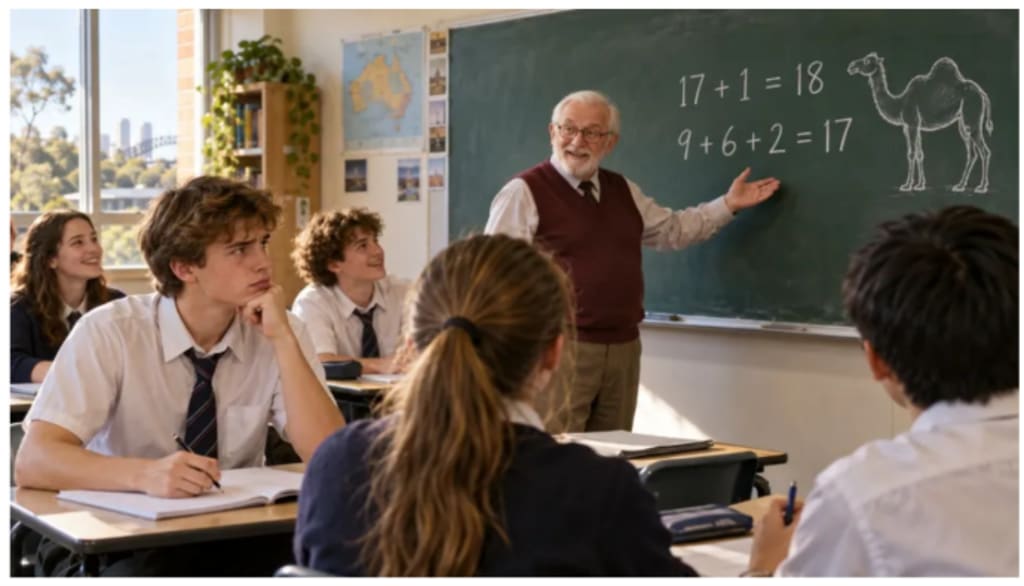
“Today,” I informed my class, “we are going to divide seventeen camels among three brothers.”
Jimmy raised his hand immediately.
“Do the brothers go to this school?”
“No,” I answered.
“Are the camels willing participants?”
“They have not been consulted.”
“Then this may become an animal-rights problem.”
“It is a mathematics problem, Jimmy.”
“That is probably what the camels have been told.”
I ignored him and wrote 17 camels on the board.
“A wealthy father owned seventeen camels. In his will, he left half of them to his eldest son, one-third to his second son and one-ninth to his youngest son.”
I wrote the three fractions beneath the number:
“The father died, and his sons attempted to divide the camels according to his instructions. Unfortunately, they encountered a problem.”
“Seventeen is not divisible by two,” Sarah said.
“Nor by three,” added Michael.
“Nor by nine,” said Emily.
“Exactly. The eldest son’s share would be eight and a half camels. The second son’s share would be five and two-thirds camels, while the youngest son’s share would be one and eight-ninths camels.”
Jimmy frowned.
“I don’t think the camels are going to like this problem.”
“The brothers agreed that no camel should be cut into pieces.”
“The camels have voted,” said Jimmy.
“They also wanted to follow their father’s will as closely as possible. How might they solve the problem?”
The Class Offers Some Solutions
Sarah suggested selling all seventeen camels and dividing the money according to the stated fractions.
“That would be practical,” I said, “but the will says that the sons are to receive camels, not money.”
Michael offered another possibility.
“They could share ownership of some of the camels.”
“How would that work?”
“The eldest son could own half of one camel, and another brother could own the other half.”
Jimmy looked concerned.
“Which end would each brother own?”
“The ownership would only exist on paper,” Michael explained.
“That is easy for you to say. You’re not the brother who receives the back half.”
The class laughed.
Emily suggested that the brothers take turns using the camels.
“One brother could use a camel for six months, and another brother could use it for the remaining six months.”
“That divides the camel’s time,” I said, “but it does not divide its ownership according to the will.”
Simon raised his hand.
“Could they wait until one of the camels has a baby?”
“That might give them eighteen camels,” he explained. “Then they could divide them properly.”
“That assumes one of the camels is pregnant,” I said.
“And that the baby is also included in the inheritance,” Sarah added.
Jimmy considered the idea.
“What happens if two camels have babies?”
“Then they would have nineteen camels.”
“So they would need another traveller to borrow one.”
“No travellers have appeared yet, Jimmy.”
“They usually do in these old riddles.”
For once, he was ahead of me.
A Traveller Arrives
“The three brothers argued for several days,” I continued. “Then a wise traveller happened to pass their home, riding his own camel.”
Jimmy nodded knowingly.
“I told you.”
“The brothers explained their problem. After thinking for a moment, the traveller offered them his camel.”
“Permanently?” asked Emily.
“No. He said they could borrow it.”
I changed the number on the board:
“The brothers now had eighteen camels. They followed their father’s instructions using this new total.”
I turned to the class.
“How many camels did the eldest son receive?”
“Half of eighteen is nine,” Sarah answered.
I wrote:
“The second son received one-third.”
Press enter or click to view image in full size
“And the youngest son received one-ninth.”
“So the three sons received nine, six and two camels.”
I added their shares:
“There were eighteen camels available, but the sons took only seventeen. One camel remained — the traveller’s camel. He climbed onto it and continued his journey.”
For a moment, the class was silent.
Then several students began speaking at once.
“That’s clever.”
“It works perfectly.”
“He gave them an extra camel without losing anything.”
“He made eighteen camels become seventeen again.”
Jimmy was not joining in the admiration. He was staring at the figures on the board.
Where Did the Extra Camel Go?
“Sir,” Michael asked, “did the traveller know beforehand that one camel would remain?”
“He must have.”
“But how?”
Sarah thought she had the answer.
“It is because he only lent them the camel. Since it never belonged to the brothers, it had to be returned.”
“That explains why it was returned,” I said. “It does not explain why it was left over.”
Emily suggested that the numbers had simply been rounded.
“The eldest son was entitled to eight and a half camels, so he received nine. The second son was entitled to five and two-thirds, so he received six. The youngest was entitled to almost two, so he received two.”
“That gives the correct whole numbers,” I said.
“But they all rounded upwards,” Michael objected. “Normally, if everyone receives more than their proper share, we need more than the original amount.”
“Perhaps the traveller donated part of his camel to each brother,” Simon suggested.
Jimmy shook his head.
“He couldn’t have. He rode away on the whole camel. At least, I assume it was whole.”
“It was,” I replied.
“Then he did not donate any part of it.”
“Maybe the extra camel was imaginary,” Sarah said.
“The traveller seemed to be riding it.”
“He might have been imaginary too.”
“If we start removing everything imaginary from mathematics,” Jimmy said, “we may lose half the curriculum.”
I allowed the class a little more time to struggle with the apparent paradox.
The traveller had temporarily increased the herd from seventeen to eighteen. The brothers then received seventeen camels between them, and the traveller recovered the one he had lent.
Nothing had been cut. Nothing had been sold. No camel had been created or lost.
It appeared that the traveller had solved the impossible inheritance perfectly.
Jimmy was still studying the original fractions.
Then he raised his hand.
“The traveller cheated.”
Jimmy Examines the Fractions
“In what way?” I asked.
“He didn’t divide the original seventeen camels according to the will.”
“The eldest received half, the second received a third and the youngest received a ninth.”
“Of eighteen,” Jimmy said. “Not of seventeen.”
“That was necessary to avoid fractional camels.”
“But it means they did not receive the fractions their father specified.”
He was correct.
Half of seventeen is eight and a half, not nine. One-third of seventeen is five and two-thirds, not six. One-ninth of seventeen is one and eight-ninths, not two.
Each brother had received slightly more than his exact share.
“Nevertheless,” I said, “the total number given to the brothers was still seventeen. How could all three receive more than their stated fractions without requiring more than seventeen camels?”
Jimmy walked to the board.
“Because the father didn’t give away the entire herd.”
He rewrote the fractions with a common denominator:
Then he added them:
The class became quiet again.
“The three fractions don’t add to one,” Jimmy said. “They add to seventeen-eighteenths.”
He wrote the missing portion underneath:
“The father’s will distributed only seventeen-eighteenths of his property. He never said what should happen to the remaining eighteenth.”
There was the secret.
When the traveller increased the herd to eighteen camels, the three stated shares became nine, six and two. Together, they accounted for seventeen of the eighteen camels. The undistributed eighteenth camel was free to return to the traveller.
The borrowed camel had not performed any magic. It had merely made the missing fraction visible.
A Clever Solution — or a Convenient One?
“So the traveller did not really solve the original problem?” Emily asked.
“He found a practical settlement,” I replied. “All three brothers received whole camels, and each received a little more than his precise entitlement. Presumably, everyone was satisfied.”
“But he did not follow the will exactly,” Michael said.
“No. An exact division would require fractional ownership, selling the herd or some other arrangement. The traveller changed the total before applying the fractions.”
Sarah looked back at the board.
“Then the camel was a distraction.”
“In a way, yes.”
Everyone had concentrated on the mysterious eighteenth camel: where it came from, how it could be given away and how the traveller managed to recover it.
Jimmy had looked somewhere else.
“The real trick,” I said, “was hidden in the fractions.”
Jimmy returned to his seat.
“The traveller knew everyone would be watching the camel,” he said, “instead of checking whether the father had given away the whole herd.”
He paused.
“Perhaps the traveller wasn’t the wisest person in the story.”
“Who was?”
“The camel. It was the only one that arrived and left with exactly what it started with.”
About the Creator
George Dimitriadis
Retired mathematics teacher from Melbourne, Australia. I write humorous classroom stories featuring Jimmy, a student who questions mathematical conventions, as well as personal reflections on life, nostalgia and everyday absurdities.
Enjoyed the story? Support the Creator.
Subscribe for free to receive all their stories in your feed.
Comments
There are no comments for this story
Be the first to respond and start the conversation.