
I’ve Taught for 30 Years. Here’s the Rule That Kept Me From Caring Too Much
A veteran teacher on why calm is not cold, and why a blank workbook should never become a test of your worth.
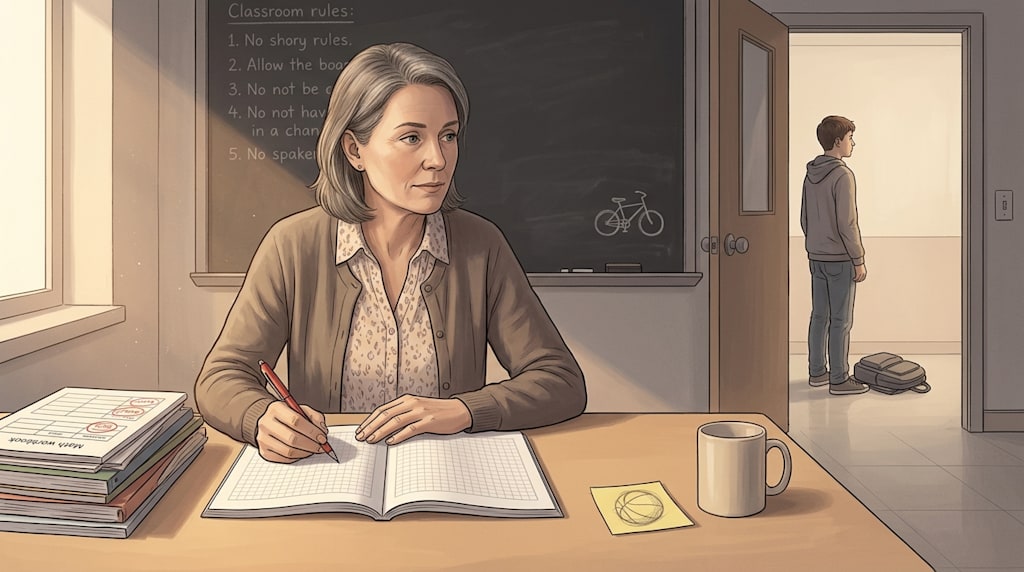
Last autumn, Ms. Li carried a boy’s schoolbag into the hallway. The zipper was half open. A math workbook slid out and lay on the floor, its corner curled, every page blank. The boy stood facing the wall and said nothing. In the office, Ms. Li called his parent. Her voice rose with each sentence. “You need to come in today,” she said, and hung up. Then she sat in her chair and cried.
I have known Ms. Li for fifteen years. She does not cry easily. She cried because she had been watching that boy for half a semester. Every day after class she kept him for twenty minutes to explain problems. On weekends she photographed his workbook and sent the pictures to his parent. She even remembered that he liked basketball, and once rewrote an applied problem so it was about shooting percentages. Each time, the boy said, “I got it.” The next day the workbook was blank again. Before she carried him into the hallway, she had just explained the same problem for the third time. The boy looked down at his book, turned two pages, and said, “Teacher, this won’t even be on the exam.”
Later, Ms. Li told me she wasn’t crying about the problem. She was crying because those twenty minutes, those photographs, and that rewritten basketball problem meant nothing to that boy. “What am I doing this for?” she said.
I didn’t answer. I knew. She was waiting for the day he would look up and say, “Teacher, you never gave up on me.” That sentence probably will not come. The boy is not cruel. He is fourteen. Too many things in his life matter more than a math problem. Ms. Li had bet half a semester on a sentence she would never hear. She lost the bet and the semester.
I was like that in my first years. One year I had a graduating class, and one girl wrote beautiful essays. I wrote long comments on every one, spending three times as long on her as on anyone else. She misread the prompt on the high school entrance exam. On the day she came back for her results, I stood in the hallway waiting to say a few words. She walked past me without turning her head. That night I was grading at home. I threw my red pen on the desk. My wife stuck her head out of the kitchen and asked what was wrong. I said nothing. She said it was written all over my face. I said nothing was wrong. She said, “You threw your pen.”
After that I made a rule. Write clear comments. Do not write long letters. The students are worth the clear comments. The problem starts when I write a long letter and quietly turn it into a request for gratitude. As I write, I start thinking, “Will she be moved?” “Will she think I am dedicated?” Then she is not moved, and I feel betrayed. A comment is a comment. It is not a love letter. If I write it like one, I should not blame the student for not writing back.
The afternoon Ms. Li finished crying, the parent arrived. The boy stood nearby. The parent kept saying, “Thank you for your trouble, Teacher.” The boy never looked up. Later, Ms. Li told me that as she looked at his lowered head, she remembered teaching her own son to ride a bike. She held the back of the seat while her son shouted, “Mom, don’t let go.” She said she hadn’t. She had let go long before. Her son rode ten meters, realized she was not holding on, turned around, and smiled. “I was never this stubborn with my own son,” she said.
That was the point. She let go of her son because she believed he would get up if he fell. She would not let go of that boy because she did not believe he would get up. Belief or no belief, the boy had to climb up on his own. A teacher can sweep the glass off the road before he climbs. After that, the teacher stands to one side. You cannot climb for him. You cannot carry him into the hallway because he climbs slowly.
My method now is clumsy. On the first day with a new class, I write the rules on the board: when homework is due, when to come ask about problems, and what happens if you talk in class. First time, a warning. Second time, five minutes standing. Then we continue. I read the rules aloud and ask if anything is unclear. After that I follow them exactly. No more, no less. When a student comes to ask a question, I explain it once. If he does not understand, I explain it a second time. If he still does not understand, I say, “Go back and look at the example in the textbook. Come again tomorrow.” I do not keep him. I do not sit with him. If he comes tomorrow, I explain it again. If he does not come, I do not chase him. Chase him too much, and he will think he is studying for me.
A young teacher once asked me, “Aren’t you afraid the students will think you don’t care?” I said, “Whether he thinks I care is not mine to control. Whether I care is something I know.” That sounds hard. Here is the rest: I care. He does not have to appreciate it. Whether he appreciates it is his business. Once I separate those two things, I throw my pen less.
I mostly agree with the saying that doctors do not treat their own family. I would change one word. A doctor does not operate on his own family because his hands shake. A teacher’s hands shake in front of students because he wants too badly to be cared about in return. Those two things look alike. They are not. If you care about a student, you explain the problem two more times when he does not understand. If you want to be cared about, you explain it a third time when he does not want to listen. The first is teaching. The second is wrestling with yourself.
My wife is a nurse. She told me about an old doctor in her department. He said very little when he saw patients. Three questions, one answer. Some patients thought he was cold. His prescriptions were accurate, and his surgeries were clean. Once his own mother was hospitalized. He did not enter the ward. He let a colleague handle everything. My wife asked why. He said, “If I go in, she will not listen to the doctor. She will listen to her son. What her son says, she believes. What the doctor says, she listens to.” He stayed out because he knew that going in would make the work harder.
A teacher in a classroom needs some of that. You are there so the student will listen to you. You cannot let him only listen to you. He has to learn to listen to himself. When you have explained something three times and he still does not understand, the third time is no longer about the problem. It is about proving that you explained it correctly. Stop. Let him go back to the example. You are not giving up on him. You are giving the act of understanding back to him.
Ms. Li never carried a student’s schoolbag into the hallway again. She changed her method. She still stayed twenty minutes after class, but only for students who came on their own. She did not chase the ones who did not come. In the first week, three came. In the second week, five. In the third week, that boy stood at the door and asked, “Teacher, which problem are we doing today?” She did not ask why he had come. She did not say, “You finally came.” She pulled over a chair and said, “Sit. I am explaining this problem for the second time. Listen carefully.”
After that day, as the boy was leaving, he said, “Thank you, Teacher.” Ms. Li was erasing the board. Her hand paused. Then she kept erasing. She did not turn around. She did not say, “You’re welcome.” She was afraid that if she turned around, her face would show too much happiness and scare him away.
I laughed when she told me. Thirty years in, I think the hardest part of teaching is not making the problem clear. It is not asking, “Did you understand?” after you have made it clear. Ask too much, and the student thinks he is listening for your sake. Do not ask, and whether he understood is something he knows in his own heart.
Last month I saw Ms. Li at the school gate. She was carrying a cardboard box toward the office. It was full of workbooks. I offered to carry it. She said no, it was not heavy. After two steps she turned back. “That boy got seventy-eight on his math test,” she said. I said that was good. She said, “I did not praise him.” I said, “You praised him in your heart.” She laughed. “Right. In my heart. If I said it out loud, he would think he was studying for me again.”
She carried the box away. The bottom was soft, and every few steps she bounced it up. I watched her and thought the distance between a teacher and a student is something like that box. You help carry it. You do not walk for him. If he goes crooked, you call out once. If he still goes crooked, you watch. He will get there, or he will not. That is his road.
I went back to the office and wrote the rules for the next lesson again. The same few: when homework is due, when to come ask about problems, and what happens if you talk in class. First time, a warning. Second time, five minutes standing. Then we continue. I stared at the board. I crossed out “second time, five minutes standing.” I wrote, “Second time, five minutes standing, then we continue class.”
I put down the pen and picked up my cup. A student gave it to me last Teacher’s Day. It has a line printed on it: “Thank you for your hard work, Teacher.” I looked at it. I turned the cup around so the words faced the wall.
About the Creator
Jin
Writer of reamstories
https://reamstories.com/jin
Enjoyed the story? Support the Creator.
Subscribe for free to receive all their stories in your feed. You could also become a paid subscriber, letting them know you appreciate their work.
Comments
There are no comments for this story
Be the first to respond and start the conversation.