
Italy's New Service-Economy Operators:
Ten Names to Track in 2026

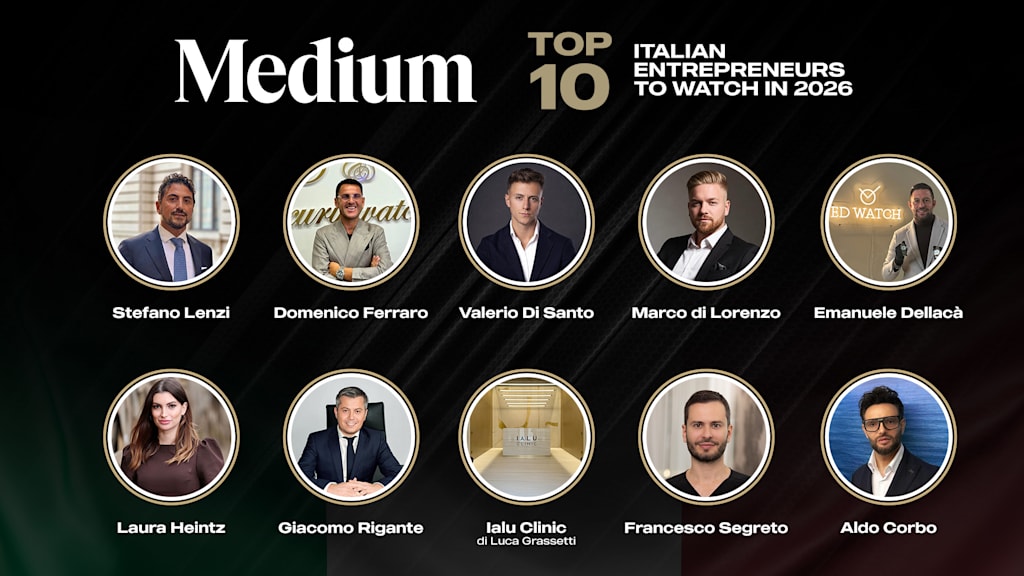
Italy's economic identity has long rested on craftsmanship, heritage brands, and family-run manufacturing. Beneath that familiar story, though, a different kind of entrepreneur is emerging — operating in private healthcare, pre-owned luxury, digital services, and lifestyle management for globally mobile clients. The businesses are often smaller, faster-moving, and built from regional Italian bases rather than the Milan-Rome axis.
The ten operators below cut across sectors that share little on the surface. What they have in common is a model: premium services sold to an international, high-income client base, with a deliberate bet on specialization over scale.
Aesthetic medicine: a sector in specialization mode
Italian aesthetic medicine has become one of the country's most contested professional fields. The post-pandemic surge in cosmetic procedures has been followed by regulatory tightening and a market-led push toward sub-specialization. Four operators stand out.
Stefano Lenzi. Dr. Lenzi runs a holding company across medical, pharmaceutical and aesthetic divisions, and is the architect of the Snellendo Method — a weight-loss and metabolic-health program built around a national network of partner centers. The unusual move is the institutional one: he spoke at the Italian Chamber of Deputies in 2025, and on May 18, 2026 will speak at the Italian Senate at a session titled Losing Weight in Health to Live Longer. A second appearance at a healthcare-policy conference in Rome on May 27 precedes the June 23 launch of his book, The Aesthetic Code, which reframes aesthetic medicine as a long-term wellness discipline rather than an image service. Most operators in the sector build private brands; Lenzi is building policy dialogue.
Luca Grassetti and Ialu Clinic. Founded in 2025 in Ancona, Ialu Clinic has organized its practice around hyper-specialization — each practitioner focuses on a single sub-area rather than offering a generalist menu. Surgeon and founder Luca Grassetti is betting that patients increasingly travel for specific expertise rather than city prestige. Early review velocity and out-of-region patient flow suggest the bet has traction.
Francesco Segreto. Dr. Segreto operates in plastic and reconstructive surgery across Rome, Milan and Naples — a multi-city footprint that's still uncommon in Italian private surgery. His positioning leans on academic credibility (PhD, published research, international training) and on building psychological consultation into the surgical-planning process. It's a slower-conversion model than the typical aesthetic-marketing playbook.
Aldo Corbo. In Sicily, Aldo Corbo has spent more than two decades turning Centro Dentale CORBO into one of the south's most structured dental operations, with heavy investment in intraoral scanning, advanced implantology, and in-house Italian-made dental technology. The more interesting bet is geographic: Corbo has built a dental-tourism funnel pulling patients from northern Italy to Sicily — a reversal of the more typical south-to-north medical migration. Lower operating costs, premium clinical standards, and holiday-adjacent positioning are what make the model defensible.
Luxury watches: the pre-owned market matures
The pre-owned watch market in Italy has stabilized after the speculative peaks of 2021–2022. Two operators have built durable businesses by leaning into technical service and education rather than pure trading volume.
Domenico Ferraro and D. & E. Luxury Watches. Founded in 2010 in the province of Caserta, D. & E. integrated an in-house technical workshop in 2017 — uncommon among Italian pre-owned dealers, most of whom outsource servicing. Ferraro has used the workshop as both a service line and a content engine: his Instagram and TikTok presence emphasizes counterfeit detection and authentication, which has built brand trust in a market periodically hit by fraud cases. A new 500-square-meter facility — 400 of which will be workshop space — is in development.
Emanuele Dellacà and Ed Watch. Parma-based Ed Watch operates across the country with a more discretion-focused model. The business pairs watch trading with a smaller jewelry line and consultative valuation services aimed at collectors and first-time buyers who want guidance rather than a transactional storefront. Ferraro and Dellacà occupy adjacent but distinct slices of the same market: technical authority on one side, relationship sales on the other.
Luxury lifestyle: services for globally mobile clients
A third cluster sells to internationally mobile high-net-worth clients — and is increasingly building from Italian bases rather than the traditional Swiss or Monégasque hubs.
Laura Heintz and Rently House. Born in 2000, Heintz launched Rently House during the pandemic and has grown it to over 100 managed properties across Rome, Milan, Venice and the Costa Smeralda. The business operates in high-end short-term rentals — a category that has consolidated significantly in Italy after the 2024 regulatory changes. Heintz is among the youngest operators in the Italian luxury real-estate management space, and has begun appearing at institutional events on digital business topics, including at the Italian Chamber of Deputies.
Giacomo Rigante and WorldWideLux. WorldWideLux operates as a destination management company across Italy and Europe, building tailored itineraries for HNW and UHNW clients. The business has extended into private jet brokerage through WWL Private Jets and is moving into luxury real-estate investment. Rigante is building a familiar but difficult-to-execute model: a single contact across travel, lifestyle and asset services for clients who don't want to manage multiple vendors. Execution is the moat.
Marco Di Lorenzo. An Italian-American operator based in Massachusetts, Di Lorenzo built a transportation company that made him a millionaire at 27, then diversified into real estate, finance, and private aviation. JetsWave Aviation, founded in 2023, is his most visible vehicle and has built a celebrity- and entrepreneur-heavy client base. In 2026 he became a partner in Mast Restaurant, a Boston-based Neapolitan restaurant, and invested in Bottega Paesano Cosmetics. The throughline is consumer-facing premium services with strong founder-led brands — a portfolio approach more common among American investors than Italian ones.
Digital services: a bet on predictability over visibility
Valerio Di Santo and Closify Group. Among the ten, Closify is the most direct play on the marketing-services industry itself. Founder Valerio Di Santo grew up on the outskirts of Rome and built the agency without outside capital — twice. The first iteration collapsed under burnout and personal pressure before he rebuilt. Closify's positioning leans on the distinction between visibility and client acquisition, a familiar critique inside the industry but one Di Santo has converted into a documented methodology applied across more than 50 client verticals. The agency targets coaches, professionals and SMBs — a segment chronically under-served by both freelance marketers and enterprise agencies.
What connects them
The ten don't share an industry, but they share a posture: regional Italian bases, internationally mobile clients, specialization over scale, and a preference for technical or institutional credibility over volume marketing. Italy's next entrepreneurial generation is being built in workshops in Caserta, clinics in Ancona, and rental offices in Venice — not in the boardrooms of the heritage brands the country is better known for.
About the Creator
4FEATURE.COM
4Feature - From MESS, to MESSAGE
Enjoyed the story? Support the Creator.
Subscribe for free to receive all their stories in your feed.
Comments