
Investing is a critical tool for building wealth and achieving financial freedom.
Investments: A Comprehensive Guide

Investing is a critical tool for building wealth and achieving financial freedom.
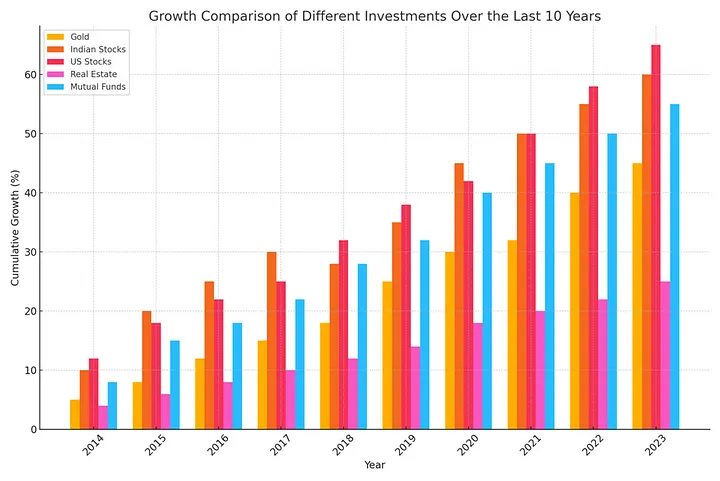
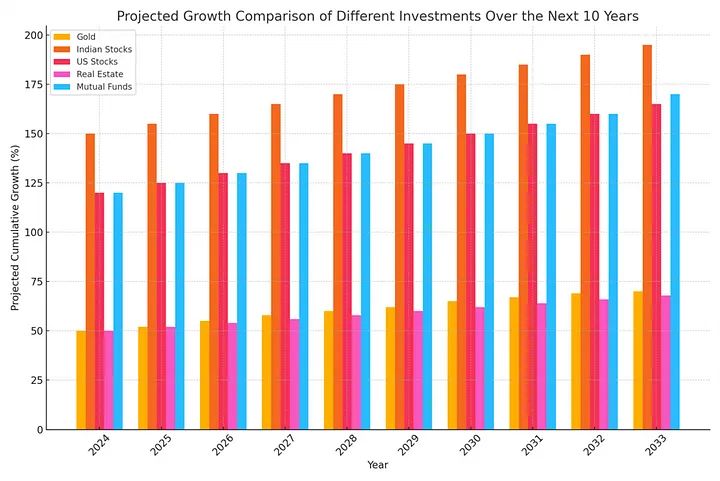
Over the years, the Indian investment landscape has transformed, providing a wide range of opportunities for investors of all types — whether it be through traditional assets like real estate and gold or newer options such as mutual funds, IPOs, and stocks. The goal of this guide is to provide a comprehensive overview of the different investment avenues available in India, the historical performance of each, and the outlook for the next decade. By understanding these investment opportunities, you can make informed decisions that align with your financial goals, risk tolerance, and time horizon.
Investments: A Comprehensive Guide
Investing is one of the most effective ways to grow your wealth and achieve financial freedom. It involves putting your money into assets that have the potential to increase in value over time, such as stocks, bonds, real estate, and other financial instruments. The primary goal of investing is to generate returns, either through capital appreciation, dividends, or interest.
Why Should You Invest?
There are many reasons why investing is essential for financial well-being. Some of the most compelling reasons include:
1. Beat Inflation: Inflation reduces the value of money over time. If you don’t invest, the purchasing power of your savings diminishes. Investments help combat inflation by providing returns that can outpace it.
2. Wealth Creation: Investing is a tool for wealth creation. Over time, the power of compounding can help your investments grow exponentially. The earlier you start investing, the more time your money has to grow.
Types of Investments
There are several types of investments, each catering to different financial goals and risk tolerances. Here are some popular types:
1. Stocks: Stocks represent ownership in a company. When you buy a company’s stock, you become a part-owner, entitled to a share of its profits. Stocks have the potential for high returns but are also accompanied by
higher risk.
2. Bonds: Bonds are debt securities issued by governments or corporations. When you invest in a bond, you are essentially lending money to the issuer, who agrees to pay you back with interest over a specified period.
Bonds are generally considered safer than stocks but offer lower returns.
Risk and Reward in Investments
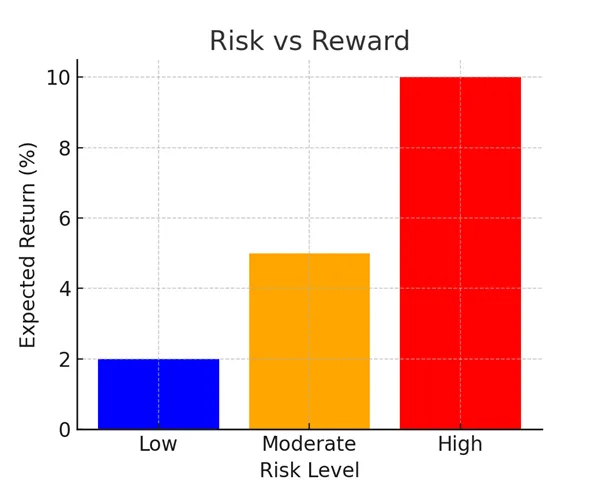
All investments come with a certain level of risk. Generally, the higher the potential return, the higher the risk involved. Investors must determine their risk tolerance before choosing investment options. Here are some
common investment risks:
1. Market Risk: The value of investments may fluctuate due to changes in the market. Stocks and cryptocurrencies are particularly susceptible to market volatility.
2. Credit Risk: This risk applies to bonds and other debt instruments. If the issuer defaults on the loan, investors may lose their money.
3. Liquidity Risk: Liquidity risk is the risk that an investor may not be able to sell an investment quickly without incurring a loss. Real estate and certain bonds can be relatively illiquid.
4. Inflation Risk: The risk that inflation will reduce the purchasing power of returns. Investments like bonds with fixed returns may not keep pace with inflation.
The Power of Compounding
Compounding is one of the most powerful tools in investing. It refers to the process where the returns earned on an investment are reinvested to generate additional returns. Over time, compounding can significantly increase the value of an investment.
For example, if you invest 1,00,000 INR at an annual interest rate of 10%, after one year, you will have 1,10,000 INR. If you reinvest the 10,000 INR interest, next year, you earn interest on 1,10,000 INR, and so on. The earlier you start investing, the more time your investments have to benefit from compounding.
Investment Strategies
There are various investment strategies that investors can adopt based on their goals, risk tolerance, and time horizon:
1. Growth Investing: Growth investors focus on companies with high growth potential. These companies may not currently be profitable but have the potential for significant future earnings. This strategy involves higher risk but can lead to substantial returns.
2. Value Investing: Value investors look for stocks that are undervalued by the market. They believe that the stock’s price will eventually reflect its true value, leading to profit. Warren Buffett is one of the most famous value investors.
3. Income Investing: Income investors focus on assets that generate regular income, such as dividend-paying stocks, bonds, or real estate. This strategy is ideal for those looking for steady cash flow, such as retirees.
4. Diversification: Diversification involves spreading investments across different asset classes to reduce risk. By diversifying, investors can mitigate losses in one asset class with gains in another.
Tips for Successful Investing
— Start Early: The earlier you start investing, the more time your money has to grow. Even small amounts can grow substantially over time due to compounding.
— Stay Consistent: Investing regularly, regardless of market conditions, helps build wealth over time.
— Do Your Research: Understanding what you’re investing in is crucial. Research the asset, industry, and risks involved before committing your money.
— Avoid Emotional Investing: Making investment decisions based on emotions, such as fear or greed, can lead to poor outcomes. Stick to your investment plan and focus on long-term goals.
— Consult a Financial Advisor: If you’re unsure about where to invest, a financial advisor can help you create a personalized investment plan.
Best Indian Stocks for Long-Term Investment (with Current Prices)
Here are some of the best Indian stocks for long-term investment, along with their current prices (as of October 2024):
1. Reliance Industries Limited (RIL): ₹2,995.35
2. Infosys: ₹2,667.00
3. Kotak Mahindra Bank: ₹2,126.89
4. ICICI Bank: ₹1,020.45
5. HDFC Bank: ₹1,562.35
6. Tata Consultancy Services (TCS): ₹3,486.00
7. Bajaj Finance: ₹7,211.35
8. Hindustan Unilever Limited (HUL): ₹2,482.00
9. Asian Paints: ₹3,072.50
10. Larsen & Toubro (L&T): ₹2,463.45
11. Avenue Supermarts (DMart): ₹3,496.90
12. Nestlé India: ₹25,981.50
13. Maruti Suzuki: ₹10,297.35
14. Divi’s Laboratories: ₹4,128.45
15. HCL Technologies: ₹1,218.00
These stocks are selected based on consistent performance, strong fundamentals, and growth potential.
Highest Dividend Paying Indian Stocks (2024)
Here are some of the highest dividend-paying stocks in India for 2024:
1. Vedanta Ltd — Dividend yield of 18.50%
2. Coal India Ltd — Dividend yield of 5.25%
3. Power Finance Corporation Ltd — Dividend yield of 3.50%
4. NTPC Ltd — Dividend yield of 4.25%
5. HCL Technologies Ltd — Dividend yield of 18.00%
6. REC Ltd — Dividend yield of 3.25%
7. Hindustan Zinc Ltd — Dividend yield of 26%
8. GAIL India Ltd — Dividend yield of 4%
9. ITC Ltd — Dividend yield of 6%
10. Steel Authority of India Ltd (SAIL) — Dividend yield of 1%
These stocks are known for their substantial dividend yields, providing a consistent income stream in addition to potential capital gains.
IPO Investment Summary: Last 10 Years & Future Outlook
**Past 10 Years**:
— IPOs in India have seen mixed outcomes depending on market conditions. Notable successes include Avenue Supermarts (DMart), IRCTC, and Happiest Minds, delivering returns of over 700%, 400%, and 300% respectively.
— Bull markets in 2016–2017 and 2020–2021 resulted in strong IPO performances, especially in tech and consumer sectors, while 2018 and 2022–2023 saw mixed or underperforming IPOs.
**Next 10 Years (Prediction)**:
— Expect more IPOs from technology, healthcare, renewable energy, and electric vehicle sectors.
— Government support for startups and rising retail participation should boost IPO activity.
— IPO performance will be influenced by global economic factors, and investors should focus on companies with solid fundamentals to manage risks.
Mutual Funds Investment Summary: Last 10 Years & Future Outlook
**Past 10 Years**:
— **Performance Overview**: Mutual funds like SBI Small Cap Fund, Axis Bluechip Fund, and Mirae Asset Emerging Bluechip Fund provided strong returns, averaging 10–15% annually. Debt funds such as ICICI Prudential Liquid Fund offered stability for risk-averse investors.
— **Sector Trends**: Equity funds focusing on large-cap and multi-cap segments were popular for growth, while small-cap funds showed higher volatility. SIPs became a popular investment route for disciplined, long-term wealth creation.
**Next 10 Years (Prediction)**:
— **Sectoral Growth**: Funds in technology, healthcare, and ESG (like SBI Magnum Equity ESG Fund) are expected to see increased interest.
— **Retail Growth**: Growing financial literacy and digital access will boost retail investor participation, especially through SIPs.
— **Balanced Approach**: Hybrid funds like HDFC Hybrid Equity Fund are likely to gain traction among investors seeking stability amidst market volatility.
— **Government Support**: Regulatory improvements and digital initiatives by SEBI will further support mutual fund industry growth.
Real Estate Investment Summary: Last 10 Years & Future Outlook
**Past 10 Years**:
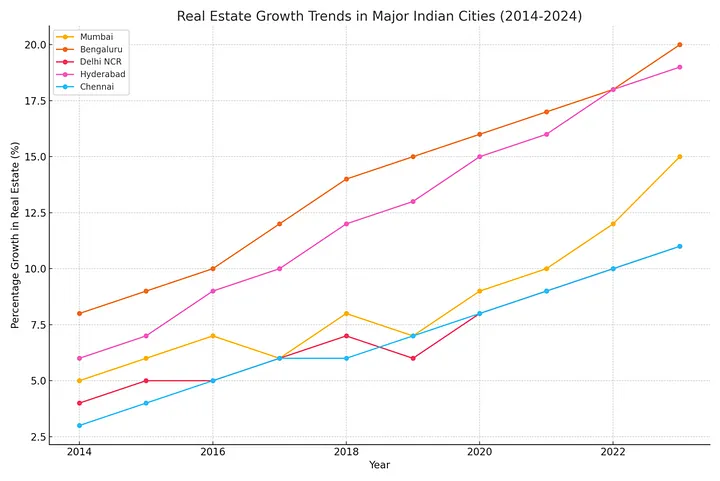
— **Performance Overview**: Real estate in India has experienced moderate but steady growth, especially in metropolitan areas. Cities like Mumbai, Bengaluru, and Delhi NCR have seen notable appreciation, driven by urbanization, infrastructure development, and increasing demand for residential and commercial properties.
— **Sector Trends**: The commercial real estate sector has grown significantly with demand for office spaces, especially in IT hubs like Bengaluru and Hyderabad. Residential real estate saw a mixed trend, with premium properties performing well, while affordable housing projects gained popularity due to government schemes like Pradhan Mantri Awas Yojana (PMAY).
— **Challenges**: Real estate faced challenges, particularly after the implementation of RERA (Real Estate Regulatory Authority) in 2017, which aimed at increasing transparency. The pandemic (2020) further affected demand and construction timelines but also pushed people to seek larger homes, boosting sales in suburban areas.
**Next 10 Years (Prediction)**:
— **Urban Expansion**: Tier-II and Tier-III cities, such as Pune, Ahmedabad, and Chandigarh, are expected to see significant real estate growth due to increasing urban migration and government focus on smart cities.
— **Commercial Sector Growth**: The commercial segment, particularly office spaces and warehouses, is expected to expand, driven by growth in IT, e-commerce, and manufacturing sectors.
— **Green and Smart Buildings**: There will be an increasing demand for energy-efficient, green, and smart buildings as people become more environment-conscious.
— **Residential Demand**: Affordable housing will continue to dominate demand, supported by government initiatives. Premium and luxury housing may see an uptick among high-net-worth individuals (HNIs).
Asset Allocation and Diversification
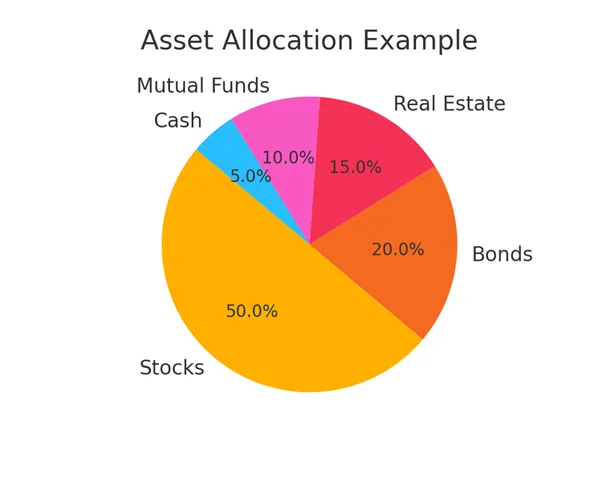
Asset allocation is the process of deciding how to distribute your investments among different asset classes, such as stocks, bonds, and real estate, to balance risk and reward according to your financial goals, time horizon, and risk tolerance. Diversification, on the other hand, is spreading investments within an asset class to minimize risk.
For example, rather than investing all your money in technology stocks, you can diversify by purchasing stocks in different industries, such as healthcare, consumer goods, and utilities. A diversified portfolio reduces the risk of significant losses because when one asset class underperforms, others may perform well and offset losses.
A typical diversified portfolio might include a mix of stocks, bonds, mutual funds, and real estate. The exact asset allocation depends on individual preferences and financial goals. A younger investor might opt for a high allocation to stocks for growth, while an older investor may prefer a more conservative approach with higher bond allocation.
Conclusion
Investing is an essential tool for achieving financial freedom, but it comes with risks. By understanding the different types of investments, assessing your risk tolerance, and developing a solid investment strategy, you can
maximize your chances of building wealth over time. Start early, stay consistent, and always make informed decisions to grow your financial future.
Like this article ? Follow/clap/ share for more better stuff
About the Creator
vinay jain
Vinay Jain is a dedicated writer specializing in health, education, and business, with a passion for creating insightful and engaging content that resonates with a wide audience. His work focus on breaking down complex concepts into simple.
Enjoyed the story? Support the Creator.
Subscribe for free to receive all their stories in your feed.
Comments
There are no comments for this story
Be the first to respond and start the conversation.