
Introduction to Deep Learning
Concepts, Models, and Applications
When I first started exploring deep learning, I was amazed by how fast the field was growing. As someone interested in artificial intelligence, diving into deep learning opened up many new opportunities for me. To better understand it, I decided to pursue an artificial intelligence certification, which helped me see how these technologies are used in real-world applications. Deep learning is transforming industries like healthcare and finance, and it's shaping the future in exciting ways. By sharing my experience, I hope to show how important and impactful this technology is.
What is deep learning?
Deep learning is a machine learning technique that models high-level abstractions in data through neural networks. It mimics the way humans learn from experience and process information. Unlike traditional machine learning algorithms that rely on manually extracted features, deep learning algorithms automatically learn to identify patterns in data by passing it through multiple layers of neurons.
These neural networks are structured in layers, where each layer processes specific features of the data before passing it to the next layer for further analysis. The "depth" of the model refers to the number of layers in the network, which helps the system learn more complex patterns and hierarchies within the data.
Key Concepts in Deep Learning
To better understand how deep learning works, it's important to familiarize yourself with some fundamental concepts:
Neural Networks: At the core of deep learning lies neural networks. These networks are composed of neurons, which are nodes that receive input, process it, and pass on the result. Neurons are organized into layers, with each layer responsible for learning increasingly complex representations of the data.
Training: Deep learning models are trained on vast amounts of labeled data. During training, the model learns to minimize errors and improve its performance through a process called backpropagation, which adjusts the weights of the neurons.
Activation Functions: Activation functions determine whether a neuron should be activated or not based on the input it receives. Common activation functions include ReLU (Rectified Linear Unit) and Sigmoid, which introduce non-linearity into the model, enabling it to learn more complex patterns.
Loss Function: The loss function measures the difference between the predicted output and the actual result. The goal is to minimize this loss during the training process.
Types of Deep Learning Models
There are several types of deep learning models, each designed to tackle specific types of data or problems. Let’s look at some of the most commonly used models:
Feedforward Neural Networks (FNN): The simplest type of neural network, FNNs, consist of an input layer, one or more hidden layers, and an output layer. These networks are used for tasks like classification and regression.
Convolutional Neural Networks (CNNs): CNNs are particularly effective for image and video processing tasks. They use convolutional layers to automatically detect spatial hierarchies in data, such as edges, textures, and patterns.
Recurrent Neural Networks (RNNs): RNNs are designed for sequential data, such as time series or natural language. These networks have loops that allow information to persist, enabling the model to remember previous inputs in the sequence and make predictions based on them.
Generative Adversarial Networks (GANs): GANs are composed of two networks—a generator and a discriminator—that work against each other. The generator creates fake data, and the discriminator evaluates its authenticity. GANs are widely used in image generation and other creative applications.
Deep Learning vs. Traditional Machine Learning
While both deep learning and traditional machine learning are part of AI, they differ in several ways. Traditional machine learning algorithms, such as decision trees or support vector machines, typically require manual feature extraction. This means that data scientists must carefully design features from the raw data before feeding it into the model.
In contrast, deep learning models automatically perform feature extraction through layers of neural networks. This ability to learn directly from raw data without the need for manual intervention makes deep learning particularly powerful for tasks involving large, unstructured datasets like images, audio, and text.
Applications of Deep Learning
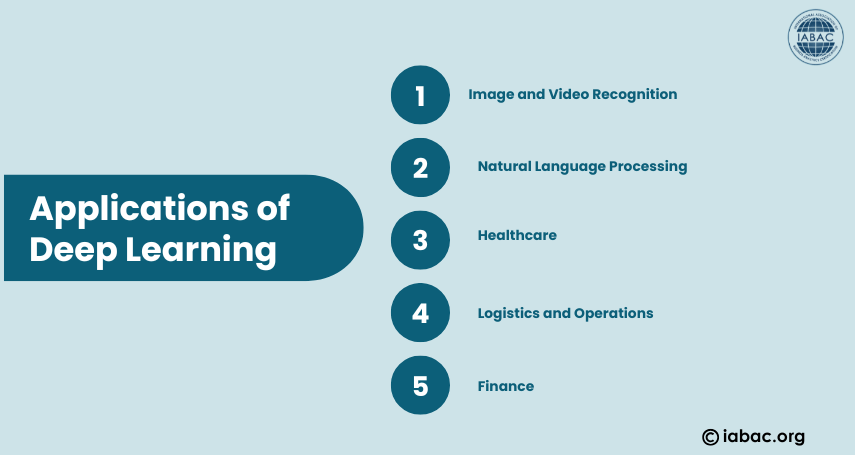
The versatility of deep learning has led to its widespread adoption in various industries. Some of the most notable applications include:
Image and Video Recognition: Deep learning models, particularly CNNs, are widely used in image and video recognition tasks. Applications like facial recognition, object detection, and autonomous vehicles rely heavily on deep learning to interpret visual data.
Natural Language Processing (NLP): Deep learning has transformed the field of NLP, allowing machines to understand and generate human language. Deep learning algorithms power tasks such as sentiment analysis, machine translation, and chatbot development.
Healthcare: In healthcare, deep learning models are being used for early disease detection, medical image analysis, and personalized treatment recommendations. For example, deep learning has been applied to detect tumors in medical images and predict patient outcomes.
Finance: Deep learning is used in the finance sector to detect fraud, predict stock market movements, and assess risks. By analyzing vast amounts of financial data, deep learning models can identify patterns that humans may overlook.
Gaming and AI Creativity: Deep learning has also been used in gaming to create more realistic non-playable characters (NPCs) and enhance gaming experiences. It has also been employed in AI-generated artwork, music, and even video content
Challenges in Deep Learning
Despite its many successes, deep learning still faces several challenges:
Data Requirements: Deep learning models require vast amounts of labeled data to perform well. Gathering and annotating this data can be time-consuming and expensive.
Computational Power: Training deep learning models, especially large ones, requires significant computational resources. This often necessitates the use of GPUs or specialized hardware like TPUs, making deep learning more resource-intensive than traditional machine learning techniques.
Interpretability: Deep learning models, particularly deep neural networks, are often referred to as "black boxes" because it's difficult to understand how they arrive at their decisions. This lack of transparency is a barrier to trust, especially in fields like healthcare and finance.
Overfitting: Deep learning models are prone to overfitting, especially when trained on small datasets. This occurs when the model becomes too complex and starts to memorize the training data rather than generalizing from it.
The Future of Deep Learning
The future of deep learning is bright, with ongoing advancements in model architectures, training techniques, and application areas. Some key trends to watch include:
Transfer Learning: Transfer learning involves taking a pre-trained model and fine-tuning it on a new dataset. This technique allows deep learning models to be applied to new tasks with less data and training time.
Edge Computing: With the rise of IoT devices, deep learning is moving to the edge. Models are being developed to run on devices like smartphones and embedded systems, enabling real-time decision-making without the need for cloud-based processing.
Explainable AI: Efforts are underway to make deep learning models more interpretable. Advances in explainable AI (XAI) will help make deep learning systems more transparent and trustworthy.
AI Ethics: As deep learning becomes more integrated into our lives, ethical considerations will become increasingly important. Fairness, transparency, and accountability in AI systems will be critical in the coming years.
Deep learning has transformed how we approach complex problems, from recognizing images to understanding human language. With its powerful models and a broad range of applications, deep learning continues to push the boundaries of AI. However, challenges like data requirements, computational power, and model interpretability remain, but ongoing advancements promise a bright future for this technology. Whether you're a beginner or an experienced data scientist, understanding the core concepts and models of deep learning will empower you to leverage this exciting field in your projects.
About the Creator
Enjoyed the story? Support the Creator.
Subscribe for free to receive all their stories in your feed.
Comments
There are no comments for this story
Be the first to respond and start the conversation.