
Interesting facts you should know about space.
let's dive into the facts.
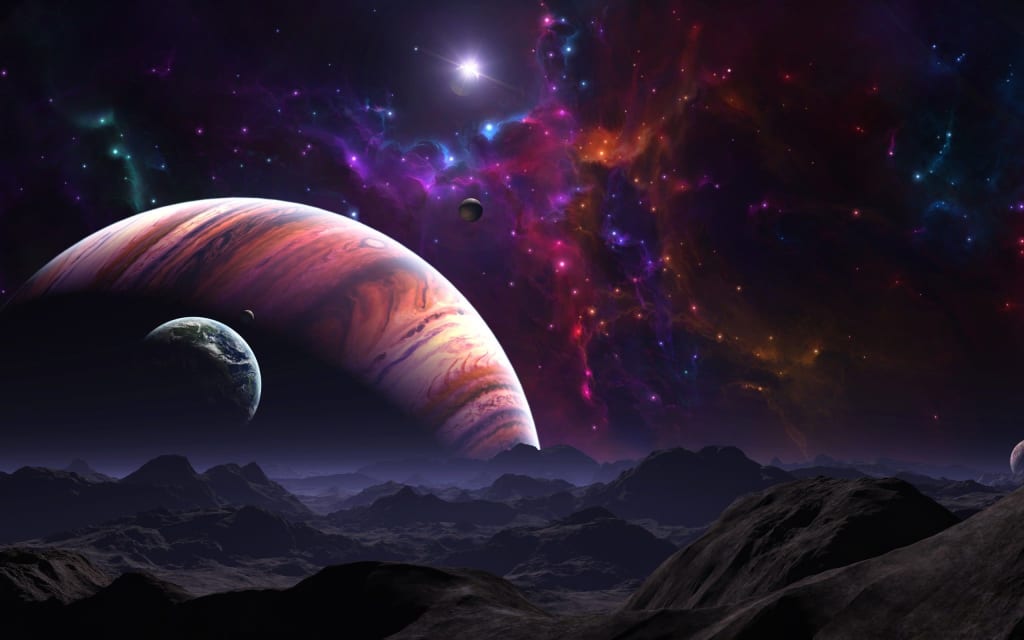
Habitable Zone: The region around a star where conditions might be right for life to exist.
Supernovae: Explosions marking the end of a massive star's life cycle, often outshining entire galaxies for a short period.
Neutron Stars: Extremely dense stellar remnants left behind after a supernova.
Pulsars: Rapidly rotating neutron stars emitting beams of radiation.
Galactic Cannibalism: When larger galaxies absorb smaller ones, altering their structure.
Dark Matter: An invisible substance that makes up most of the matter in the universe, yet it does not emit, absorb, or reflect light.
Dark Energy: A mysterious force driving the accelerated expansion of the universe.
Cosmic Microwave Background Radiation: The afterglow of the Big Bang, filling the universe with faint radiation.
Galactic Clusters: Large groups of galaxies bound together by gravity.
White Dwarfs: The remnants of low to medium mass stars, including our Sun, after they exhaust their nuclear fuel.
Red Giants and Red Supergiants: Late-stage stars, expanding and cooling as they near the end of their lives.
Galactic Superclusters: Vast collections of galaxies gravitationally bound together.
The Local Group: A small cluster of galaxies that includes the Milky Way.
The Great Attractor: A gravitational anomaly in intergalactic space pulling galaxies, including our own, towards it.
Cosmic Rays: High-energy particles originating from outside the solar system.
The Universe is Expanding: Space itself is expanding. Galaxies are moving away from each other, and this discovery led to the Big Bang Theory.
The Speed of Light: Light travels at a speed of about 299,792 kilometers per second (186,282 miles per second) in a vacuum.
Black Holes: These are regions in space where gravity is so strong that nothing, not even light, can escape.
The Milky Way: Our galaxy is a barred spiral galaxy containing billions of stars, including our Sun.
The Sun: It's a star, composed mainly of hydrogen and helium, and is the primary source of energy for life on Earth.
Asteroids and Comets: These are remnants from the formation of our solar system. Asteroids are mostly rocky, while comets are icy.
Space Debris: Thousands of pieces of human-made debris, including old satellites and spent rocket stages, orbit Earth, posing a risk to spacecraft.
The Oort Cloud: A hypothetical region surrounding the solar system where comets originate.
The Kuiper Belt: A region beyond Neptune where Pluto and other dwarf planets reside.
Exoplanets: Planets orbiting stars outside our solar system. Thousands have been discovered.High-energy particles originating from outside the solar system.
Gamma-Ray Bursts: The most energetic explosions in the universe, likely resulting from supernovae or neutron star mergers.
Quasars: Extremely bright and distant active galactic nuclei powered by supermassive black holes.
The Magnetosphere: Earth's magnetic field, protecting the planet from solar wind and cosmic radiation.
The Hubble Space Telescope: Launched in 1990, it has provided stunning images and valuable scientific data about the universe.
The James Webb Space Telescope: Planned to be the successor to Hubble, promising to revolutionize our understanding of the cosmos.
The International Space Station: A habitable space station orbiting Earth, serving as a microgravity and space environment research laboratory.
The Van Allen Belts: Regions of charged particles trapped by Earth's magnetic field.
Solar Flares and Coronal Mass Ejections: Eruptions on the Sun's surface that can affect Earth's magnetosphere and disrupt communications.
The Drake Equation: An attempt to estimate the number of extraterrestrial civilizations in our galaxy capable of communication.
The Fermi Paradox: The apparent contradiction between the high probability of extraterrestrial life and the lack of evidence for, or contact with, such civilizations.
Space Tourism: A burgeoning industry aiming to provide civilians with opportunities to travel to space.
Space Elevators: Theoretical structures designed to transport materials and people from Earth into space using a cable anchored to the ground.
About the Creator
Naveen Sridhar
content writer
Enjoyed the story? Support the Creator.
Subscribe for free to receive all their stories in your feed.
Comments
There are no comments for this story
Be the first to respond and start the conversation.