
Interactive Puzzle Story Ideas: The Alternative to Traditional Puzzle Books
Why mystery adventures, code-breaking challenges, and detective stories are creating a new kind of reader engagement
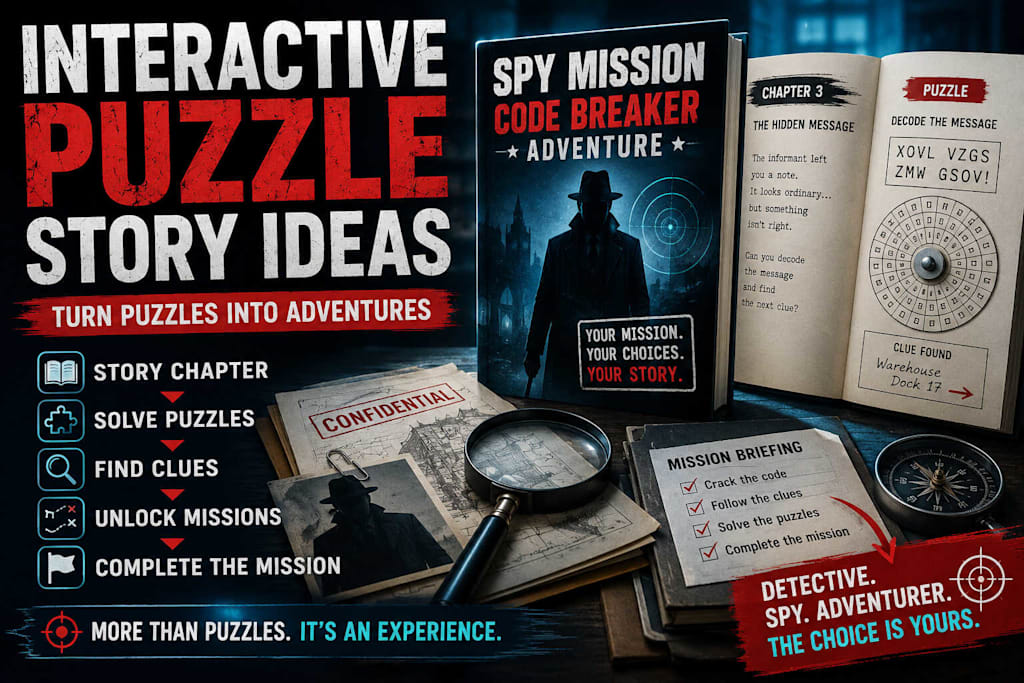
Walk into any bookstore and the puzzle section looks exactly like it did when you were a kid. Word searches. Sudoku. Crosswords. Mazes. I Spy books where you hunt for a tiny comb in a cluttered kitchen scene. Fill-in puzzles with numbered squares. The formats haven't evolved. Publishers keep printing the same grids with different themes. Ocean animals one month. Space exploration the next. The puzzle itself never changes. You solve it. You turn the page. You solve another one. There's no reason to remember what happened on page twelve when you reach page forty.
This repetition works for some people. It always has. But there's a growing gap between what puzzle books offer and what readers actually want when they pick up something interactive. Most puzzle formats reset after every page. The reader solves one isolated challenge and starts over. Nothing carries forward. No stakes. No reason to keep going beyond the satisfaction of finishing another grid.
That gap is where interactive puzzle story ideas start to get interesting.
What happens when puzzles become part of a story instead of existing as isolated pages? The reader doesn't just solve a crossword. They decode a message that reveals where the missing artifact is hidden. They don't just complete a maze. They navigate a spy through a compound to retrieve a dossier. The puzzle has a purpose. The answer matters. The outcome changes what happens next.
I've been watching how some publishers are approaching this. The ones moving away from standalone puzzle generators and toward connected narrative experiences. Detective puzzle books where each chapter ends with a clue. The clue unlocks a puzzle. The puzzle reveals information. The information advances the story. The next chapter raises a new challenge. The reader becomes part of the mission instead of just filling in blanks.
This isn't a new concept in theory. Escape rooms built their entire industry on it. People pay money to be locked in a room and solve puzzles that tell a story. The same logic applies to books. Interactive mystery books create momentum. The reader wants to continue because the outcome matters. Someone stole the painting. The clock is running. The cipher on the napkin leads to a safe deposit box. You need to crack it before the next chapter or the trail goes cold.
The formats showing up in this space are more varied than I expected. Spy puzzle books built around mission briefings. Code breaker books where every solved puzzle translates to coordinates or passwords. Mystery activity books structured like case files with evidence, witness statements, and embedded puzzles. Interactive puzzle adventures that read like novels but stop at decision points where the reader must solve something to proceed. Treasure hunts where the map is incomplete until you solve three separate challenges. Undercover operations where your cover identity depends on whether you can decode the enemy's transmission.
These aren't just puzzle collections with a thin story wrapper. The story and the puzzle are the same thing. Remove the puzzle and the story stops. Remove the story and the puzzle becomes meaningless.
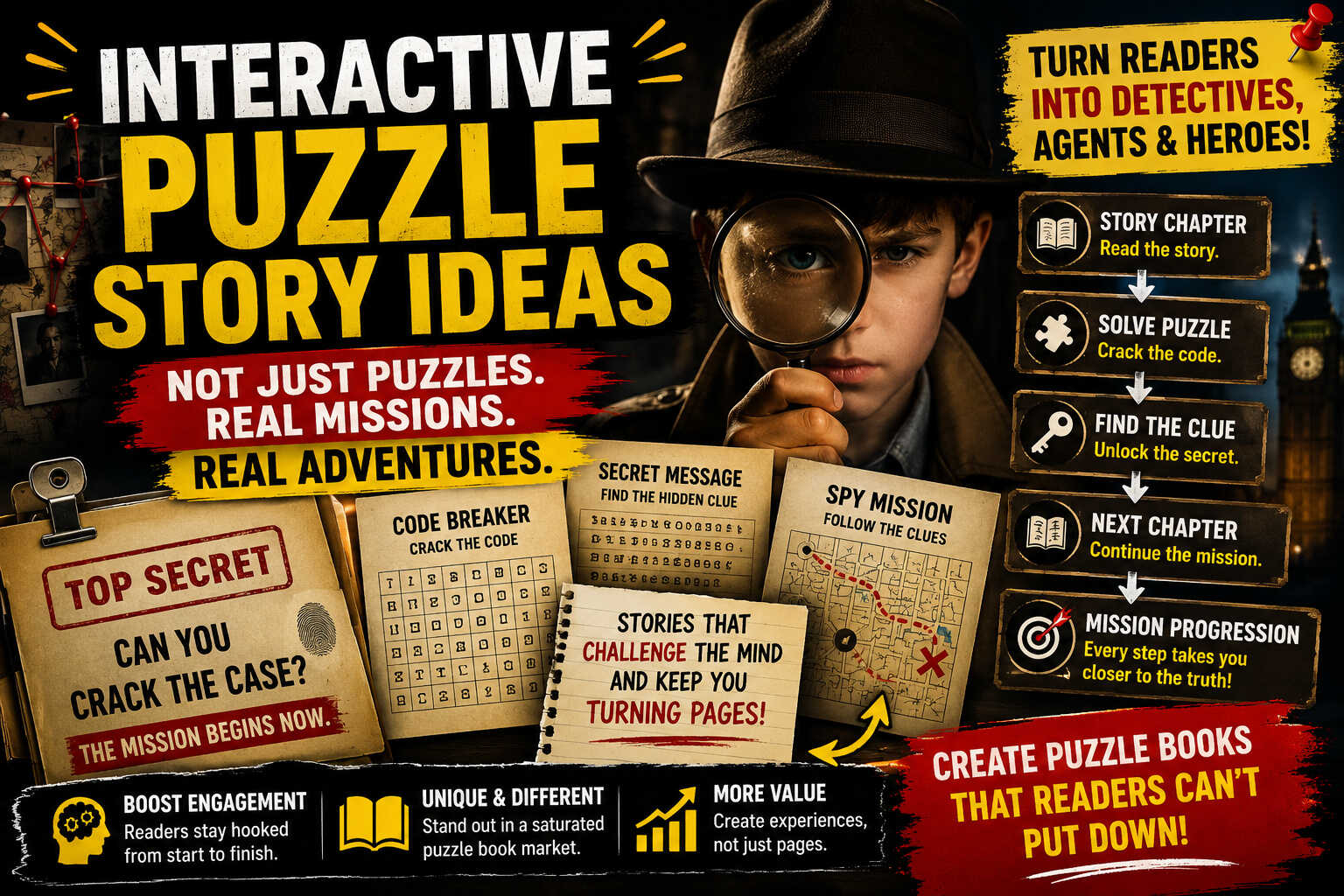
The publishing challenge is real. Traditional puzzle generators are designed for word searches, sudoku, crosswords, mazes. They spit out grids. They don't generate connected experiences. A publisher trying to build a story-driven puzzle book has to do the narrative work manually. They have to weave the puzzles into the plot so the reader doesn't feel like they're alternating between a story and a homework assignment.
While researching how publishers create story-driven mystery and code-breaking books, one of the resources I came across was because it focused on spy missions, detective-style activities, and connected puzzle experiences rather than standalone grids. What stood out was the approach to building a narrative around the puzzles instead of tacking a story onto pre-made formats. The missions weren't isolated. They connected. One solution led to the next objective. That structure is harder to build than a standard puzzle book, but it changes how the reader experiences the material.
Some publishers are using tools that support formats like Cipher Crackers, Secret Message Decoders, Code Breaker Challenges, and Spy Mission Storybooks. From a publishing perspective, these tools matter because they allow for puzzle types that don't fit the traditional generator model. A substitution cipher isn't a word search. A decoder wheel isn't sudoku. These formats require the puzzle and the narrative to be developed together. The tool creates the mechanism. The writer creates the reason the mechanism exists.
The reader exploring examples and publishing approaches related to spy mission books will notice that the best ones don't explain the rules in a separate section. The rules are embedded in the fiction. You're a recruit. Here's your briefing. The message is encoded. Figure it out. That framing does more work than any instruction page.
This is where puzzle story ideas become genuinely different from traditional puzzle books. A crossword tells you exactly what to do. A story-driven puzzle makes you figure out what you're even looking at. Is this a code? Is this a map? Is this a list of suspects or a hidden message? The reader has to engage at a different level. They read more carefully. They look for patterns. They become investigators instead of solvers.
The formats that seem to work best follow a simple structure. Establish the world and the problem quickly. Introduce the first puzzle early, before the reader loses interest. Make the solution feel earned but not impossible. Use the answer to unlock new information. Raise the stakes. Repeat. The reader should never feel like they solved a puzzle just to solve another puzzle. They solved it to find out what happens next.
Detective investigations work well in this format because the reader naturally wants to know who did it. Missing artifact mysteries work because the reader wants to know where it is. Spy missions work because the reader wants to know if the operation succeeds. The puzzle becomes the engine of curiosity.
Traditional puzzle books don't have curiosity. They have completion. You finish the grid. You feel satisfied. You move on. Story-driven puzzle experiences have suspense. You finish the cipher. You learn the location of the safe house. You turn the page to find out if your team got there in time.
I keep thinking about why this matters for publishing. Puzzle books are a stable category. They sell. But they're also interchangeable. A sudoku book from one publisher is functionally identical to a sudoku book from another. Interactive puzzle adventures are harder to replicate. The story is the differentiator. The specific puzzles tied to that story are the differentiator. A reader who gets invested in one series has a reason to buy the next volume. They want to see what case the detective takes next. They want the next mission brief.
This doesn't mean traditional puzzle books are dying. They aren't. But it does mean there's an opening for something else. Readers who want more than grids are looking for interactive puzzle story ideas that give them a reason to stay engaged past the first ten minutes. Publishers who figure out how to build narrative momentum into puzzle formats are creating something that doesn't have a direct competitor on the shelf next to it.
The publishing tools are catching up. The formats are expanding. Cipher-based challenges, hidden message layers, multi-step logic puzzles embedded in prose. These aren't just gimmicks when they're built into the story properly. They're the method by which the reader advances. The reader isn't solving for points. They're solving to turn the page.
That distinction is what makes this category worth watching. Not because it's replacing anything. Because it's offering something that hasn't existed in the puzzle book aisle before. A reason to keep reading. A reason to care about the answer. A puzzle that doesn't end when you fill in the last square, but when you finally understand what the entire story was building toward.
Interactive puzzle stories may become more interesting than isolated puzzle collections for exactly that reason. The puzzle isn't the destination anymore. It's the road. And readers who have spent years turning page after page of disconnected grids are starting to notice there's a different way to get where they want to go.
About the Creator
Smart Energy Saving
power costs, explore alternative energy ideas, and find what actually works in real homes without expensive installations or complicated systems.
Enjoyed the story? Support the Creator.
Subscribe for free to receive all their stories in your feed.
Comments
There are no comments for this story
Be the first to respond and start the conversation.