
Influences on Development
How biology, relationships, culture, and everyday opportunities shape a child’s developing world

If Two children enter the same classroom and receive the same materials and directions. One begins immediately, while the other watches before participating. It would be easy to describe one as confident and the other as hesitant. Yet those descriptions tell us very little about what each child brings to the experience.
Perhaps one has used the materials before. The other may be waiting for a demonstration or trying to understand an unfamiliar routine. Before deciding what either response means, we need to consider the experiences and conditions surrounding it.
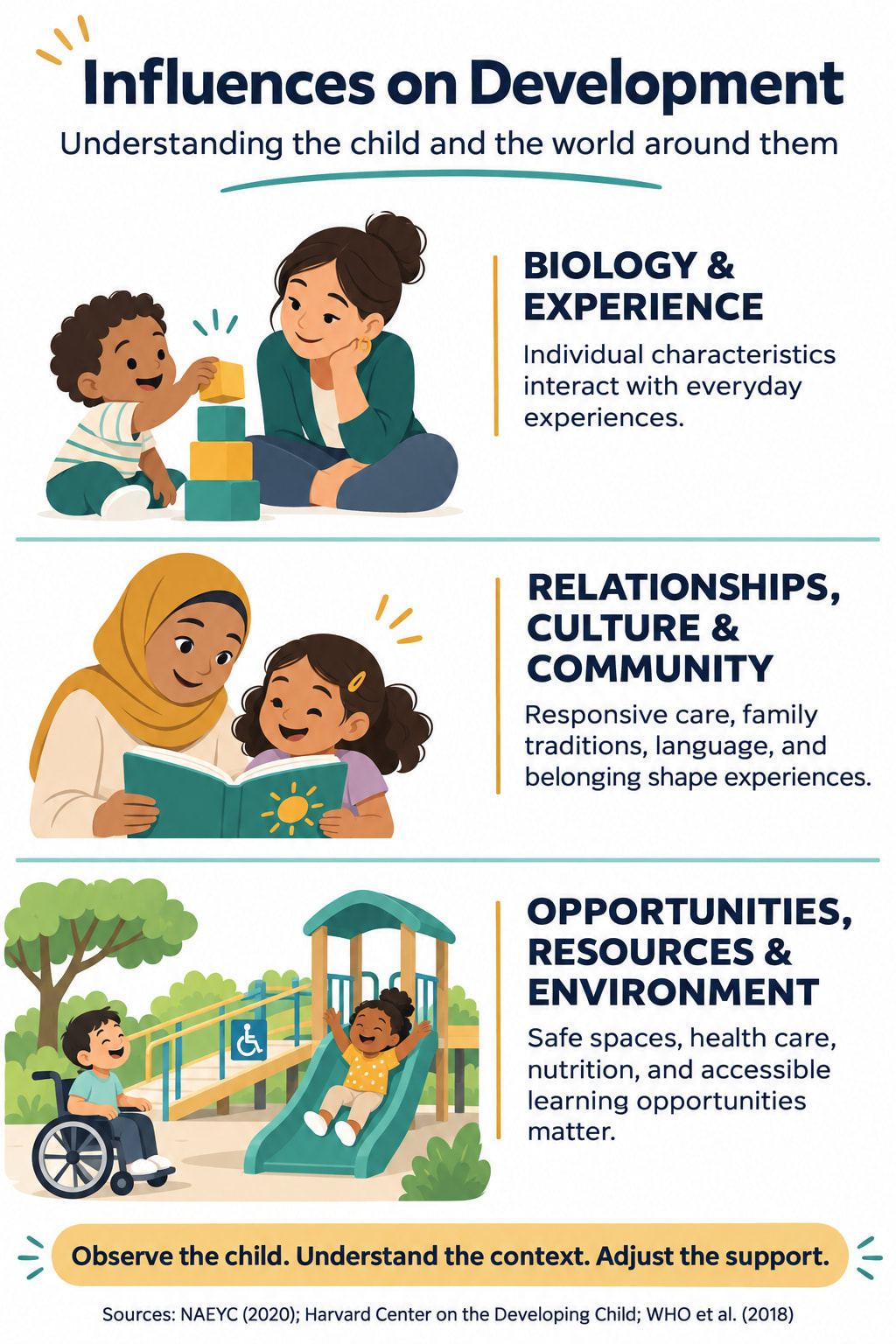
Understanding early childhood development requires this broader view. Children bring individual characteristics into environments filled with people, expectations, resources, and opportunities. The National Association for the Education of Young Children (NAEYC, 2020) explains that development reflects an ongoing interaction between biological characteristics and the environment. Each influences the other over time. NAEYC
For parents, caregivers, and educators, that understanding offers a practical starting point: look closely at the child, then examine the experience we are asking that child to navigate.
Biology and Experience Work Together
Biological influences include inherited characteristics and the developing systems of the body and brain. Experiences include daily interactions, routines, instruction, play, and encounters with the surrounding world. These influences are connected throughout development.
Consider a child learning to use scissors. The task involves physical coordination alongside familiarity with the tool and an understanding of what to do. Watching the child struggle does not immediately reveal which part needs attention.
An adult could begin by demonstrating how to hold the scissors and position the paper. The next attempt might show that the child understands the action but has difficulty managing both materials. Offering a smaller piece of paper could make the task easier to handle.
This example illustrates why I find specific observations more useful than broad labels. “The child opened and closed the scissors but needed help holding the paper” gives an adult something concrete to work with. “The child is not good at cutting” leaves the next step unclear.
The same approach applies when children respond differently to a new activity. An adult can offer a demonstration, allow time to observe, and provide a manageable first attempt. The response gives us information about what to adjust.
Individual differences also deserve respect. NAEYC (2020) emphasizes that development varies between children and across areas within the same child. Age provides context, while a child’s experiences and current abilities help explain the support that may be useful. NAEYC
Imagine two children completing a puzzle. One quickly recognizes where the pieces belong but needs help turning them. Another handles the pieces easily while needing a model for comparing shapes. Both may finish with assistance, but their next learning opportunities would look different.
Relationships Shape Everyday Learning Experiences
Much of early childhood happens in the company of other people. Caregivers explain routines, respond to questions, demonstrate actions, and help children make sense of unfamiliar situations.
The Center on the Developing Child at Harvard University (2017) describes responsive exchanges between children and adults as serve and return. A child signals an interest or need, and an adult responds. These attentive exchanges support developing brain architecture and provide a foundation for learning. Download Resources
Picture a toddler pointing toward a dog outside the window. The caregiver notices and says, “You see the dog. It is running.” The caregiver then pauses. The child might point again, make a sound, or look toward the adult.
There is no need to turn the moment into a vocabulary test. The adult has joined the child’s interest and made room for another response.
A similar exchange can happen during a difficult task. Suppose a child pushes away a container that will not open. An adult could say, “That lid is tight. Watch me turn it,” demonstrate, and offer another attempt. The response acknowledges the difficulty and provides usable information.
I would rather begin with that kind of clear support than repeatedly tell a child to keep trying without showing what might help. Persistence needs somewhere to go. A demonstration gives the next attempt a direction.
Relationships also give adults opportunities to learn about children. A caregiver might notice that a child follows a routine comfortably at home but struggles with a different version at school. Sharing those observations could help the educator introduce a familiar cue or explain an overlooked step.
Culture Gives Experiences Meaning
Culture is present in ordinary routines: the languages people use, how stories are shared, how family responsibilities are organized, and what participation looks like.
NAEYC (2020) recognizes that cultural contexts influence how children demonstrate their abilities and engage in learning. For example, some children have considerable experience observing others before joining an activity, while others are accustomed to frequent direct interaction with adults. NAEYC
Imagine a child who quietly watches a classroom demonstration. An educator might interpret the silence as confusion. A conversation with the family could reveal that watching carefully before participating is familiar to the child.
That information would not answer every question about the child’s understanding. It would give the educator a reason to look more closely before deciding that silence means disengagement.
The practical response could be simple: demonstrate the task, invite participation, and allow the child an opportunity to show understanding through action.
Culture also belongs in the materials we select. Imagine a classroom activity about meals. If every picture shows the same foods, utensils, and seating arrangements, the activity offers a narrow starting point. An educator could invite families to share examples of familiar meals and use those examples when introducing sorting, counting, or descriptive language.
The learning goal can remain clear while the materials connect with a wider range of experiences. Planning begins with asking what children already recognize and how that knowledge can support the next step.
Community Extends the Circle of Support
A child’s world includes places and people beyond home and school. Libraries, parks, health services, neighborhood organizations, and extended family networks can all become part of daily life.
The Center on the Developing Child at Harvard University (n.d.) describes the developmental environment as the full range of experiences and exposures children encounter where they live, grow, play, and learn. This includes relationships alongside conditions such as housing, clean water, and access to green space. developingchild.harvard.edu
Consider a family interested in attending a library story hour. Having a program nearby is one part of access. Transportation, opening hours, language, and accessibility may determine whether the family can participate.
From a planning perspective, this distinction matters. Listing an opportunity does not tell us whether people can use it.
A program could examine attendance patterns, ask families about practical barriers, and consider adjustments. Perhaps offering another session time or providing information in additional languages would make participation more manageable. The appropriate response would depend on what families actually report.
This is one reason community knowledge matters. People who use a service can identify obstacles that are easy to overlook from the planning side.
Opportunities and Resources Influence What Children Can Practice
When we observe a child performing a task, we rarely see the full history of opportunities behind that performance.
Imagine two children asked to use a computer mouse. One has practiced at home; the other is using one for the first time. Their initial performance would offer limited evidence about how either child will learn with instruction.
An educator could explain the controls, demonstrate clicking and dragging, and provide a short practice activity before introducing the main task. This would create a clearer starting point for observing progress.
The same question applies to unfamiliar games, classroom tools, and routines: has the child had an opportunity to learn what we are expecting?
Resources also include the conditions that support daily well-being. The nurturing care framework identifies good health, adequate nutrition, responsive caregiving, safety and security, and opportunities for early learning as connected components of support for young children (World Health Organization et al., 2018). who.int
That framework encourages us to look beyond the activity itself. A carefully prepared lesson is one part of a much larger developmental setting.
Environmental Conditions Deserve Attention
The physical arrangement of an activity is something adults can examine directly.
Imagine a child trying to complete a tabletop task while sitting in a chair that makes reaching the materials awkward. Before introducing additional directions, the adult could adjust the seating and placement of supplies.
Or consider a group activity in a busy room. An educator might try a quieter location, reduce the number of materials presented at once, or demonstrate one step before distributing supplies. These are possible adjustments to observe, rather than guaranteed solutions.
Broader environmental conditions can influence children directly and through their effects on caregivers. Harvard’s Center on the Developing Child (n.d.) emphasizes that housing, environmental exposures, and community conditions belong in our understanding of development. developingchild.harvard.edu
This perspective also changes how I would approach family communication. Before assigning an activity that requires printing, internet access, or purchased supplies, I would examine whether those requirements are necessary. Could the same goal be supported through familiar household objects or materials the program provides?
That question places responsibility on the design of the experience as well as the person participating.
Choosing a More Useful Next Step
Biology, experience, relationships, culture, and environmental conditions overlap in everyday life. An observation rarely tells us which influence explains everything.
What it can do is guide a thoughtful next step. Describe the action, ask about relevant experiences, check the materials, offer a clear demonstration, and watch what happens next.
A child who watches before joining may benefit from time and an invitation. A child struggling with a tool may need an adjusted material. A family unable to attend an event may need a different access option.
Understanding these influences gives adults more precise questions to ask and more purposeful choices to make. The next time a child struggles with an activity, we can begin by looking carefully at both the child and the experience we have provided.
References
Center on the Developing Child at Harvard University. (2017, June 19). 5 steps for brain-building serve and return. https://developingchild.harvard.edu/resources/handouts-tools/5-steps-for-brain-building-serve-and-return/
Center on the Developing Child at Harvard University. (n.d.). What surrounds us shapes us: An expanded story of early childhood development. https://developingchild.harvard.edu/key-concepts/what-surrounds-us-shapes-us/
National Association for the Education of Young Children. (2020). Developmentally appropriate practice: A position statement of the National Association for the Education of Young Children. https://www.naeyc.org/resources/position-statements/dap/contents
World Health Organization, United Nations Children’s Fund, & World Bank Group. (2018). Nurturing care for early childhood development: A framework for helping children survive and thrive to transform health and human potential. World Health Organization. https://www.who.int/publications/i/item/9789241514064
About the Creator
Learning by Design
Instructional Design & eLearning educational articles.
Enjoyed the story? Support the Creator.
Subscribe for free to receive all their stories in your feed.
Comments