
If You Understand These 5 AI Terms, You’re Already Ahead of 90% of People
No technical jargon — just the concepts that actually matter

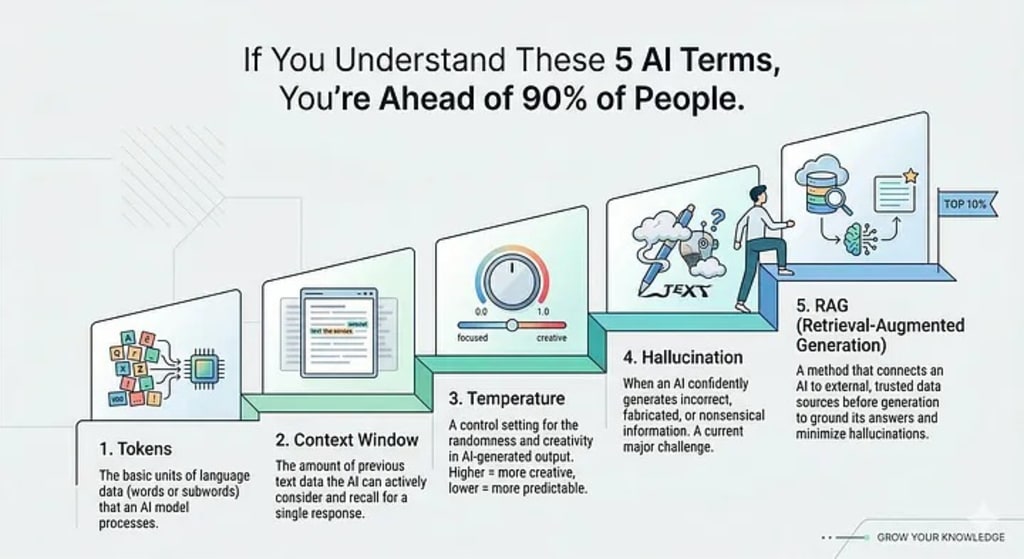
If You Understand These 5 AI Terms, You Are Ahead of 90% of People
Understand the basic concepts of AI without complicated technical jargon.
In today's era, Artificial Intelligence (AI) is no longer just a trendy word—it is changing nearly every part of our lives. Whether it's social media, online shopping, or chatbots—AI is at work everywhere.
But the truth is, most people consider AI difficult, complex, and only for experts.
The reality is quite the opposite.
If you just understand a few basic terms, you can not only understand AI better but also get ahead of most people.
Let's understand these 5 important AI terms in simple language.
1. Machine Learning
If AI is a big idea, then machine learning is its real engine.
Machine learning means that a computer learns from data on its own, without having to be taught everything step-by-step.
Simple example:
Like teaching a child to recognize a cat:
You show it pictures of cats repeatedly
Slowly it learns to recognize itself
In the same way, a computer learns patterns by looking at data.
Where it is used:
YouTube video recommendations
Netflix suggestions
Spam email filters
The more data, the better the performance.
2. Neural Networks
This is an AI system that is inspired by the human brain.
It consists of several layers, where each layer processes information little by little.
Think of it this way:
Suppose you are looking at an image:
First layer: recognizes edges and shapes
Second layer: recognizes patterns like eyes, noses or wheels
Last layer: decides what it is
Uses:
Face recognition
Speech recognition
Image recognition
These make AI more intelligent.
3. Deep Learning
Deep learning is actually an advanced version of machine learning.
It has more layers of neural networks, which is why it is called “Deep”.
Why is it important?
This is the technology that makes today’s AI really powerful.
Where it is used:
Self-driving cars
Voice assistants (like Siri, Alexa)
Chatbots
It enables AI to do difficult tasks.
4. Natural Language Processing (NLP)
This is the technology that enables computers to understand and respond to human language.
In simple terms, it gives AI the ability to “read” and “speak”.
Example:
Mobile keyboard suggestions
Chatbots’ responses
Why is Google Translate difficult?
Why is it difficult?
Human language is very complex:
slang
emotion
humor
incomplete sentences
It's not all easy to understand, but NLP is getting better at it.
5. Generative AI
This is the most popular term today.
Generative AI doesn’t just analyze data—it also creates new content.
What can it create?
Articles and Stories
Images
Music
Videos
Simple example:
Like listening to thousands of songs and creating your own new song.
Why is it important?
It’s changing different industries:
Marketing
Design
Education
Now AI is becoming more than just a tool, but a creative partner.
Why are these 5 terms important?
You might be wondering what’s the point of learning all this?
1. You won’t be confused
AI won’t seem complicated anymore.
2. You’ll make better decisions
You’ll know which technology is really useful.
3. You’ll understand the difference between hype and reality
Not everything that is said to be “AI-powered” is truly advanced.
What to do next?
If you want to go a step further, do this:
Use AI tools
To learn more than just reading:
AI writing tools
image generators
chatbots
Be curious
AI is changing every day—it’s important to stay updated.
Think practical
Always think:
“How will this help me in my work?”
Finally
Understanding AI is not as difficult as people think.
You don’t need a coding or technical degree—just understanding the basic concepts is enough.
Machine Learning, Neural Networks, Deep Learning, NLP, and Generative AI—this is the foundation on which today’s world runs.
And now… you understand them.
That means you’re truly ahead of 90% of people.
The real difference is this:
Now you don’t just hear about AI—you understand it.
About the Creator
Mohib Ullah
I write about crime, justice, and political affairs, focusing on real cases and current events. My goal is to deliver clear, research-based content that informs readers about law, society, and government systems.
Enjoyed the story? Support the Creator.
Subscribe for free to receive all their stories in your feed.
Comments
There are no comments for this story
Be the first to respond and start the conversation.