
I Wanted to Publish a Coloring Book. Then I Saw the Competition
A simple KDP idea led me into some unexpected publishing categories.
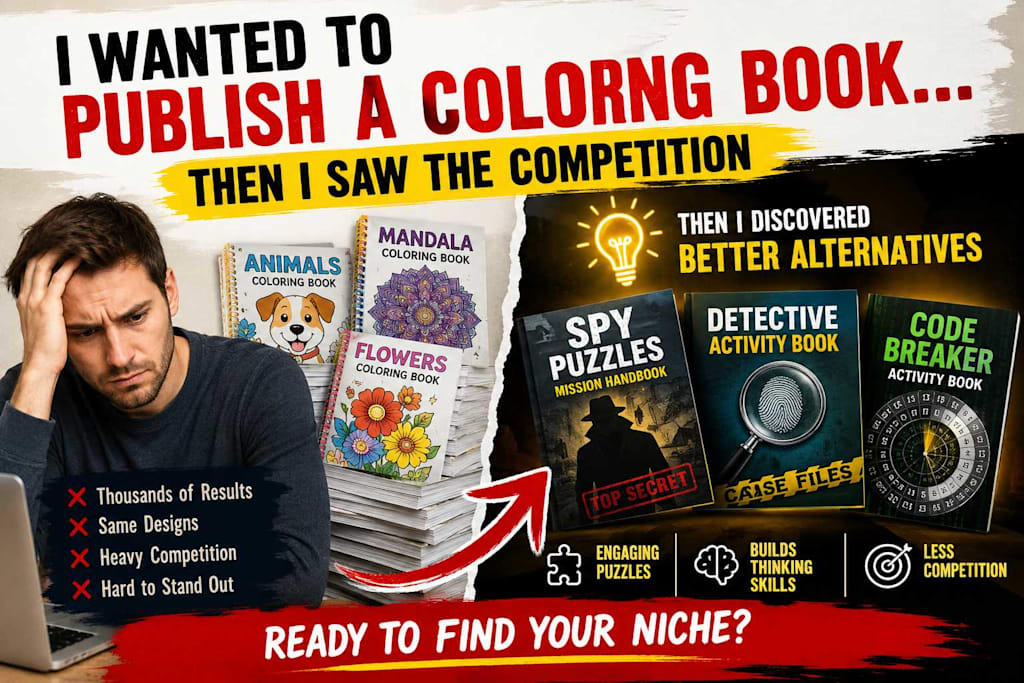
I got the idea sitting in my car outside a Barnes and Noble in late October. The air had that sharp smell of fall and the parking lot was half empty because it was a Tuesday afternoon and most people were still at work. My sister had sent me a text about some guy she knew from college who was supposedly making money selling journals on Amazon.
I didn't care about journals. Never kept one. Never understood the appeal of writing down your feelings in a book that no one reads. But the text stuck in my head because I was bored and I was looking for something else to do with my evenings besides scrolling through my phone until my eyes hurt and my neck got stiff. I started thinking about what I could actually make. Something simple. Something that didn't require me to be a writer or an artist or someone with connections in New York.
I used to draw when I was younger. Nothing good. Just sketches in the margins of notebooks during class. Cars with weird proportions. Faces that looked like potatoes. But I remembered coloring books. Everyone buys coloring books. Kids tear through them in a weekend and ask for another one. Adults use them for stress or whatever reason adults use them. My mom had a stack of them next to her chair for years. She'd color while watching TV. Never finished one completely.
Just picked at pages. I sat there in the parking lot with the engine running and googled how to publish a coloring book right on my phone. The screen was bright against the gray afternoon and the AC was running because the sun was still warm through the windshield. I just kept reading. Amazon KDP coloring books came up first. Low content publishing. Upload a PDF. Set a price. No inventory.
No shipping. No talking to suppliers. No begging stores to carry your product. It sounded like something I could actually do without having twenty thousand dollars or a warehouse or any idea what I was doing. That was the appeal. Low barrier. Low risk. Low everything.
I went home and opened my laptop and started looking at what was already out there. I figured I'd find a niche. Maybe animals. Maybe mandalas. Maybe something for truck lovers or people who like coffee shops or gardeners or people who are afraid of spiders and want to color them into submission.
I don't know. I thought finding a niche would be the fun part. Like picking a flavor at an ice cream shop. But it wasn't fun. It was exhausting. Every category I clicked had thousands of results. Thousands. Not hundreds. Thousands. And the covers all looked like they were made by the same tired person using the same five templates.
Thin spines. White backgrounds. Generic clip art that looked like it was pulled from a free website in 2004. Some had decent reviews. Some had none. But the sheer volume was what hit me first. I kept scrolling and it felt like the same book repeating itself with a slightly different title and a slightly different shade of blue on the cover. I wanted to publish a coloring book because it seemed simple. But simple for me meant simple for everyone else too. That should have been obvious from the start. It wasn't. I had to see it to believe it. I had to scroll through twenty pages of results before the reality sank in.
I spent three nights doing this. Just scrolling Amazon like a zombie. Looking at bestseller ranks. Trying to understand what made one coloring book sell and another one sit there with no reviews, no sales, no hope. I watched some videos on my phone while eating dinner. Read some forums while sitting on the toilet. People talking about KDP publishing like it was this open door that anyone could walk through. And it is.
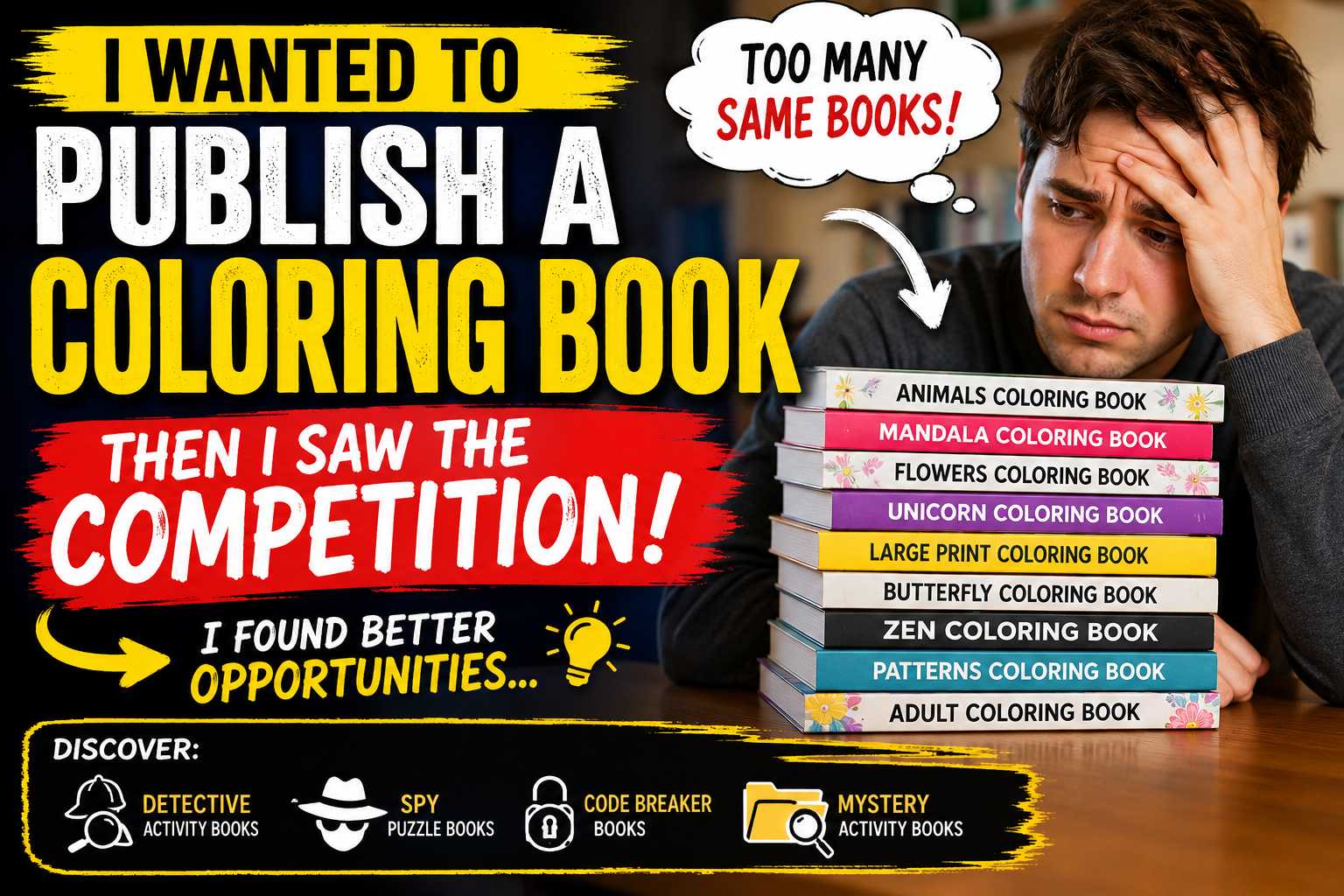
The door is open. Wide open. But the hallway behind it is packed. Shoulder to shoulder. Everyone trying to squeeze through the same narrow space with the same product in their hands. I started feeling this tightness in my chest. Not dramatic. Not like a movie moment where the hero realizes his dream is dead. Just this sense that I was late. Not too late to get in. But too late to get in easily. Too late to show up with a generic animal coloring book and expect anyone to notice me standing in the back of that massive crowd.
I backed up and looked at the broader low content publishing world. Maybe coloring books were just one lane and I was being stubborn. Maybe I could do word search books. I liked word searches as a kid. My grandma always had those big thick books on her coffee table with the spiral binding. She'd do them with a pencil that was almost too short to hold. She'd circle the words and then read the leftover letters to see if they spelled something funny. So I searched word search books on Amazon. Same thing.
Pages and pages. Giant print. Large print. Jumbo print for people who can't see anything. Themed. Unthemed. Every holiday. Every occupation. Every age group from three to ninety-three. The market was full. I checked sudoku books. Even worse. Sudoku books are everywhere. They never die and they multiply. Every airport. Every drugstore. Every online category. Millions of them. Fill-in puzzle books too. Same grid layouts. Same fonts. Same cover designs with old people smiling on the front like completing a fill-in puzzle is the highlight of their week.
I even looked at i spy books. Those visual search books where kids look for hidden objects among a pile of junk. Tons of them. Software-made. Thrown up fast by people who never even looked at the interior. Competing on price down to the penny. Two ninety-nine versus three ninety-nine and the cheaper one wins because the content is basically identical. You can't tell one from the other without opening them.
I started questioning what I was even doing. Not in a motivational poster way. Just honestly. Like, why would someone buy my book instead of the ten thousand others that already exist? I didn't have an audience. I didn't have a brand. I didn't have a cute Instagram following of moms who would buy anything I made because they like my personality or my kitchen backsplash. I was just a guy with a laptop and an idea that thousands of other people already had, most of whom had already uploaded their versions months ago. That stung a little.
I don't like admitting that. But it did. I felt stupid for thinking it would be easy. Not because someone told me it was hard. But because I looked at the numbers and the numbers didn't lie. The shelves were full. The categories were stuffed. The easy money wasn't there. It had already been picked up by people who got there before me.
I took a break for a few days. Didn't look at anything publishing-related. Just worked my regular job and came home and watched TV and tried not to think about it. But my brain doesn't let things go that easy. I kept thinking about it. Not the coloring book specifically. Just the whole thing. This whole side hustle culture. Everyone saying you can make money if you just follow their system. Everyone selling courses about how to make money by making low content books. And then everyone flooding the same categories because the course told them to. It felt like a loop. A crowded loop.
A machine that eats hope and spits out identical books. I didn't want to be another body in the pile. But I also didn't want to quit just because it was hard. I needed to find something that wasn't already picked clean by a thousand other people with the same exact idea. I just didn't know where to look.
I started searching differently. Instead of looking at what was selling the most, I started looking at what was selling well but didn't have as much competition. I know that sounds obvious. But when you're new, you look at the top sellers and you want to copy them. That's the trap. The top sellers are usually there because they got in early or they have an email list or they got lucky during a holiday rush.
Copying them as a nobody is like showing up to a concert after the headliner already played and expecting people to cheer for your cover band. So I started digging into subcategories. Activity books that weren't just blank journals or repetitive puzzles. I started finding these weird little corners that felt like secret rooms in a house where everyone else was crowded in the living room arguing over the same couch.
Mystery activity books. Books where kids solve cases. Detective activity books with fingerprints and clues and suspect lineups. Spy puzzle books with secret codes and invisible ink prompts and mission debriefs. Code breaker books where you decipher messages to unlock the next page. I didn't even know these existed as a category. But they did. And they had reviews. Real reviews. Not just "cute book" or "nice pictures." Parents saying their kids spent hours on them.
Teachers buying them for classrooms. Grandparents saying their grandson wouldn't put it down. Not millions of reviews. But solid. Consistent. Engaged readers who cared enough to write three sentences about why they liked it. That was different. That was alive.
The difference hit me immediately. A coloring book is passive. You hand it to a kid. They color. Maybe they finish it. Maybe they don't. It's fine. It's whatever. But these mystery and spy books were active. The kid had to think. Had to work through it. Had to finish to see what happened next. The engagement was deeper. The parent felt like they bought something educational without it being boring homework. That felt like a real product.
Not just paper with lines or empty shapes waiting for crayons. It felt like something someone could love. Something they remembered. Something they asked for the next one of. That was the thing I had been missing. The connection.
I got obsessed with the idea. Not obsessed in a manic way where I don't sleep. Just kept coming back to it. While driving to work. While waiting for coffee. While sitting on the couch half-watching a show I didn't care about. I started looking at the interiors of these books. How were they made? A mystery activity book isn't just random puzzles thrown together like a salad bar. It needs a story thread. Clues that connect. A progression that makes sense. Detective activity books need case files. Evidence lists.
Suspect profiles. Red herrings. Spy puzzle books need ciphers. Gadget descriptions. Mission briefs that sound official. Code breaker books need different encryption methods. Symbols. Number substitutions. Pattern shifts. This was way more interesting to me than uploading fifty pages of flower outlines or thirty pages of word searches. It felt like making something. Even if it was still low content publishing at the core, it felt like building a tiny world instead of filling a template that ten thousand other people were also filling.
But then I hit the wall. The software problem. I started looking for tools to help make these kinds of books. And almost everything I found was for the same old categories. Word search generators. Sudoku makers. Fill-in puzzle software. I spy layout tools. The standard stuff. The crowded stuff. Nothing for spy missions. Nothing for detective stories. Nothing for code-breaking sequences that build on each other.
I found some generic activity book templates but they were just mixed puzzles. A crossword here. A maze there. A word search on page five and a sudoku on page six. Not a cohesive theme. Not a book that felt like one experience from start to finish. Just a grab bag of boredom. A coloring book at least has a theme. These mixed puzzle books didn't even have that. They were just pages.
I spent another week just looking. Downloading trials that expired in three days. Watching demo videos where some guy talked for twenty minutes without showing anything useful. Reading forum posts from 2019 about software that didn't exist anymore. Most of it was garbage. Or too complicated. Or designed for people who already knew graphic design and could use Illustrator like it was a second language.
I don't know graphic design. I can barely use PowerPoint without making everything look like a ransom note. I needed something that understood the genre. Something built for mystery and spy content specifically. Not a generic puzzle tool that I would have to hack and duct tape into something that resembled a spy book.
While researching how publishers were creating spy and detective-style activity books, one of the resources I came across was because it focused on code-breaking and mystery-based publishing rather than traditional puzzle categories. I'm not saying it solved everything for me. I'm not saying I bought it or didn't buy it. I'm not giving you a review or telling you it's the answer to your problems. I'm just saying it was one of the few things I found that wasn't another word search generator wearing different clothes and calling itself new.
It actually had cipher wheels. Secret message layouts. Mission brief templates. Spy ID cards. Stuff that matched what I was seeing in the successful books. That was rare. Most tools just repackage the same five puzzles and call it an activity book. This at least looked like it understood the category I was actually interested in.
I kept researching beyond that. I wasn't ready to commit to anything. I never am. I like to sit with an idea until it either dies from neglect or demands to be made so loudly I can't ignore it anymore. I looked at more mystery activity books. Read the negative reviews. That's where the real info is. People complaining that the puzzles were too easy and their eight-year-old finished it in twenty minutes. That the story didn't make sense and the clues contradicted each other.
That the book was too short for the price. That gave me a roadmap. I could see what was missing. Detective activity books that actually had a coherent case from start to finish. Spy puzzle books with escalating difficulty so the kid didn't get bored after page three. Code breaker books that taught you the method instead of just giving you the answer key on the next page like a lazy teacher. The gaps were obvious once I knew where to look. And the gaps were everywhere.
I started sketching out a book. Just notes on my phone while waiting in lines or sitting in parking lots. A spy theme. Kid gets recruited by a secret agency. Has to decode messages to find the hidden base. Simple stuff. But connected. Every page matters. Not random. Not filler. I realized that was the other problem with so much low content publishing. Filler. People stretching thirty pages of content into a hundred pages because Amazon's algorithm supposedly likes thicker books. But readers aren't stupid.
Kids especially. They can feel when a book is padded. When the same puzzle repeats with tiny changes. When the author stopped caring on page forty and just copy-pasted the same template with different numbers. I didn't want to make filler. Even if it meant less profit per book. I'd rather make something that gets passed around at recess. Something a kid shows their friend. That feels different. That feels like it matters.
I still don't know exactly what my first book will be. I'm not standing here like an expert who figured it all out and is now going to teach you the system. I'm still figuring it out. I started out wanting to publish a coloring book because it seemed like the easiest door into this whole world. And it is easy. The door is right there. Wide open. But the room behind it is so full you can't turn around without bumping into someone else's mandala book.
Word search books, sudoku books, fill-in puzzle books, i spy books. All the same. All the easy doors. All slammed with people who had the same idea six months ago. I don't want to fight that crowd. I don't have the energy for it. I'm not built for elbowing my way through a thousand identical listings hoping someone accidentally clicks on mine because the thumbnail loaded first.
The weird thing is, I never would have found the mystery and spy categories if I hadn't gone through the coloring book research first. I had to see the dead end to look for the side door. That's how it works sometimes. You don't know what you're actually looking for until you exhaust what you thought you wanted. I wanted simple. Simple was crowded.
So I kept walking. And I found these other categories that feel alive. Less crowded. More interesting to make. More interesting to buy. The readers actually care. They leave detailed reviews. They buy the next book in the series. They ask for more. That matters more to me than being in the biggest category with the most competition.
I think about that parking lot a lot. Sitting in my car. Googling how to publish a coloring book. Thinking I had it figured out in five minutes. I was so sure. And now months later I'm still researching. Still sketching ideas. Still not published. But I'm not discouraged. Not really. I'm just glad I didn't upload another generic coloring book into that pile of sameness. I'm glad I looked longer. Found something that actually excites me. Something that feels like it has room for one more voice. One more story. One more kid who wants to feel like a spy for an afternoon.
Publishing opportunities sometimes appear in places you were not originally looking. I wasn't looking for spy missions or detective cases or secret codes. I was looking for a coloring book. And I found something better. Not because I'm smart. Not because I have some special insight. Just because I didn't stop at the first idea. I kept scrolling. Kept searching. Kept getting annoyed until the annoyance pushed me somewhere else. That's not a strategy. That's not a hack. That's not a framework. That's just what happened. And sometimes that's enough.
About the Creator
Brooks Ghost Max
I'm just a running shoe geek with a serious addiction to foam. My current obsession? The Brooks Ghost Max. I spend my days analyzing stack heights and heel drops to help you decide if that $150 price tag is actually worth it.
Enjoyed the story? Support the Creator.
Subscribe for free to receive all their stories in your feed.
Comments
There are no comments for this story
Be the first to respond and start the conversation.