
I Thought Teaching Was Just Standing at the Lectern. Then I Learned Where the Real Work Happens.
A teacher’s honest letter to new teachers about health, boundaries, the stories no one sees, and why you can’t save everyone.
Beyond the Lectern
Before I entered the profession, I thought a teacher’s life was bells, textbooks, and chalk dust.
Later I learned that the bell is only the beginning. Most of the work happens outside the bell.
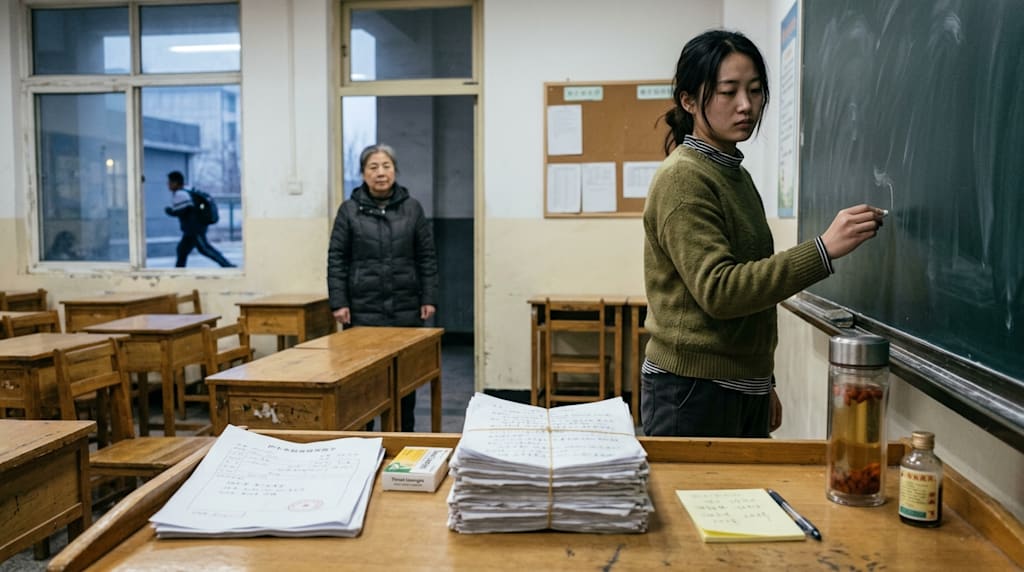
I arrive at school at 6:30 a.m. and am still replying to parents at 10 p.m. There are three things on my desk: a physical exam report, throat lozenges, and a stack of ungraded essays. The older teachers keep goji berries in their thermoses. The younger teachers keep stomach medicine in their drawers. When the dismissal bell rings, the students rush out. I sit behind the lectern, write the name of the child who was daydreaming on a sticky note, and think about how to pull him back next class.
Before I became a teacher, I thought the most important thing was to teach well. Of course you have to teach well. But teaching well is only the basic skill. A teacher’s ability is pulling attention back when a student’s mind drifts, steadying the class when it falls into chaos, saying things clearly when parents are anxious, and still walking into the classroom when you can barely hold on.
You don’t just teach knowledge. You manage emotions, discipline, relationships, and boundaries. Many times, you are not teaching. You are catching.
But you can’t catch everyone.
In my first few years of teaching, I did home visits. I visited the homes of almost all my early students. Back then I always thought that if I understood a little more and helped a little more, maybe I could change something. Later I learned that a teacher is only a teacher. Teaching and guiding students inside the school is already the job. Outside the school, there is much you cannot interfere with, and should not interfere with. People can mistake that boundary for coldness. It is a limit. Some causes and consequences are too heavy for one person to carry.
I have remembered my senior colleague’s story for many years.
She taught elementary school. In her first year, she had a child with intellectual disabilities. The whole class excluded him, and he could not manage going to the bathroom by himself. He often relieved himself right there during class. No teacher or classmate could easily like a child like that. But out of a first-year teacher’s sense of responsibility, my colleague took care of him for a whole year. His grades did not improve, but at least he learned some basic self-care. She thought that after the second year’s class reassignment she would be free. When the reassignment came and the child was not in her class, she was happy. But the parents pulled strings and had the child transferred back into her class. The other subject teachers complained, but at the compulsory education stage, there was no way around it. The child’s parents understood that other teachers would reject their child, so in the third year, they again found a way to keep him with her. My colleague was helpless. In the fourth year, she voluntarily transferred to teach first grade, and only then was she free.
She later told me that what she feared most in those years was not washing his pants. It was that every time the class list came out, she would look for that name first. If she found it, her heart sank. If she didn’t find it, something still felt wrong. In the fourth year, she transferred to first grade. When the list came out, the name was not there. She sat in the office, rested her hand on the list, and said nothing. After a long while, she went to wash her hands.
That was when I understood: being good to students has to be within your limits.
“Don’t be too good to your students” is easy to misunderstand. It doesn’t mean be cold-blooded. It means don’t mistake unlimited responsibility for love. You can care. You can help. But you cannot burn yourself as fuel. Rules come before warmth. Fairness comes before favoritism. Once the system assumes you will always catch everything, the one dragged down in the end is often you. If you collapse, your students may not be saved either.
Another thing that shook me was the classes of older teachers.
Older teachers are a strange, almost magical presence. The same students, the same knowledge points, the same explanation methods, and yet an older teacher can make the children understand more clearly. No matter how chaotic the class, when an older teacher walks in, the students settle down on their own. That authority has no physical form. It still fills the room. Like Zhang Liao, whose name was said to stop children from crying. Impossible to explain, but it works.
My aunt taught first and second grade her whole life. Many children who gave others headaches were fine as soon as she stood there. No matter how difficult the child, two words from her and they settled down. But the same thing did not work on her own grandson. He called her Grandma, not Teacher.
Later, after I had sat in on many classes, I began to understand: when new teachers listen to older teachers’ classes, the key is what they don’t teach. When they pause. When they leave silence. When they pull the children’s attention back. When they let the children relax. These are the things most easily overlooked. Children are not ducks to be force-fed. You cannot keep talking and expect them to keep absorbing. Every teacher has seen a whole class with their minds drifting off. The key is how you call their souls back without making a show of it.
I once saw an older teacher walk into a classroom without saying a word. She looked at her watch and waited three seconds. After three seconds, the class quieted down on its own. She didn’t shout “Quiet!” She didn’t bang the desk. She simply opened the textbook and paused. That pause was her lesson.
Later still, I began to pay attention to my health.
In your first few years, the school usually organizes a physical exam for all teachers. Don’t think you’re young and skip it. Being young is the most dangerous time. Older teachers are less likely to have problems. They have seen almost everything over the years. Their edges have been smoothed. The absurd things that happen in schools have become ordinary to them, so their mindset is better. Young teachers, though, every year there are young teachers hiding in my office crying. In recent years, the teachers at our school whose exams turned up problems have mostly been young teachers. There are more liver nodules. Why so many liver nodules? Anger damages the liver.
It sounds like a joke. It is written in blood and tears.
I saw a young teacher whose exam report showed a nodule on her liver. The doctor asked her, “Do you get angry often?” She said, “No. There are just ten things a day to be angry about.” The doctor didn’t respond, just lowered his head and wrote in the chart. She folded the report, put it in her bag, went back to school, and kept teaching. That afternoon, two students in her class fought, and a parent argued on the phone for forty minutes. She hung up, sat in her chair, peeled a throat lozenge, and put it in her mouth. The lozenge was sweet. She didn’t cry.
When a young teacher cried in the office, the older teachers usually didn’t try to console her. They handed her a cup of tea, set it on the desk, and walked away. The one crying wiped her face, touched up her makeup, and went into the classroom. The bell rang. The class could not stop.
If I could give new teachers one bit of advice, I would say:
First, your health matters most. Don’t skip the physical exam. Don’t shortchange sleep. Don’t stay angry too long. You may think it’s dedication; your body will keep the bill.
Second, don’t be too good to your students. Do what you can. Don’t easily promise, “I’ll always take care of this.” Don’t carry every special need alone. Keep a record of important communications. Protecting yourself is also protecting your students.
Third, sit in on older teachers’ classes. Listen to how they don’t speak, how they pause, how they leave silence, how they pull attention back. Those things are worth more than lesson plans.
Fourth, in your first year, don’t chase perfection. Chase stability. Stand firm in the classroom, hold your boundaries, and find colleagues and mentors you can ask for help. Crying isn’t shameful. Carrying it all alone is what’s dangerous.
Fifth, remember you are only a teacher. What you can be responsible for is often just a limited stretch of a student’s life. When they pass through your hands, you can give them a little stability, a few methods, a bit of kindness. But many family causes and consequences, many paths of growth, you cannot interfere with or change. People can mistake that boundary for coldness. It is a limit. That limit is part of the job.
Teacher’s Day is coming. I used to think this holiday was meant to praise teachers. Later I came to feel it is more like a reminder: teachers are ordinary people too. They get tired, cry, get sick, doubt themselves, and ask late at night whether they are suited to this. But the next day, when the bell rings, they still have to walk in.
The day before school started, I arranged the desks and chairs and wiped the blackboard clean. I tucked the physical exam report into a drawer and put throat lozenges in my pocket. Outside the window, a student ran past and called, “Hello, teacher!” I turned around. They were already far away.
The bell rang.
I walked in.
See you tomorrow.
About the Creator
Jin
Writer of reamstories
https://reamstories.com/jin
Enjoyed the story? Support the Creator.
Subscribe for free to receive all their stories in your feed. You could also become a paid subscriber, letting them know you appreciate their work.
Comments
There are no comments for this story
Be the first to respond and start the conversation.