
How to Teach Letter Sounds to Struggling Students: What Finally Worked for My Daughter
After months of flashcards, frustration, and trial and error, these research-backed strategies finally helped my daughter connect letters to sounds and start reading with confidence.

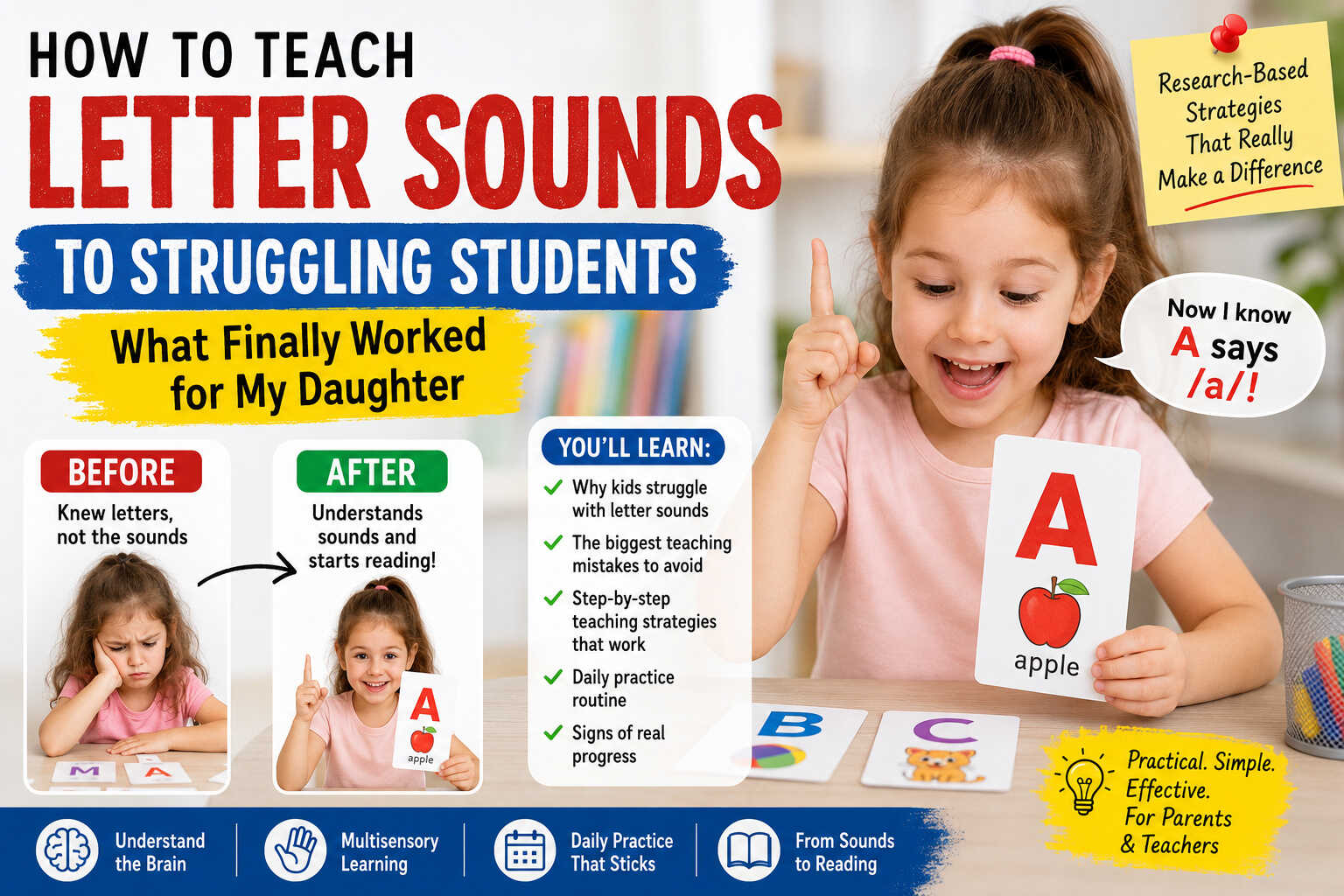
If you are trying to figure out how to teach letter sounds to struggling students, you are probably where I was three years ago. My daughter knew every letter in the alphabet by age four. She could sing the song. But when I pointed at a letter and asked what sound it made, she stared at me like I had asked her to solve calculus. The alphabet song was just a song. The letters were just shapes. The sounds? Those were invisible.
Since then I have spent hundreds of hours reading educational research, talking to teachers, watching my daughter struggle and slowly improve, and trying different approaches until I understood what actually works. I want to share what I learned. Not because I am an expert. Because I was the parent who needed this information and could not find it written in plain language.
Why Some Kids Cannot Connect Letters to Sounds
Here is what I did not understand at first. Letter recognition and letter sound correspondence are not the same skill. A child can look at the letter B and say "that is B" without having any idea that B makes a /b/ sound. That gap is where a lot of struggling readers get stuck.
The brain processes visual symbols and auditory sounds through different pathways. Connecting them requires a deliberate bridge. Some children build that bridge naturally. Others need it built for them, step by step, with explicit instruction that leaves nothing to chance.
I used to think my daughter was not trying hard enough. I was wrong. She was trying. Her brain just had not developed the phonemic awareness needed to hear, isolate, and attach sounds to symbols. That is not a motivation problem. That is a wiring problem. And wiring problems get solved with the right teaching, not with more pressure.
The Mistakes I Made at Home
I made every mistake possible. I bought alphabet flashcards and drilled her daily. I pointed at letters during dinner and asked for sounds. I got frustrated when she forgot a sound she had supposedly learned the day before. I treated letter sounds like vocabulary words. If you repeat them enough, the child memorizes them. That is not how early reading skills develop.
I taught too many sounds at once. I mixed uppercase and lowercase without explaining they were the same sound. I moved on when she got a sound right once, assuming she had learned it. I never connected the sound to anything meaningful. No word. No context. Just "what sound does this make?" over and over until we both hated it.
Most parents and even some teachers make these mistakes. Not because they are bad at teaching. Because nobody ever explained how memory for letter sounds actually forms.
Why Memorization Alone Fails
My daughter could sometimes say the right sound when I showed her a letter card. But if I asked her the next day, or if the letter appeared in a different font, she drew a blank. She had not learned the sound. She had memorized a flashcard. That is a completely different thing.
Recognition and recall are not the same. When a child looks at a letter and says the sound because they have seen that exact card fifty times, that is recognition. Real learning means they can retrieve the sound from memory without the visual prompt. That requires retrieval practice, not just exposure.
I also learned that cognitive load matters more than I thought. When you dump twenty-six letter sounds on a child at once, their working memory gets overwhelmed. The brain starts dumping what it cannot process. That is why fewer sounds, taught deeply, work better than the whole alphabet taught shallowly.
How Memory for Letter Sounds Actually Develops
I had to stop thinking about letter sounds as facts to memorize and start thinking about them as skills to build. Skills need practice, context, and time.
The brain stores letter sounds more securely when multiple senses are involved. A child who sees the letter, says the sound, traces the shape, and connects it to a word they know is building stronger neural pathways than a child who just looks at a flashcard. That is why multisensory learning works. It is not a teaching gimmick. It is how the brain encodes information for long-term memory retention.
I also learned about spaced repetition. Cramming does not work for letter sounds. Five minutes every day for two weeks beats thirty minutes once a week. The brain needs repeated encounters with information, spaced out over time, to move it from short-term to long-term storage. That is why daily repetition alone is sometimes ineffective. It is not about repeating. It is about spacing.
Another thing I missed: blending. Teaching a child that C makes a /k/ sound and A makes an /a/ sound is useless if they cannot blend those sounds into "ca." Blending is the skill that turns isolated sounds into reading. And it does not develop automatically. It needs direct teaching.
What the Research Actually Says
Explicit instruction means teaching something directly, clearly, and systematically. You do not assume the child will figure it out. You show them. You explain. You model. You guide. You practice. That is the opposite of the discovery-based approach I had been using, where I showed a letter and hoped she would somehow connect it to a sound.
Structured literacy means teaching reading in a logical sequence. You start with simple, consistent sounds. You build. You do not jump around. You teach a small set of sounds, practice blending them, and then add more. This reduces confusion because the child is never drowning in too much new information at once.
Phonemic awareness is the ability to hear and manipulate sounds in spoken words. A child who cannot hear that "cat" has three separate sounds will struggle to connect those sounds to letters. That is why phonemic awareness activities should happen alongside letter sound teaching. Not after. Integrated.
Phonics is the method of teaching reading by correlating sounds with letters or groups of letters. When taught systematically, phonics gives struggling learners a reliable tool for decoding words instead of guessing. That is why structured phonics instruction matters for kindergarten literacy and beyond.
A Step-by-Step Approach That Worked
Here is what I ended up doing. It took months, not days. But it worked.
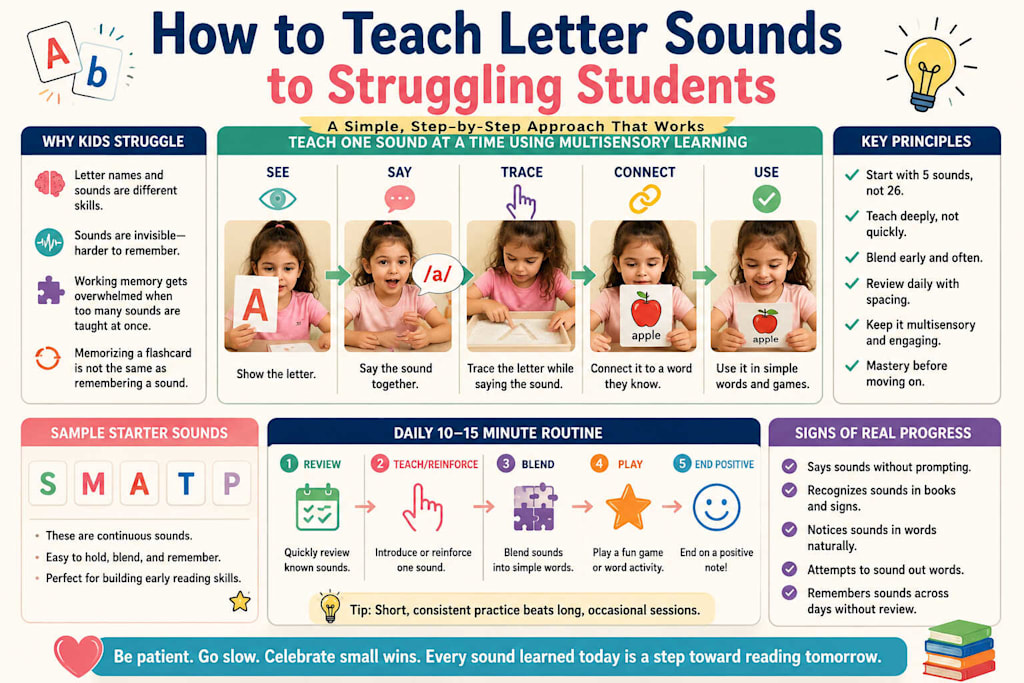
Start with five sounds. Not twenty-six. Five. Pick sounds that are visually distinct and easy to pronounce. I started with S, M, A, T, and P. These are continuous sounds, meaning you can hold them out without adding an extra vowel sound. That matters because it makes blending easier later.
Teach one sound at a time. Show the letter. Say the sound. Have the child say the sound. Have them trace the letter while saying the sound. Connect it to a word they know. "M says /m/ like mommy." Do not move on until they can say the sound without hesitation, in different contexts, on different days.
Add a new sound only when the previous ones are solid. I thought progress meant moving forward. Real progress means mastery. If your child knows three sounds cold, that is better than knowing ten sounds poorly.
Once you have five sounds, start blending. Make simple words. "Sam." "Mat." "Pat." Do not worry about spelling rules yet. Just get them connecting sounds into words. This is where reading readiness turns into actual reading.
Then add more sounds, five at a time. Keep reviewing the old ones. Keep blending. Keep connecting sounds to real words. This is systematic instruction. It is slow. It is boring for adults. It is exactly what struggling learners need.
A Simple Daily Routine for Home Practice
We did this for ten to fifteen minutes a day. No more. Longer sessions do not help. They tire the child and create resistance.
Start with review. Quick flash through known sounds. If they hesitate, spend extra time on that one. Do not rush.
Introduce or reinforce one new sound if they are ready. Use the multisensory approach. See it, say it, trace it, connect it to a word.
Practice blending with known sounds. Make up words. Use letter tiles or magnets. Let the child physically move the letters together as they say the sounds. That physical movement helps anchor the skill.
End with something fun. A simple game. A word hunt around the house. A silly sentence using the sounds they know. The goal is to end on a positive note so they want to come back tomorrow.
Do this every day. Not most days. Every day. Spaced repetition only works if the spacing is consistent.
Signs Real Progress Is Happening
I learned not to trust a single correct answer. Real progress looks like this.
The child says the sound without prompting, not just when you point at the letter but when they see it in a book or on a sign. That is transfer. It means the learning is generalizing beyond the flashcard.
They start noticing sounds in words without being asked. "Hey, that says /t/ like turtle." That is phonemic awareness developing alongside letter knowledge.
They attempt to sound out words, even if they get them wrong. The attempt matters more than accuracy at this stage. It means they understand that letters represent sounds and sounds can be combined.
They remember sounds from previous days without review. That is when you know the memory is sticking.
Progress is not linear. Some weeks nothing seems to happen. Then suddenly they put three sounds together and read a word for the first time. That moment is worth every boring ten-minute session.
Why Repetition Sometimes Does Not Work
I used to think if my daughter forgot a sound, we just needed to repeat it more. That is not always true.
Repetition without engagement does not build memory. If a child is mindlessly reciting sounds while thinking about something else, the brain is not encoding anything. Active participation matters.
Repetition without context does not build memory either. A child who says /b/ fifty times in isolation may still not recognize /b/ in the word "bat." The sound needs to be connected to real reading and real words.
And repetition without spacing is basically cramming. The brain needs time between encounters to consolidate. That is why daily short practice beats long occasional sessions. It is also why a child can seem to know a sound on Tuesday and forget it by Thursday. The memory has not had enough spaced encounters to solidify.
When Structured Instruction Becomes Important
If you have been trying informal letter sounds activities at home and your child is still struggling after a few months, it may be time to look at structured literacy programs. Not because you failed. Because some children need a level of organization and sequencing that is hard to create from scratch as a parent.
Structured literacy programs use explicit instruction, systematic sequencing, and built-in review. They do not leave gaps. They do not assume the child will figure out patterns on their own. They teach every step deliberately.
While trying to understand how educators organize these teaching stages, I ended up reading an educational guide that broke down the sequence in a way that helped me connect everything I had been learning. The guide is at It was not a product recommendation. It was just a resource that showed me how systematic teaching looks when someone has already mapped out the progression from single sounds to full reading.
After that, I became curious how different structured reading approaches compared with one another, so I continued reading a detailed review that examined one program alongside the educational principles I had already been learning. That review is at Again, this was research. Not a sales pitch. Just me trying to understand the landscape after realizing my daughter needed more structure than I could provide on my own.
Practical Takeaway
If you are teaching letter sounds to a struggling student, here is what to do tomorrow.
Pick five sounds. Choose continuous sounds like S, M, A, T, P. Teach one at a time using see-say-trace-connect. Do not add a new sound until the current ones are solid. Practice blending every day, even if it feels too early. Keep sessions short. End on a positive note. Be patient. Trust the process.
That is it. No special tools required. No expensive program needed to start. Just a clear sequence, consistent practice, and the willingness to go slower than you want to.
FAQ
How do you teach letter sounds to struggling readers?
Start with five continuous sounds taught one at a time using a multisensory approach. Have the child see the letter, say the sound, trace the shape, and connect it to a familiar word. Only add new sounds after the current set is mastered. Practice blending daily. Keep sessions short and consistent.
What is the best order to teach letter sounds?
Start with sounds that are continuous and easy to pronounce, such as S, M, A, T, P. These can be held out without adding an extra vowel sound, which makes blending easier. Teach five sounds at a time before adding more. Build from simple to complex.
Why do students struggle with letter sounds?
Some children have not yet developed the phonemic awareness needed to hear and isolate individual sounds. Others are overwhelmed by too many sounds taught at once. Recognition and recall are different skills, and many children appear to know a sound when they have only memorized a flashcard. The brain needs explicit instruction to connect visual symbols to auditory sounds.
How can I help a child remember letter sounds?
Use multisensory methods that engage sight, sound, and touch. Connect each sound to a meaningful word. Practice daily in short sessions. Use spaced repetition rather than cramming. Ensure the child can retrieve the sound without prompting before moving on. Connect sounds to real words and real reading.
Which activities improve letter sound recognition?
Tracing letters while saying sounds, using letter tiles for blending, word hunts around the house, and simple games that connect sounds to real words. The key is active participation and connecting sounds to context, not just isolated repetition. Physical movement like moving letter tiles together helps anchor the skill.
Why does not repetition always work?
Repetition without engagement, context, or proper spacing does not build lasting memory. The brain needs active encoding, meaningful connections, and time between practice sessions to consolidate information into long-term memory. Mindless recitation does not create neural pathways. Spaced, engaged, contextual practice does.
Conclusion
Learning how to teach letter sounds to struggling students changed how I think about reading entirely. I used to believe that some kids pick it up naturally and others do not. Now I believe that every child can learn letter sounds if they are taught in a way their brain can process. That means explicit instruction, systematic sequencing, multisensory engagement, and patience.
My daughter reads now. Not fluently. Not without effort. But she can sound out words, blend sounds, and recognize letters in context. That started with five sounds, ten minutes a day, and a parent who finally stopped trying to speed things up and started trying to understand how learning actually works.
If you are in the middle of this struggle, keep going. Slow down if you need to. Teach fewer sounds. Connect everything to something real. And trust that the small daily steps are building something bigger than they look.
About the Creator
Understandshe
I write about healing, self-growth, and the messy but beautiful journey of becoming. Honest lessons, real stories, and gentle insights you’ll also find on UnderstandShe.
Enjoyed the story? Support the Creator.
Subscribe for free to receive all their stories in your feed.
Comments
There are no comments for this story
Be the first to respond and start the conversation.