
How to Teach Alphabets to Preschoolers in a Fun Way (Without Flashcards or Worksheets)
Simple Play-Based Alphabet Activities That Help Preschoolers Learn Letters Naturally at Home

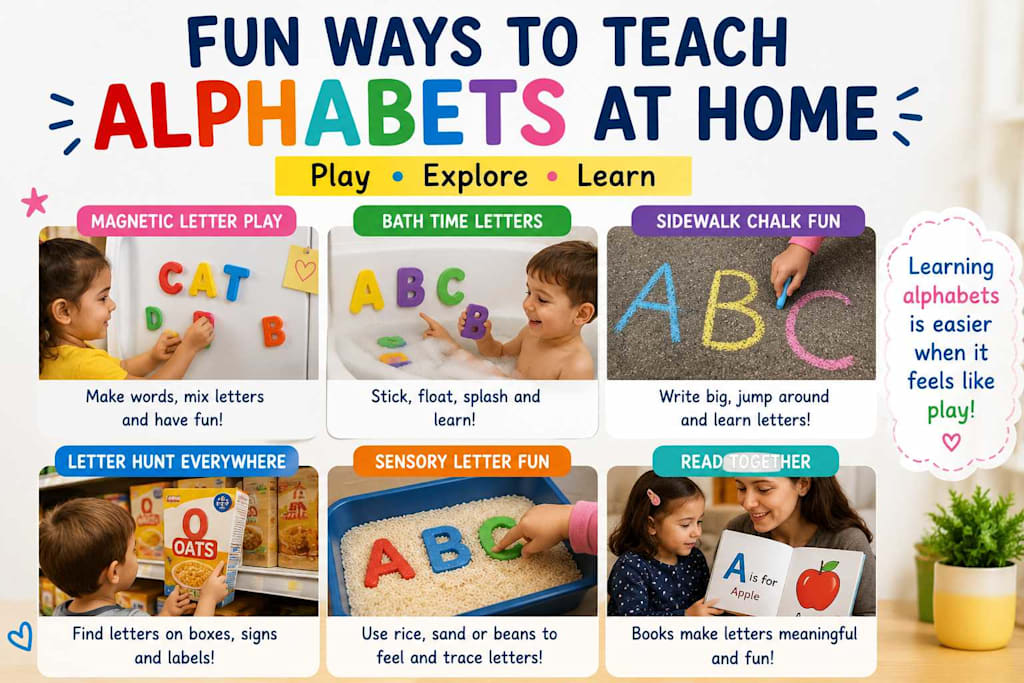
My daughter was standing on a kitchen chair, reaching for the cereal box on the counter. She was three, barely tall enough to see over the edge, and she grabbed the Cheerios box and stared at the big yellow O on the front. "That's my letter," she said. I didn't know what she meant. "My letter. O. Like my name. Olivia." She wasn't reading. She wasn't even close. But she had noticed that one circle on a cereal box and connected it to herself. That was the first time I realized she was already learning letters without me doing anything formal at all.
A few months before that, I had bought a set of alphabet flashcards from the dollar store. I sat her down at the kitchen table, spread them out, and pointed at A. "This is A. A says ah." She looked at the card, looked at me, and pushed the whole stack onto the floor. I tried again the next day. Same result. By day four she saw the flashcards come out and walked away. I was frustrated. I thought I was doing something wrong. Every parenting blog said to practice letters daily, so I kept pushing. She kept resisting. The more I tried to "teach" her, the less she wanted anything to do with the alphabet.
That cereal box moment changed how I thought about the whole thing. She didn't need a lesson. She needed a reason to care about a letter. The O mattered because it was hers. It was on something she ate every morning. It wasn't abstract. It wasn't on a card in front of her face. It was real, it was connected to her world, and she found it herself.
After that I stopped setting up alphabet time. I stopped buying workbooks. I stopped trying to make her sit still and repeat after me. Instead I started watching where letters already showed up in her life and I started using those moments. Not as lessons. Just as part of what we were already doing.
The magnetic letters on our refrigerator became something different. Before, I had arranged them in alphabetical order and expected her to look at them. She ignored them. Then one day I started making nonsense words while she was eating her snack. I spelled out "MOM" and pointed to myself. I spelled "DOG" and pointed to our actual dog sleeping on the rug. She didn't care about the spelling. But she noticed that those shapes meant something. She started moving the magnets around herself. She made a row of all the same letter and laughed. She put a B next to an R and asked what it said. I told her it said "burr" and she giggled because it sounded funny. That was it. No quiz. No correction. Just playing with shapes and sounds.
Bath letters were the same. I bought a set of foam letters that stuck to the tub wall and at first she just threw them in the water and watched them float. Then she started sticking them up in order, not alphabetical order, just whatever order she felt like. She put a J next to a T next to an M. I asked her what word that made. She said "juh-tuh-muh" and laughed so hard she got water in her mouth. But she was hearing the sounds. She was connecting the shape to a noise. That is what letter recognition actually looks like at three years old. It doesn't look like a child sitting quietly and reciting the alphabet. It looks like a wet kid in a bathtub making up nonsense words and having fun.
We started a simple game at the grocery store. I called it "find your letters." Every time we walked down an aisle I would point to a product and ask if she saw any letters from her name. She got excited when she spotted an L on a bag of chips. She yelled "I found it!" loud enough that a woman in the next aisle looked over. I didn't care. She was looking at packaging. She was noticing letters in the wild. That was more useful than any flashcard session I had tried to force at home.
Sidewalk chalk became another tool without being a tool. We drew big letters on the driveway and she jumped from one to the other. I would call out a letter and she would run to it. Sometimes she got it wrong and jumped on the wrong one. I didn't correct her. I just called out another one. She was moving her body, she was outside, she was engaged. The learning was buried inside the game. She didn't know she was practicing letter recognition. She thought she was playing a jumping game.
The key with all of this was keeping it short. I never spent more than five or ten minutes on any of these activities. Sometimes it was two minutes. She would lose interest and I would let her. That was the hardest part for me. I wanted to keep going. I wanted to squeeze more learning out of every moment. But preschoolers don't work that way. Their brains are built for short bursts. The second it starts feeling like work, they shut down. I had to learn to quit while she was still having fun. That meant walking away from the magnetic letters while she was still moving them around. It meant stopping the grocery store game after three or four letters, not ten. It meant putting the sidewalk chalk away before she got tired of it.
I also stopped worrying about whether I should teach letter names or sounds first. I had read articles that said sounds were more important for reading. Other articles said names first. I drove myself crazy trying to decide. Then I noticed my daughter was picking up both at the same time without me planning it. When she saw the letter S on a stop sign she said "S, sss, like snake." She didn't know which was the name and which was the sound. She just knew that shape made that noise. That was enough. The experts could argue about the order. My kid was doing fine without the debate.
I made one big mistake early on that I want to mention because I see other parents doing it too. I tried to teach too many letters at once. I would pull out five or six flashcards and expect her to learn them all in one sitting. That overwhelmed her. When I switched to just focusing on one or two letters at a time, and only the ones that showed up in her life naturally, she remembered them better. We spent a whole week just noticing the letter T because her favorite toy was a truck. Every T we saw that week was exciting because it was connected to something she loved. That one letter stuck. Then we moved on. There was no rush. The alphabet has been around for a long time. It will still be there next week.
Another thing that helped was letting her teach me. I would pretend I didn't know what a letter was and she would tell me. She loved being the expert. I would hold up a block with a letter and say "I forget, what is this one?" She would shout the answer and feel proud. That confidence mattered more than whether she actually knew every letter perfectly. I wanted her to feel like letters were something she could figure out, not something an adult had to explain to her.

As she got a little older, around four, I started wondering if the playful approach was enough. She knew most of her letters by then, but not in any organized way. She knew the ones that mattered to her. She knew O for Olivia, T for truck, D for dog. But she didn't know Q or X or some of the less common ones. I started thinking about whether we needed something more structured.
I looked into different phonics programs and how they organized letter introduction. Some started with the most common sounds. Some grouped letters by shape. Some used stories to connect letters to sounds. I spent time reading about how a structured curriculum builds from simple sound awareness into full letter recognition rather than expecting kids to memorize the whole alphabet at once. That made sense to me because it matched what I had already seen work with my daughter. She learned letters when they were connected to sounds she already knew, not when they were presented in order on a chart.
I came across a breakdown of how one particular program organized its phonics progression and lesson structure while I was researching different approaches. The page at laid out how some structured curriculums move from basic sound awareness into letter recognition step by step, which helped me understand why my daughter had responded better to hearing sounds first than to seeing letters in isolation. Reading about how a formal program sequences its lessons gave me a better sense of what natural letter learning might look like if it had more direction behind it.
That research led me to look at a few different opinions on whether a structured phonics program made sense for a family that was already doing well with playful learning at home. I found a discussion of one program's strengths and limitations that helped me separate the marketing language from what would actually matter for our situation. The review at pointed out that while the program's step-by-step approach to sound awareness looked useful for families who wanted more guidance, the digital format and lesson structure might not fit every child's attention span or every parent's teaching style.
That matched what I had already figured out. My daughter learned best when she was moving, playing, and discovering letters on her own terms. A program that required her to sit in front of a screen for structured lessons would have been a step backward for us.
I never signed up for any program. I didn't need to. What I needed was the confidence to trust that play was enough. The research helped me see that the structured approach and the playful approach weren't enemies. They were just different paths to the same place. Some families need the structure. Some kids thrive with it. My kid thrived with cereal boxes and bath letters and jumping on chalk drawings. That was her path.
The biggest change for us was my own attitude. I stopped measuring progress. I stopped counting how many letters she knew. I stopped comparing her to other kids her age. I stopped worrying about whether she was behind. Those worries were mine, not hers. She was having fun. She was curious. She was noticing letters everywhere we went. That was the whole point.
If you are a parent trying to figure out how to teach alphabets to preschoolers in a fun way, my advice is simple. Put the flashcards away. Look at what your child already loves. Find the letters hiding in those things. Make a game out of it. Keep it short. Let them quit while they are still interested. Let them be the teacher sometimes. Let them get it wrong without correcting every mistake. Trust that they are learning even when it looks like playing.
My daughter is five now. She can read simple words. She still doesn't know the alphabet in perfect order and I don't care. She knows that letters are part of her world. She knows they have sounds and those sounds make words and words mean things. She learned that from a cereal box, a bathtub, and a driveway full of chalk. No program needed. Just a parent who finally stopped trying to teach and started letting her play.
About the Creator
Understandshe
I write about healing, self-growth, and the messy but beautiful journey of becoming. Honest lessons, real stories, and gentle insights you’ll also find on UnderstandShe.
Enjoyed the story? Support the Creator.
Subscribe for free to receive all their stories in your feed.
Comments
There are no comments for this story
Be the first to respond and start the conversation.