
How to Choose the Right Online Course in 2026 (Without Wasting Time or Money)
A practical guide to smarter learning decisions

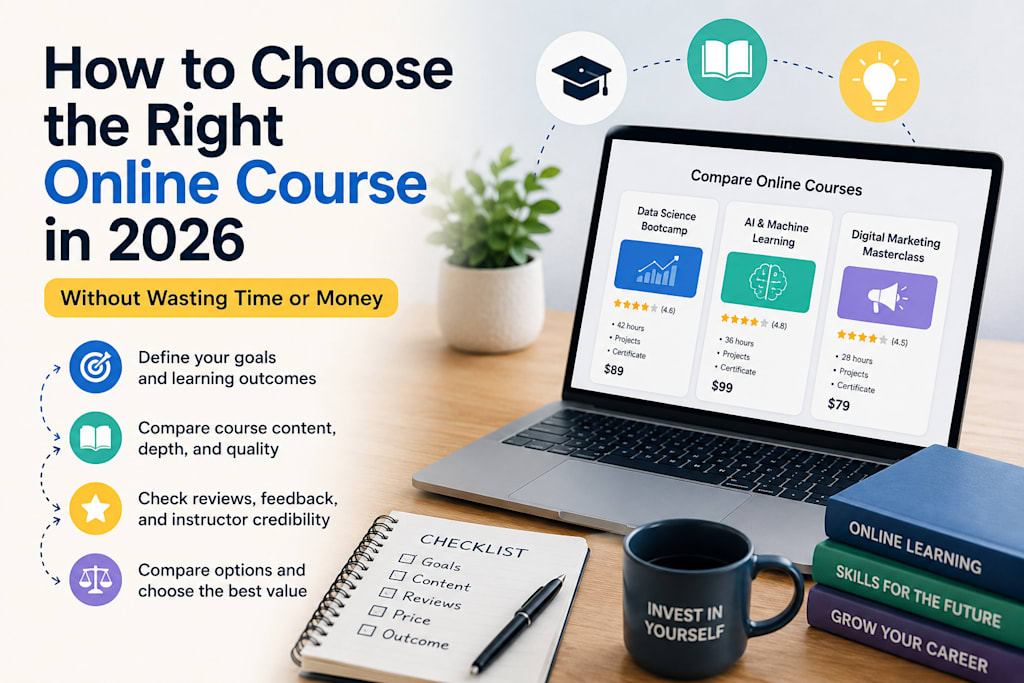
Online learning has exploded over the past few years.
Almost every skill now has dozens, if not hundreds, of courses available across multiple platforms.
While this is great for accessibility, it has created a new problem:
Most learners don’t struggle with access to education anymore — they struggle with choosing the right course.
And choosing incorrectly can lead to wasted time, money, and motivation loss.
Here’s a practical guide to help you make better decisions.
1. Focus on the actual outcome, not the title
Many courses sound similar on the surface.
For example:
- “Learn Python”
- “Master Python”
- “Python for Beginners”
But the real difference is in the outcome.
Before enrolling, ask:
What exactly will I be able to do after completing this course?
Good courses clearly define outcomes such as:
- building projects
- solving real problems
- creating a portfolio
- gaining job-ready skills
If the outcome is vague, the course value is usually low.
2. Compare curriculum depth
Two courses with identical titles can vary massively in quality.
A basic course might only cover theory, while a strong one includes:
- real-world projects
- case studies
- tools used in industry
- workflow simulations
- assignments with feedback
Depth matters more than branding or marketing.
3. Don’t rely only on reviews
Reviews can be helpful, but they are often biased by:
- short-term excitement
- marketing influence
- lack of long-term evaluation
Better signals include:
- syllabus structure
- instructor experience
- course updates
- practical assignments
- community support
4. Match course format to your learning style
Not every learner benefits from the same format.
Some people need:
- live classes
- accountability
- mentorship
Others prefer:
- self-paced learning
- short lessons
- flexible schedules
There is no universal “best course” — only the best course for your learning style and goals.
5. Compare multiple courses before deciding
One of the biggest mistakes learners make is choosing the first course they find.
In reality, the same skill is often taught differently across platforms in terms of:
- depth
- teaching style
- practical focus
- price
- outcomes
Comparing options side-by-side leads to much better decisions.
This is why course discovery platforms exist — to help learners explore and compare different online courses in one place instead of relying on scattered recommendations.
One example is https://skillpublic.com/
It allows users to explore and compare courses across multiple online education providers, making it easier to choose based on real value rather than marketing claims.
Final thoughts
Online learning is one of the most powerful tools for career growth today.
But the real skill is no longer just learning — it’s choosing what to learn.
The better your decision-making process, the faster your progress will be.
Instead of rushing into the first course you see, take time to compare, evaluate, and choose strategically.
Because in modern education, the right course matters as much as the effort you put into it.
About the Creator
Oleh Diogen
I write about online education, EdTech platforms, and course selection strategies. Focused on helping learners compare online courses, build digital skills, and make smarter learning decisions in AI-driven education.
Enjoyed the story? Support the Creator.
Subscribe for free to receive all their stories in your feed.
Comments
There are no comments for this story
Be the first to respond and start the conversation.