
How Space Missions Are Helping Us Understand the Origins of the Solar System
Created by Sazim Hossain
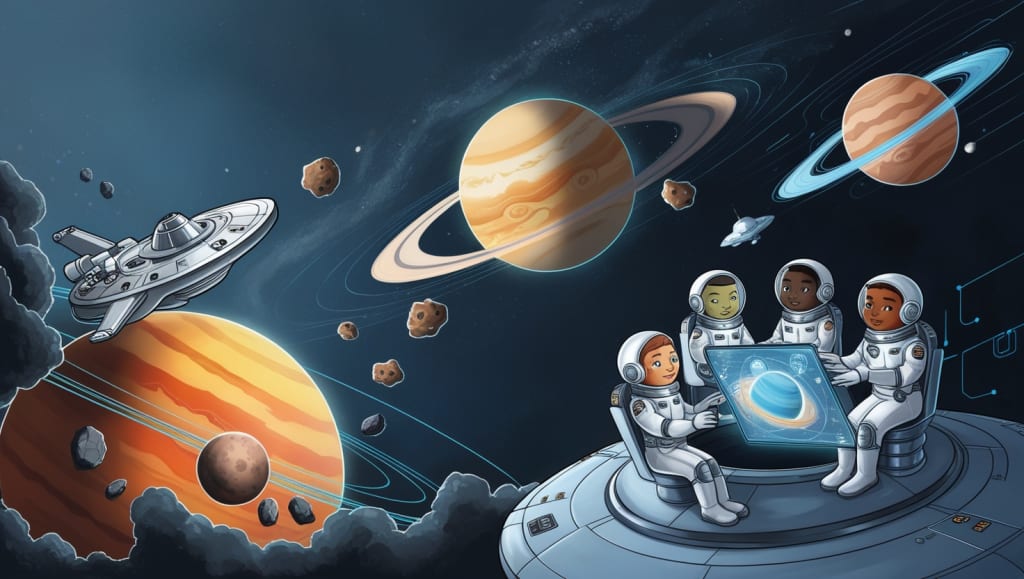
The origins of our solar system have captivated humanity for centuries, sparking curiosity and wonder about how our cosmic neighborhood came to be. While ancient civilizations gazed up at the stars and crafted myths to explain the universe, modern science has taken us on an incredible journey of discovery. Space missions, equipped with advanced technology and guided by the spirit of exploration, are now unlocking the secrets of the solar system's birth. These missions are helping us piece together the puzzle of our origins, providing insights that are as profound as they are inspiring.
The Quest to Uncover the Solar System's Origins
Understanding the origins of the solar system is like piecing together a cosmic jigsaw puzzle. Each planet, moon, asteroid, and comet holds a clue to the past, a fragment of the story that began over 4.5 billion years ago. But to assemble this puzzle, we need to venture beyond Earth, sending spacecraft to explore distant worlds and gather data that cannot be obtained from our planet alone.
One of the most ambitious missions in this quest is NASA's New Horizons, which famously flew by Pluto in 2015. While its primary mission was to explore the distant dwarf planet, New Horizons is also venturing into the Kuiper Belt, a region of the solar system filled with ancient, icy objects. These objects are remnants from the early solar system, essentially time capsules that have remained largely unchanged since the dawn of our cosmic neighborhood. By studying them up close, scientists can gain insights into the building blocks that formed the planets and the processes that shaped the solar system's evolution.
The Role of Comets: Rosetta and Beyond
Comets, often described as "dirty snowballs," are some of the oldest and most primitive objects in the solar system. They are composed of ice, dust, and organic molecules, and they originate from the outer reaches of the solar system, in regions like the Kuiper Belt and the Oort Cloud. Because comets have remained largely unchanged since their formation, they offer a unique glimpse into the conditions that existed in the early solar system.
The European Space Agency's Rosetta mission was a groundbreaking effort to study a comet up close. Launched in 2004, Rosetta spent over a decade traveling through space before rendezvousing with Comet 67P/Churyumov-Gerasimenko in 2014. The mission made history when it successfully deployed the Philae lander, which became the first spacecraft to land on a comet's surface.
Rosetta's observations revolutionized our understanding of comets and their role in the solar system's formation. Among its many discoveries, Rosetta found complex organic molecules on the comet's surface, supporting the idea that comets may have played a key role in delivering the ingredients for life to Earth. Additionally, the mission provided valuable data on the composition of the comet's nucleus, its activity as it approached the Sun, and the way it sheds material into space. These findings are helping scientists piece together the story of how comets, and by extension, the solar system, formed.
Asteroids: The Building Blocks of Planets
While comets offer clues about the icy outskirts of the solar system, asteroids provide insights into the rocky inner regions where the planets formed. These remnants of planetesimals—the small bodies that coalesced to form planets—are like fossils from the early solar system, preserved in space for billions of years.
NASA's OSIRIS-REx mission is a prime example of how space missions are advancing our understanding of asteroids. Launched in 2016, OSIRIS-REx traveled to Bennu, a near-Earth asteroid that is believed to be a pristine example of the material that formed the rocky planets. The mission's goal was to collect a sample of Bennu's surface and return it to Earth for analysis.
In 2020, OSIRIS-REx successfully collected a sample from Bennu, marking a significant achievement in planetary science. The sample, which returned to Earth in 2023, is now being studied by scientists to learn more about the composition of the early solar system. By analyzing the minerals, organic compounds, and isotopic signatures in the sample, researchers hope to gain insights into the processes that led to the formation of planets and the origins of water and organic materials on Earth.
Probing the Gas Giants: Juno and the Secrets of Jupiter
The gas giants—Jupiter and Saturn—are the behemoths of the solar system, and they hold crucial clues to its formation. Jupiter, in particular, is thought to have played a key role in shaping the architecture of the solar system, influencing the formation and migration of other planets.
NASA's Juno mission is currently orbiting Jupiter, providing unprecedented views and data about the giant planet. Launched in 2011, Juno is studying Jupiter's atmosphere, magnetic field, and interior structure. One of the mission's primary goals is to understand how Jupiter formed and how it has evolved over time.
Juno's discoveries have been nothing short of spectacular. The spacecraft has revealed the existence of massive, swirling storms at Jupiter's poles, unlike anything seen before in the solar system. It has also provided insights into the planet's deep interior, suggesting that Jupiter's core may be larger and more diffuse than previously thought. These findings are helping scientists refine their models of how giant planets form and evolve, shedding light on the early solar system's dynamics.
The Future of Solar System Exploration
As we continue to explore the solar system, new missions are on the horizon that promise to deepen our understanding of its origins. NASA's Lucy mission, for example, is set to explore the Trojan asteroids, which share an orbit with Jupiter and are thought to be remnants of the primordial material that formed the outer planets. By studying these ancient objects, Lucy will provide new insights into the processes that shaped the solar system's formation.
Meanwhile, the James Webb Space Telescope, launched in 2021, is offering a new window into the early solar system by observing distant objects and phenomena that are beyond the reach of current spacecraft. Webb's powerful instruments are enabling scientists to study the composition of exoplanetary systems, many of which may resemble the early solar system, offering a comparative perspective on our own origins.
Conclusion: A Journey of Discovery
The exploration of the solar system is one of the most exciting and inspiring endeavors of our time. Through space missions, we are not only learning about distant worlds but also uncovering the story of our own cosmic origins. Each new discovery brings us closer to understanding the processes that gave rise to the planets, moons, and other celestial bodies that make up our solar system.
These missions are a testament to human curiosity and ingenuity, showing that with the right tools and the spirit of exploration, we can unlock the mysteries of the universe. As we continue to push the boundaries of what is possible, we are not only expanding our knowledge of the solar system but also inspiring future generations to look up at the stars and wonder about their place in the cosmos.
About the Creator
Enjoyed the story? Support the Creator.
Subscribe for free to receive all their stories in your feed.
Comments
There are no comments for this story
Be the first to respond and start the conversation.