
How I Stopped Teaching Letters the Hard Way (And What Worked Better at Home)
I thought more flashcards would solve the problem. Instead, I had to rethink how my child actually learned letter recognition at home.

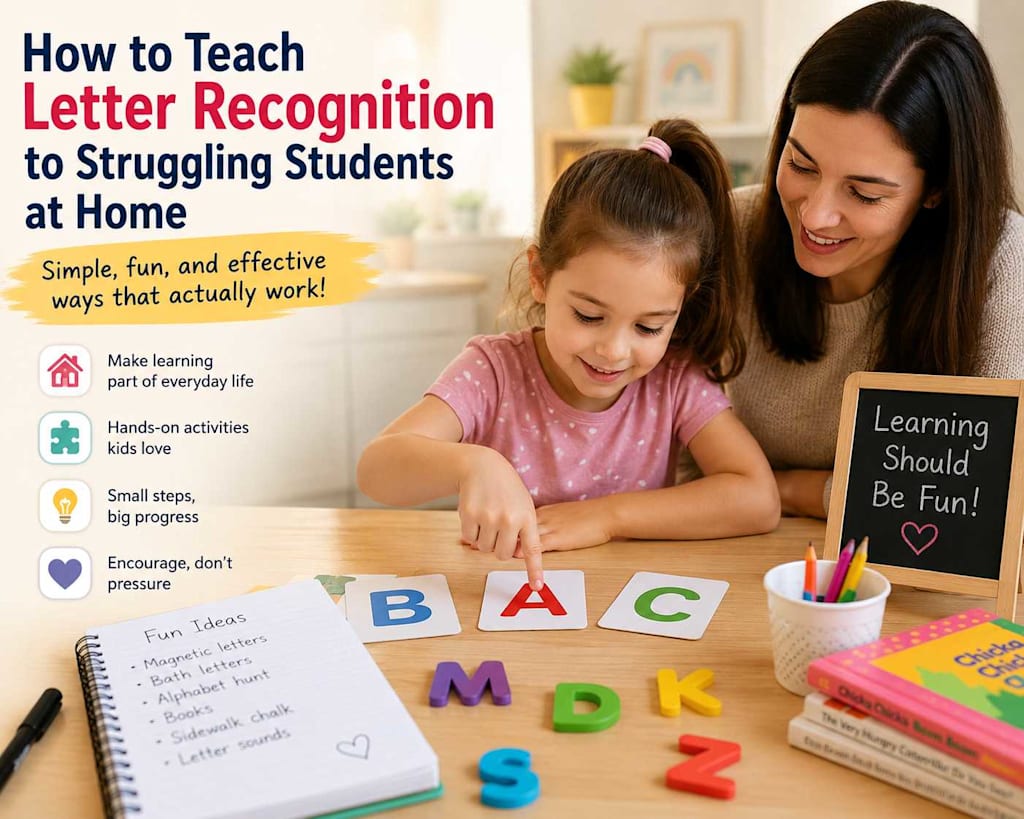
My daughter could sing the alphabet song before she turned three. All twenty-six letters, in order, pitch perfect. She'd do it in the bathtub, in the car, while eating cereal. I thought we were ahead of the game. I thought letter recognition was basically handled.
Then she turned five and we sat down with a workbook from the dollar store. I pointed to a letter "A" on the page. She stared at it. She looked at me like I had asked her to name a constellation. Then she sang the song. The whole song. She got to "A" and pointed at the air, not the paper, and smiled like she'd solved it.
She had no idea what an "A" looked like. She had memorized a melody. That was it. The letters were just sounds in a sequence. Individual symbols meant nothing to her. I sat there with that workbook and I felt stupid. I had been hearing that song for two years thinking it meant something it didn't.
That was the beginning of realizing I had no idea how to teach letter recognition at home. I thought it would happen naturally. I thought if I just exposed her to enough books and songs, the letters would click. They didn't.
Why Nothing We Tried Seemed To Work
The first thing I bought was flashcards. Big colorful ones with animals on them. A for alligator, B for bear. She liked the animals. She memorized the animals. Ask her what letter the alligator was under and she'd say "alligator." Not "A." Alligator. She had learned the picture, not the symbol. I kept drilling her. I'd hold up the card, cover the animal, and wait. She'd get frustrated. I'd get frustrated. We'd both end up mad at a piece of cardboard.
We tried alphabet apps next. The ones with games and songs and dancing letters. She loved them. She'd play for an hour. But when I turned off the tablet and asked her to find a "C" in her name, she couldn't do it. The apps were entertainment. The learning wasn't transferring off the screen.
Worksheets were worse. She has a short attention span for sitting still. Five minutes in and she'd be rolling on the floor, asking for a snack, picking at her fingernails. I'd push her to finish the page. She'd cry. Not loud crying. The quiet kind where she just stops and looks at the table. I'd feel like a jerk. Then I'd feel angry that I felt like a jerk when all I wanted was for her to learn three letters.
The books weren't helping either. We'd read the same ones over and over. She'd memorize the story and "read" it back to me. I'd get excited thinking she was learning. Then I'd hand her a new book and she'd look at the pictures and make up a completely different story. She wasn't reading. She was performing. And I had been clapping for it.
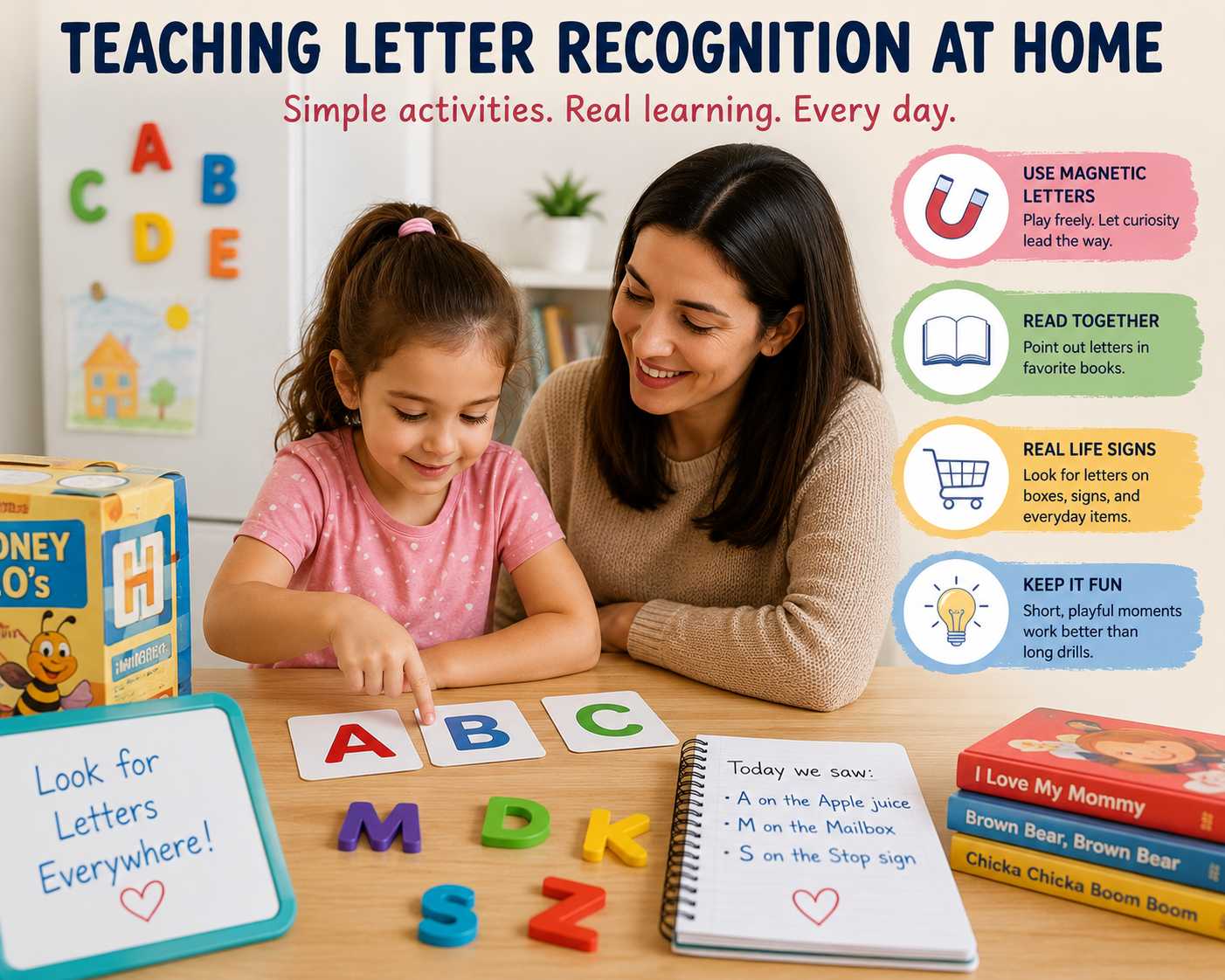
The Mistakes I Didn't Realize I Was Making
I was treating letter recognition like a performance. I wanted her to get it right so I could check a box. I wanted to post a video of her naming letters. I wanted to tell my mother she was reading. I wanted proof that my kid was normal, smart, on track. Every flashcard session was about me feeling better, not about her learning anything.
I was also comparing her to a kid down the street. He was six months younger and could write his name. His mom would mention it casually at the bus stop. I'd go home and push my daughter harder. Like her learning had anything to do with him. It didn't. But I couldn't stop measuring.
Another mistake: I was teaching letters in isolation. A flashcard with an "F" on it has no meaning. It's just a shape. A worksheet with letters to trace is just a chore. I was asking her to memorize abstract symbols with no context. No wonder her brain checked out. If someone showed me thirty random squiggles and told me to memorize them, I'd check out too.
I also thought more time meant more learning. We were doing structured practice every single day. Twenty minutes after dinner. Like homework for a four-year-old. It turned letters into a punishment. Something she had to endure before she could go play. I was making the alphabet feel like a job she hated.
Small Changes That Made Learning Feel Easier
The first thing I stopped doing was the daily sit-down sessions. I threw the schedule away. No more "okay, time to practice letters." That phrase alone made her shoulders drop. I decided that if she was going to learn letters at home, it had to happen while we were living our lives. Not during a special lesson.
I bought a set of foam bath letters. Not to quiz her. Just to play with. She'd stick them to the wall, make towers, throw them like boats. One day she asked me what a red one was. I told her it was an "R." She said "R" and stuck it to her forehead. That was it. No test. No "now find the S." Just a single letter in a moment when she was relaxed and curious.
I started pointing out letters on things she already cared about. The "M" on the M&M's bag. The "K" on the Kellogg's box. The "X" on the Xbox controller. I'd just say it. "That's a T." No expectation she'd repeat it. Sometimes she did. Sometimes she ignored me. Either way was fine. I was just putting the information out there.
The biggest shift was letting her move while she learned. She hates sitting. So we stopped sitting. We took sidewalk chalk outside and drew letters on the driveway. She'd jump from the "A" to the "B." We'd make letters out of sticks in the yard. We'd shape our bodies into letters standing up. She learned "Y" fast because she could stand with her arms up. She thought it was funny. I didn't care if it was funny. I cared that she remembered it.
Everyday Activities That Naturally Build Letter Recognition
Grocery shopping became our secret classroom. I'd let her hold the list, which was just scribbles to her, but I'd point out the big letters on signs. The "P" on the pharmacy sign. The "S" on the sale poster. The numbers on the aisle markers. She started noticing them herself. She'd point and say "that says five" or "that starts with B." She was wrong half the time. I didn't correct her every time. Sometimes I just said "yeah, good eye" and kept walking.
We got a set of magnetic letters for the fridge. I didn't arrange them in order. I didn't spell words. I just stuck them up randomly. She'd move them around while I cooked dinner. She made a line of all the blue ones. She stuck a "D" to a "O" and called it a snowman. Then one morning she pointed to a "J" and said "that's in my name." It was. I almost dropped the spatula. She had seen it herself. No flashcard. No drill. Just a magnet on a fridge while I made eggs.
Mail was another one. She loved getting the mail. I'd let her sort it. Junk mail with big letters. The "A" on the auto insurance envelope. The "V" on the Visa statement. She'd hand me pieces and announce the first letter she saw. Sometimes right, sometimes wrong. Either way, she was looking. That was the point.
We also used books differently. Instead of me reading and her listening, I'd pick books with huge letters and let her "read" the letter sounds she knew. If a page had a big "B" and a bear, I'd wait. Sometimes she'd say "buh." Sometimes she'd say "bear." Either way, I didn't force the letter. I just let the book do the work. Books she already loved were the best. She knew the story, so she wasn't stressed about the plot. She could focus on the shapes.
When I Started Looking For More Structure
After a couple months of this casual approach, something changed. She was noticing letters more. She'd point them out without me asking. But I also started feeling like I was running out of ideas. I was making it up every day. Some days were great. Some days I had no clue what to do next. I needed a map. Not because the fun stuff wasn't working. Because I wanted to know what came after she knew ten letters. What then?
I started looking into how to help a child recognize letters in a more organized way. I read about phonics for beginners. I learned that letter recognition and letter sound activities work best when they're connected, not separate. I had been teaching her the name of the letter and the sound as two different things. That was confusing her. I needed a better sequence.
I looked at a bunch of different approaches online. Some were all apps. Some were all workbooks. Some required me to become a teacher with a lesson plan. I didn't want that. I wanted something that understood what I had already figured out: kids learn letters when they're relaxed, moving, and interested. Not when they're sitting at a table being drilled.
While comparing different reading programs, Reading Head Start was one of the structured options I spent time researching. I was looking for something that could give me a step-by-step path without turning me into a tutor. The program seemed to break things down into short sessions, which matched what I had learned about my daughter's attention span. It also looked visual and sound-based, which fit how she learned best.
But I had questions. I wasn't sure if paying for a program made sense when I had already found some things that worked. I also didn't want to turn a program into another source of pressure. I was still learning how to back off. I spent some time reading through this breakdown of how Reading Head Start approaches early reading skills It laid out the phonics sequence in plain language, which helped me understand what order makes sense for teaching letters and sounds.
I also looked at this year's honest parent feedback on the program I wanted to see what real parents said, not just marketing. Some mentioned it worked well for kids who needed to move and hear sounds. Some said their kids didn't click with it. That kind of mixed feedback felt more real to me than perfect five-star reviews.
I didn't sign up right away. I bookmarked it and kept doing what we were doing. But having a structured reading program in my back pocket felt better than guessing. I knew that if our homemade approach hit a wall, I had somewhere to go that wasn't another random worksheet.
Comparing Different Learning Approaches
I tried enough different things to know that not every approach fits every kid. Some children sit still and love tracing. Mine doesn't. Some kids learn from apps with cartoons. Mine watched the cartoons and ignored the letters. Some parents have the patience to create elaborate alphabet games every day. I don't. I have a job and two kids and a house that never stays clean.
What I learned is that the best letter recognition activities are the ones that happen without you forcing them. If you have to bribe your kid to do it, it's not working. If you have to threaten them, it's definitely not working. The alphabet should be part of the world they live in, not a subject they study.
Structured programs can help. They can give parents a roadmap when they feel lost. But they only work if the parent doesn't turn them into another form of pressure. A reading program for preschoolers or kindergarten letter recognition should feel like support, not a replacement for paying attention to your own kid. No program knows your child better than you do. But some programs can tell you what to teach next when you honestly don't know.
I also realized that preschool letter recognition and kindergarten letter recognition are different stages. At four, you're just planting seeds. At five, you're building a foundation. At six, if they're still struggling, you might need more than casual exposure. The timeline matters. Early literacy activities that work for a four-year-old might bore a six-year-old or frustrate them because they know they're behind. You have to match the activity to the age and the child, not just the skill.
Final Thoughts
My daughter is not reading novels. She still confuses "b" and "d" sometimes. She still has days where she looks at a letter she knew yesterday and goes blank. But she can recognize most of the alphabet now. She can find letters in her name. She doesn't run away when I grab a book. That sounds small. It isn't.
If you're trying to teach letter recognition at home and nothing seems to stick, I want you to hear this. Your child is not broken. You are not failing. The flashcards didn't fail because your kid is slow. They failed because flashcards are boring and abstract and have nothing to do with real life. Worksheets didn't fail because you're a bad parent. They failed because sitting still and tracing lines is not how every brain learns.
Learning letters at home works when it stops feeling like school and starts feeling like life. When the alphabet is on your cereal box and your street sign and your bath toys, it becomes real. When you stop testing and start noticing, your child stops performing and starts learning. Reading readiness doesn't come from pressure. It comes from safety. From a brain that feels okay getting it wrong.
The other kids might know more letters today. That doesn't mean they'll know more in a year. Some kids who memorize the alphabet at three stall out later. Some kids who can't name five letters at five explode into reading at six. The starting line doesn't determine the finish. What determines it is whether your kid still wants to try.
So put the flashcards away. Stop the daily drills. Look at your child. Watch what they like. Put letters where they already are. Let them move. Let them play. Let them get it wrong without fixing it every single time. They will get there. Not because you forced them. Because you got out of the way enough to let them learn.
About the Creator
Understandshe
I write about healing, self-growth, and the messy but beautiful journey of becoming. Honest lessons, real stories, and gentle insights you’ll also find on UnderstandShe.
Enjoyed the story? Support the Creator.
Subscribe for free to receive all their stories in your feed.
Comments
There are no comments for this story
Be the first to respond and start the conversation.