
How HR Analytics Courses Are Evolving with New Tech
The Role of Technology in HR Analytics
As an HR analytics professional, I’ve seen how the field has changed with new technologies. HR analytics courses are evolving to teach us how to use tools like AI, machine learning, and big data to make smarter decisions. These courses now focus on helping HR professionals use tech to improve performance, enhance employee engagement, and drive better business outcomes.
The Role of Technology in HR Analytics
Transformation of HR Decision-Making: HR analytics, also called people analytics, is how HR departments approach decision-making by shifting from traditional methods to data-driven insights.
Traditional HR Practices: Traditionally, HR relied on manual processes and essential tools, such as performance metrics and engagement surveys, to track employee data.
Introduction of Advanced Technologies: With the rise of technologies like AI, machine learning (ML), and big data, new opportunities have emerged for HR professionals to optimize their workflows and analyses
Improved Data Analysis: These new technologies allow HR departments to analyze large amounts of employee data more quickly and accurately, providing deeper insights into workforce trends.
Adapting HR Analytics Courses: In response to these changes, HR analytics courses have evolved to incorporate training on integrating AI, ML, and other tools into day-to-day HR functions.
Predictive Insights for HR Professionals: These technologies can help HR professionals identify trends, predict future outcomes, and make data-driven decisions to improve the workplace.
Impact on Workforce and Organization: These tools help HR professionals make more informed decisions and enhance workforce engagement, retention, and overall organizational performance.
Incorporating Artificial Intelligence in HR Analytics Courses
Improved Decision-Making: By mastering AI tools, HR professionals can enhance their decision-making processes and focus on more strategic, high-value initiatives.
Enhanced Performance Assessment: AI tools help HR professionals assess employee performance more accurately, ensuring better talent management.
Predictive Analytics for Retention: AI can predict which employees are at risk of leaving, enabling proactive retention strategies.
Efficient Recruitment: AI streamlines recruitment by automating resume screening and candidate matching, saving time and resources.
Automated Feedback Analysis: AI-powered sentiment analysis allows HR to gain real-time insights from employee feedback, improving workplace culture.
Data-Driven Strategy Development: HR professionals can use AI-driven insights to develop data-backed strategies that align with organizational goals.
Machine Learning: Improving Predictive Analytics in HR
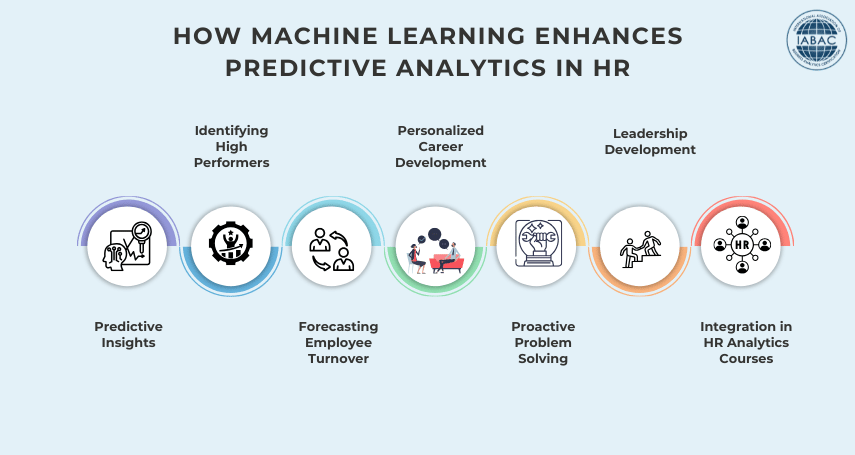
Machine learning (ML) is changing how HR uses data by making it easier to predict future trends based on past information. It helps HR professionals make better decisions about their workforce by analyzing large amounts of data. With ML, HR can move from just reacting to situations to planning ahead and being more proactive.
Predictive Insights: ML analyzes historical data to identify trends, helping HR predict future employee behavior, such as turnover rates and performance patterns.
Forecasting Employee Turnover: ML algorithms can predict which employees are likely to leave, allowing HR to take preventive measures and improve retention strategies.
Identifying High Performers: During recruitment, ML helps identify candidates who are most likely to succeed in a given role, enhancing hiring decisions.
Personalized Career Development: ML recommends customized career paths for employees based on their skills, performance, and career aspirations, fostering growth and satisfaction.
Proactive Problem Solving: With predictive analytics, HR can address issues like employee dissatisfaction before they escalate, ensuring smoother workforce management.
Leadership Development: ML helps identify high-potential employees who could be groomed for leadership roles, supporting long-term talent development strategies.
Integration in HR Analytics Courses: HR analytics courses now incorporate ML training, teaching professionals to build and implement predictive models for data-driven decision-making
Big Data and HR Analytics: A Perfect Match
Big data is changing the way HR works. It allows HR teams to access a wealth of information about employees, including performance, work habits, and feedback from surveys. This data, which was once difficult to interpret, now enables HR to make smarter, more informed decisions.
Access to Vast Employee Data: Big data provides HR with comprehensive insights into employee performance, work habits, and satisfaction through a variety of data points.
Uncovering Hidden Insights: By analyzing large datasets, HR professionals can identify patterns and trends that would have been impossible to uncover using traditional methods.
Evolving HR Analytics Courses: HR analytics courses are evolving to teach professionals how to collect, process, and analyze big data effectively, ensuring they can make data-driven decisions.
Use of cloud-based platforms Professionals are trained to use cloud platforms, advanced databases, and analytics tools to manage and process large amounts of data efficiently.
Tailoring HR Strategies: With big data insights, HR professionals can better understand workforce trends and adapt strategies to meet the unique needs of employees.
Data Visualization Tools: Making Insights Actionable
Data visualization tools like Tableau and Microsoft Power BI are essential for transforming complex data into easily interpretable formats. These tools help HR professionals present insights through interactive dashboards, charts, and graphs, making it easier to communicate findings to stakeholders.
As HR analytics courses evolve, they now emphasize the importance of mastering data visualization. By learning these tools, HR professionals can make complex data accessible, enabling quick decision-making. Real-time dashboards also help HR teams track key performance indicators (KPIs) and adjust strategies to meet organizational goals.
The Rise of Employee Experience Platforms in HR Analytics
Focus on Employee Experience: Employee experience is becoming a key priority in HR as organizations recognize its impact on engagement and business performance.
Employee Experience Platforms: These platforms, powered by HR analytics, collect employee feedback, measure satisfaction, and track engagement across the organization.
Integration with AI and Big Data: Employee experience platforms use AI and big data to provide HR professionals with real-time insights into employee sentiment.
Training on Employee Experience Platforms: HR analytics courses progressively including modules on how to effectively utilize these platforms to collect and analyze employee feedback.
Proactive Retention Strategies: By addressing employee concerns early, HR professionals can improve retention and boost morale.
Personalized HR Programs: Data from these platforms allows HR to create personalized development plans, reward systems, and recognition programs for employees.
Creating a Positive Work Environment: The use of these platforms helps HR professionals foster a positive work environment by responding to employee needs and concerns.
Future Trends: What’s Next for HR Analytics Courses?
The future of HR analytics is brimming with possibilities. As new technologies continue to emerge, HR analytics courses will evolve to incorporate them. One technology to watch is blockchain, which could revolutionize HR data security by providing a transparent and immutable way to store and share employee information. Additionally, advancements in automation and AI will further streamline HR processes, allowing HR professionals to focus on strategic initiatives while leaving repetitive tasks to technology.
IABAC (International Association of Business Analytics Certification) offers industry-recognized certifications in HR analytics, data science, AI, and business analytics. Their programs equip HR professionals with the skills needed to leverage emerging technologies like AI, machine learning, and big data, empowering them to make data-driven decisions and drive organizational success.
About the Creator
Enjoyed the story? Support the Creator.
Subscribe for free to receive all their stories in your feed.
Comments
There are no comments for this story
Be the first to respond and start the conversation.