
How AI Is Changing the Way We Explore the Cosmos?
Created by Sazim Hossain
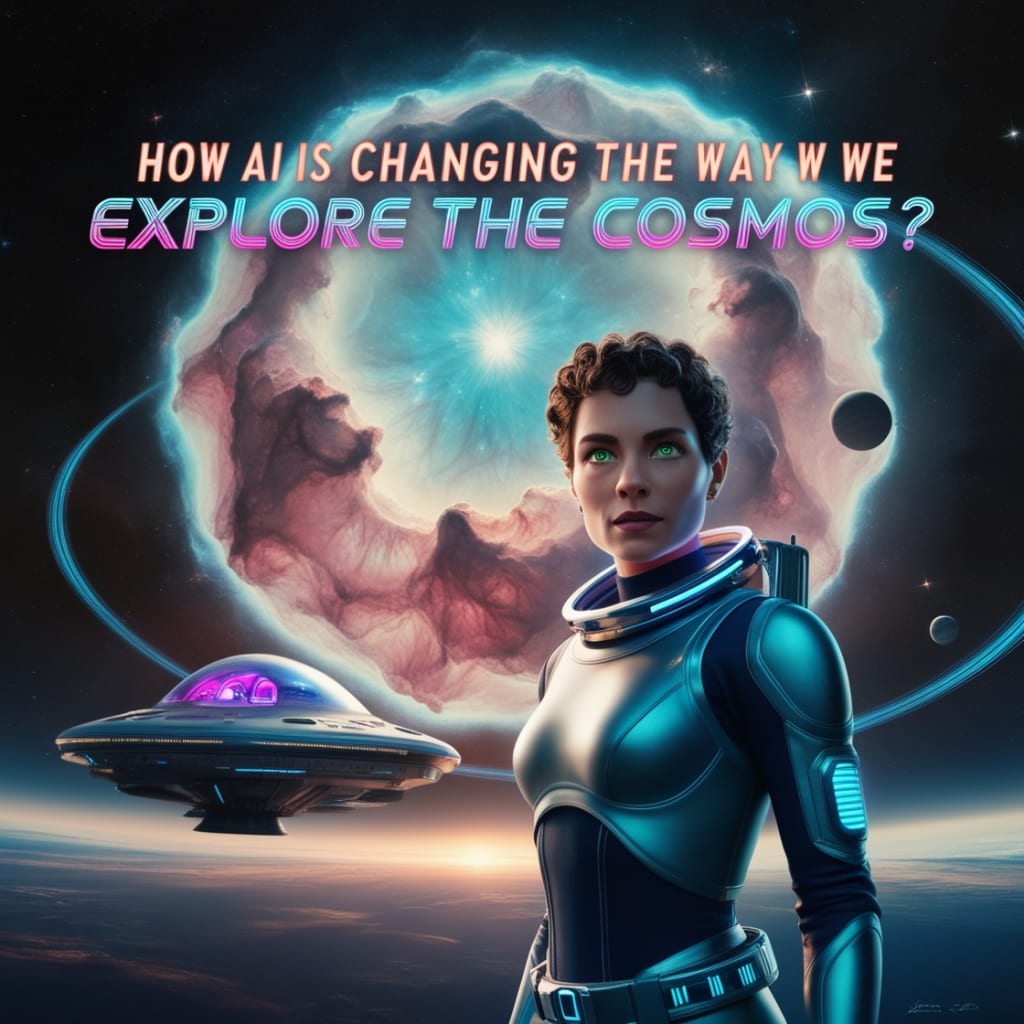
The cosmos, a boundless expanse of mystery and wonder, has long captivated human imagination. From ancient stargazers to modern scientists, humanity's quest to understand the universe has driven remarkable advances in technology and knowledge. Today, artificial intelligence (AI) is at the forefront of this cosmic journey, revolutionizing the way we explore and comprehend the universe. This partnership between human curiosity and machine intelligence is not just enhancing our understanding of the cosmos; it's transforming the very process of discovery itself.
### AI: The Cosmic Navigator
Traditionally, exploring space involved painstaking manual calculations and data analysis. Telescopes and spacecraft gathered vast amounts of information, but processing this data required immense human effort and time. Enter AI—particularly machine learning algorithms and neural networks—that are redefining how we interpret celestial phenomena and manage astronomical data.
One of the most compelling examples of AI’s impact is in the field of exoplanet discovery. The search for planets beyond our solar system has been significantly accelerated by AI. NASA’s Kepler Space Telescope, which has been on a mission to discover exoplanets, has generated an enormous amount of data. Scientists faced the daunting task of sifting through this data to identify potential planets. Enter AI-driven algorithms.
The breakthrough came with the development of the Transit Exoplanet Survey Satellite (TESS), which monitors star systems for periodic dips in brightness that could indicate orbiting planets. To process the vast amounts of data from TESS, researchers employed machine learning models. For instance, Google's AI technology, which was originally developed for image recognition, was repurposed to analyze light curves—graphs that represent changes in brightness over time. This adaptation led to the identification of several new exoplanets, including one notable discovery, LTT 1445 Ab, a new planet in a system with three stars.
### AI and the Search for Extraterrestrial Intelligence (SETI)
The search for extraterrestrial intelligence (SETI) has been another area where AI has made substantial contributions. SETI aims to detect signals from intelligent civilizations elsewhere in the galaxy. This search involves sifting through enormous amounts of radio data to find potential signals.
A project called Breakthrough Listen, one of the most ambitious SETI projects to date, uses AI to process and analyze radio waves from distant stars. The traditional approach of analyzing these signals was laborious and time-consuming. AI, however, has transformed this process. Machine learning algorithms, trained to recognize patterns and anomalies in vast datasets, can detect potential signals far more quickly than human researchers.
A notable example is the discovery of a mysterious signal that briefly intrigued scientists as a possible extraterrestrial transmission. Although the signal was ultimately attributed to a human-made source, it demonstrated AI’s ability to detect even the faintest anomalies, pushing the boundaries of what we might find in the search for alien life.
### AI in Cosmic Cartography
AI is also changing the way we map and understand the structure of the universe. Projects like the Sloan Digital Sky Survey (SDSS) have mapped millions of galaxies, generating data that can be overwhelming for human analysts. Here, AI algorithms come to the rescue by classifying galaxies, identifying patterns, and even predicting their evolution.
One striking example is the use of AI to map dark matter. Dark matter, which makes up a significant portion of the universe’s mass, does not emit light or energy, making it difficult to observe directly. Researchers use AI to analyze gravitational lensing effects, where massive objects bend the light from more distant galaxies. By training neural networks to identify and interpret these lensing patterns, scientists can infer the distribution of dark matter with unprecedented accuracy.
### AI and Space Missions
AI is also revolutionizing space missions, making them more autonomous and efficient. For instance, NASA’s Mars rovers, such as Perseverance, are equipped with AI algorithms that enable them to make real-time decisions. These algorithms help the rover navigate the Martian terrain, avoid obstacles, and select scientific targets for exploration. This autonomy is crucial for missions where communication delays with Earth can span up to 20 minutes.
One remarkable example is the AI system used by the European Space Agency's (ESA) Rosetta mission. The Rosetta spacecraft, which successfully landed on the comet 67P/Churyumov-Gerasimenko, utilized AI to manage its operations and ensure successful data collection from the comet’s surface. The AI system enabled Rosetta to perform complex maneuvers and adjustments, showcasing the potential for AI to enhance space exploration missions.
### The Future of AI in Cosmic Exploration
As we look to the future, AI's role in cosmic exploration is likely to expand even further. The advent of quantum computing and more advanced machine learning models promises to unlock new possibilities in analyzing cosmic data. AI will continue to aid in the discovery of new celestial bodies, refine our understanding of cosmic phenomena, and even assist in designing future missions.
The integration of AI into space exploration is not just about processing data more efficiently or performing complex calculations. It represents a profound shift in how we approach the cosmos. By leveraging AI, we are enhancing our ability to explore the universe and unravel its mysteries, from the smallest exoplanets to the largest cosmic structures.
In this era of AI-driven exploration, humanity stands at the threshold of unprecedented discoveries. The cosmos, once an inscrutable and distant frontier, is becoming more accessible and understandable. With AI as our guide, we are not just observing the universe; we are beginning to decode its secrets and chart new territories in the great expanse of space.
As we continue this journey, it’s clear that AI is not merely a tool but a partner in our quest to understand the cosmos. Together, we are exploring new horizons, pushing the boundaries of knowledge, and inspiring future generations to reach for the stars.
About the Creator
Enjoyed the story? Support the Creator.
Subscribe for free to receive all their stories in your feed.
Comments
There are no comments for this story
Be the first to respond and start the conversation.