
Homesteading Books for Beginners Didn’t Help Me Start (This Did)
I spent months reading and saving ideas… but nothing actually changed in my backyard until I found a simple way to start.
I spent probably six months watching homesteading videos before I did a single thing. Every night I'd scroll through feeds of people building chicken coops and planting massive gardens and canning tomatoes like it was nothing. I'd save posts. I'd screenshot ideas. I'd send links to my wife like "look at this setup" and she'd nod and go back to whatever she was doing. In my head I was basically a homesteader already. I had the knowledge. I had the vision. I just needed the land.
Then we moved to a house with a backyard. Not a farm. Not even a big yard. Just a normal suburban patch of grass with a fence that needed paint and a corner that got decent sun in the afternoon. I stood out there the first day with a coffee and told myself this was it. This was where it started. I was going to grow food and maybe get some chickens and figure out rainwater collection and composting and all of it.
I did nothing for another two months.
I kept watching videos. I kept saving more posts. The backyard stayed exactly the same. The grass grew. I mowed it. That was the only thing I did out there. Mow the grass and stand around feeling like I was planning something big. My wife stopped asking about it. I think she could tell I was stuck in that loop where research feels like work. Like if I just found the right video or the right post, everything would click and I'd know exactly what to do.
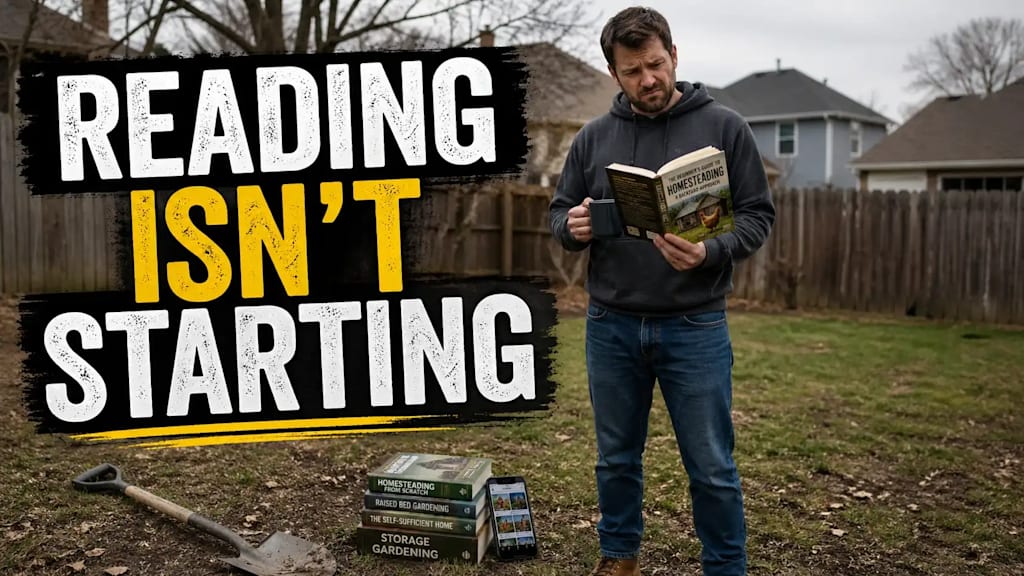
That's when I bought a homesteading book for beginners. I found it at a used bookstore, thick paperback with a cover showing a garden and some chickens and a cabin. Felt like the missing piece. I thought okay, videos are scattered and random but a book is organized. A book has a beginning and an end. Someone wrote this to teach people like me. I paid maybe twelve bucks for it and started reading that night.
The book was actually pretty good in some ways. It talked about soil health and crop rotation and how to start compost and what kind of tools you actually need versus what people buy and never use. It gave me a lot of concepts I didn't have before.
I understood why you don't plant tomatoes in the same spot every year. I understood what hardiness zones meant. I learned about raised beds and why they drain better and how to build them cheap. It felt like I was finally getting the foundation.
Like I wasn't just watching random people online anymore. I had real information from someone who knew what they were talking about.
But here's the thing the book never gave me. It never told me what to do first. Not really. It had chapters on everything. Chickens, bees, gardening, preserving, building structures, water systems. All useful. All interesting. But I finished that book and stood in my backyard and still had no idea where to start.
The book made homesteading feel like this enormous thing where everything connects to everything else. You need compost for the garden but you need scraps for the compost but you need to be eating from the garden to have scraps and maybe you need chickens for the manure but you need a coop first and the coop needs to be in the right spot and before you know it you're standing in the grass with a book in your hand wondering if you need to build a fence before you plant or plant before you build a fence or if you should just dig up the whole yard and start over.
I read that book twice. I underlined stuff. I made notes in the margins. I told myself I was preparing. But preparation was just another word for stalling. The backyard was still grass. Still empty. Still waiting. I'd go out there with a shovel sometimes and just stand there trying to figure out the perfect spot for a raised bed.
Too much sun? Not enough? What if I put it there and then realize I need the space for a shed later? What if the soil underneath is bad and I didn't test it? What if I build it wrong and waste all the wood and soil? The book gave me enough information to see all the problems but not enough to pick one thing and just start.
I started reading more. Articles online. More books from the library. Forums where people argued about the best way to start seeds. Every piece of information made me feel smarter and more stuck at the same time. I could talk about homesteading now.
I could explain companion planting and the benefits of no-till and why you should rotate crops. But I couldn't build a single raised bed without second-guessing myself for an hour. The information became the obstacle. The more I knew, the more I saw what could go wrong, and the less I wanted to touch anything.
Then one night I came across something different. Not another book. Not another video of someone showing off their perfect setup. It was a practical homesteading system. A step-by-step backyard setup that laid out exactly what to do in what order. I almost skipped it because I'd seen so many things promising to make it easy Most of them sounded good until you actually tried to use them. and they were always vague or trying to sell some expensive kit. But this one was different. It wasn't about having a farm. It wasn't about doing everything at once. It was about starting with a small backyard and actually building something in the right order so you weren't trying to manage ten projects at the same time.
I hesitated for a week. I read the sales page like three times looking for the catch. But honestly I was tired of standing in my yard doing nothing. I was tired of being the guy who knew a lot and had nothing to show for it. So I got it. Not expecting much. Figured it would be another thing to add to my pile of research.
The difference hit me immediately. It didn't teach me more concepts. It removed the guesswork. It told me step one, step two, step three. That kind of step-by-step backyard setup was the first time I didn’t feel stuck.
It showed me what to build first and why that specific thing mattered before anything else. It gave me measurements that worked for a small yard. It told me what materials to get from a normal hardware store without needing special tools. For the first time I wasn't trying to figure out the whole system before I started. I just had to do the next step.
I built my first raised bed the following weekend. It was messy. I measured wrong twice and had to recut a board. The drill battery died halfway through. I got dirt everywhere. My wife came out and laughed at how serious I looked covered in sawdust and sweat. The bed wasn't perfectly level. The corners didn't line up exactly. But I filled it with soil and planted some lettuce and spinach seeds the same day. Nothing fancy. Just something.
A week later I built a second one. Smaller. For herbs. Then I started a compost pile in the corner using an old trash can I drilled holes into. None of it looked like the videos. None of it looked like the book covers. But I was actually doing things. My hands were dirty. My backyard had stuff in it that I built. The grass wasn't just grass anymore.
I still have that homesteading book for beginners. It's on a shelf in the garage. I don't open it much now. It gave me ideas and awareness and a lot of concepts I probably needed somewhere in the back of my head. But it never got me moving.
Reading felt like progress for a long time. Underlining sentences felt like doing something. Talking about plans felt like building. But nothing was actually happening out there in the yard until I had clear steps in front of me. Until I stopped trying to understand the whole picture and just did the next thing.
Sometimes I still stand out there and look at what I've built so far. Two crooked raised beds. A compost pile that smells a little weird. Some seedlings coming up uneven and patchy. It's not much. It's definitely not a homestead. But it's real. And it only started when I put the books down and picked up a hammer.
About the Creator
Brooks Ghost Max
I'm just a running shoe geek with a serious addiction to foam. My current obsession? The Brooks Ghost Max. I spend my days analyzing stack heights and heel drops to help you decide if that $150 price tag is actually worth it.
Enjoyed the story? Support the Creator.
Subscribe for free to receive all their stories in your feed.
Comments
There are no comments for this story
Be the first to respond and start the conversation.