
Historic Facts About The Earth
Earth As We Know It
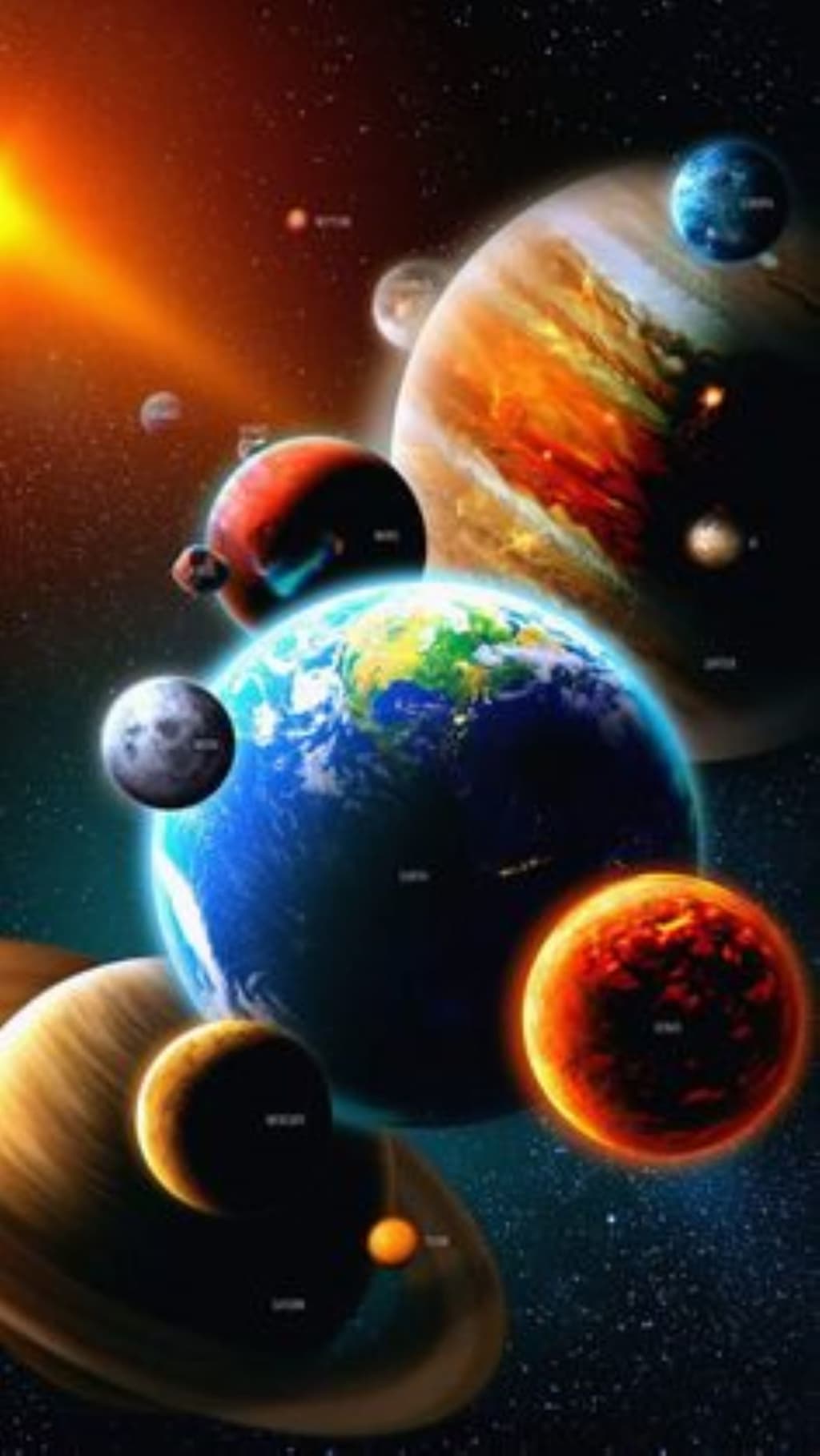
This is Earth
You reside in this area of the solar system, which is also where you reside in your neighborhood.
The distance between the Earth and the moon is shown here, and it doesn't appear to be that great.
Remember that the distance between the earth and the moon at their furthest point is 250,288 miles; every planet in our solar system might fit within that space, but let's speak about planets instead. Jupiter's Great Red Spot is roughly twice as large as Earth, and Saturn's rings are roughly nine times broader than Earth. Even though some of the pieces of Saturn's rings are as big as mountains, they are little compared to the size of our Sun.
Just keep in mind that you are looking at Earth from the Moon, Mars, Saturn's rings, and just beyond Neptune, all of which are four billion miles away. However, a billion is a large figure, so let's put that into perspective. In comparison to the size of our Sun, which is frighteningly large, the length of one million seconds is roughly eleven and a half days, while the length of one billion seconds is over 31 years. As Carl Sagan once quipped, the number of stars in the universe is greater than the total number of sand grains on all the beaches on the planet.
None of those compare to the size of a galaxy. In fact, if you shrink the size of our solar system down to the size of a quarter and then transverse the Milky Way galaxy using the same scale, the diameter of the Milky Way will be about the size of the United States. This is because the Milky Way galaxy is much larger than our little wimpy Sun. The biggest star we know of, V Y Canis Majoris, is about 2,000 times the diameter of our Sun.
An Old English noun with the most common spelling of eore evolved into the Modern English word Earth via Middle English. Every Germanic language has cognates for it, and *er has been identified as the ancestor root. The word eore was already being employed to translate the various meanings of the Latin word terra and the Greek letter g in its earliest attestation, including the ground, its soil, dry land, the human world, the surface of the earth (including the sea), and the globe itself. Earth may have been a personified goddess in Germanic paganism, similar to Roman Terra/Tell's and Greek Gaia. Late Norse mythology had Jör ('Earth'), a giantess who was frequently described as the mother of Thor.
Earth has traditionally been written in lowercase.The earth was used to indicate its definite notion as "the globe" starting in early Middle English. By the time of Early Modern English, nouns were typically capitalized. The earth was also written as the Earth, especially when it was mentioned among other celestial bodies. As a result of analogy with the names of the other planets, the name Earth has been used less frequently in recent years, however the word and its variations are still widely used.Oxford spelling now recognizes a variety of house styles, with the lowercase version being the most prevalent and the capitalized version being a valid alternative. Another convention has "Earth" written in lowercase when it comes before the word the, such as in "the atmosphere of the earth," but capitalizes it when it appears as a name (for example, "Earth's atmosphere").
About the Creator
Enjoyed the story? Support the Creator.
Subscribe for free to receive all their stories in your feed.
Comments
There are no comments for this story
Be the first to respond and start the conversation.