
He rowed all night and didn't knock.
And why it's the perfect antidote to doomscrolling.
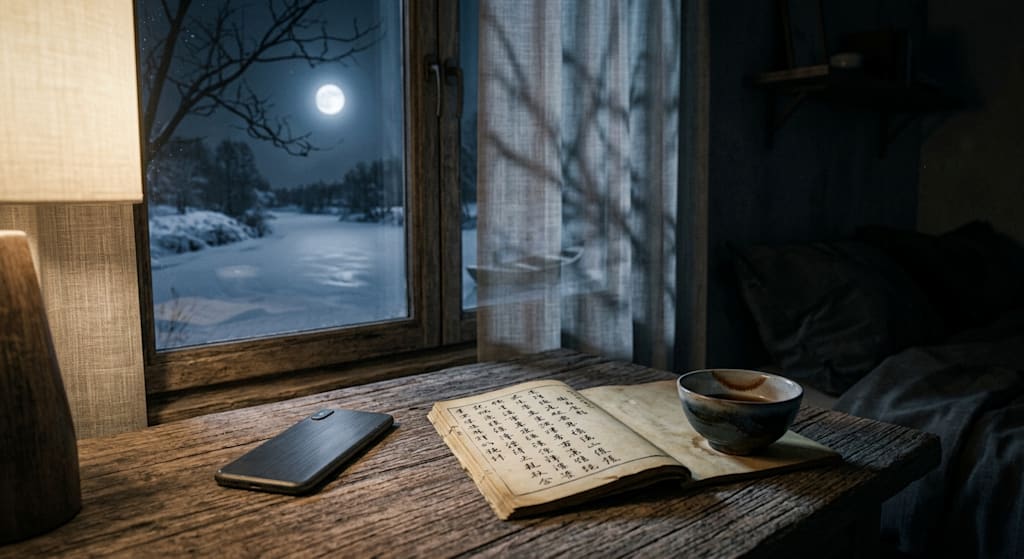
One in the morning. He put down his phone.
The screen went dark, reflecting a blurry face. Outside the window, the locust tree swayed in the wind. Leaves rubbed against leaves, the sound brittle. A dog barked twice in the neighboring house, then stopped.
He flipped through an old book on the table and came to the page of A New Account of the Tales of the World.
Wang Ziyou lived in Shanyin. One night it snowed heavily. He woke, opened his chamber, and called for wine. Looking out, all was white. Suddenly he thought of Dai Andao. At that time, Dai was in Shan, so Ziyou took a small boat and rowed through the night to reach him. After a full night he arrived at the gate, but turned back without entering. When asked why, he said: "I came on a whim, and when the whim was spent, I returned. Why must I see Dai?"
He stared at those four characters: xing jin – the fancy exhausted.
An ancient man visited a friend. He rowed a boat all night. At the door, he did not enter, turned, and left. The reason was that short – the mood was gone, so no need to step inside. Clean as a single footprint in fresh snow, clear to the eye.
He looked down at his phone. Tonight, he had scrolled for over three hours. Dozens of short videos. Laughed seven or eight times. Tapped "like" more than a dozen times. And then?
Then he had no answer. He lacked the ease of "when the fancy is spent." He only had a sore thumb. For the ancients, "spent" was a full stop – the sentence ended, the brush rested. For us today, "spent" is a frayed rope snapping, with no memory of what it had tethered, and no sense of where it falls.
Daytime was much the same.
Up at dawn, checking the phone. At noon, replying to hundreds of messages. Late at night, still fretting over tomorrow's affairs. Walking fast as the wind. Eating without tasting. Lying down without resting. Three sentences could consume an entire day – any more would be excess.
He recalled the morning commute on the subway. A girl in the seat next to him was crying into her phone. The carriage was packed, everyone tucked into their own small frames. No one looked at her. She finished crying, wiped her face with her sleeve, and kept thumbing down. The next video was a cat. The corner of her mouth twitched – a sort of smile.
That kind of crying – like a glass of water spilled onto concrete. No vessel to catch it. It flowed, evaporated, and left nothing.
Did the ancients have such moments?
They did. The Nineteen Old Poems say: "I do not mind the singer's toil, / Only grieve that few can hear the tune."
The ancients suffered because they sang and no one listened. We suffer because screens are flooded with "seen," yet no one truly hears. Different. One was absence; the other, excess. And in the end, absence and excess grew into the same shape.
He closed the book. The cover was worn, its corners curled like seashells licked by waves for years.
Outside, the wind picked up. The shadow of the locust tree swayed across the curtain – once, then again. Slowly. Like that ancient boat voyage, "a full night to reach" – so slow that the whole night was good for only one thing: going somewhere, or not.
Suddenly, he realized how extravagant Wang Ziyou's "fancy spent" really was. It required a whole night of snow, a whole night of rowing, a specific name, a specific road – just to deserve those two words. All he needed now was a flick of his thumb to exhaust that word a hundred times over. Used so often, the word grew thin, like a worn‑out sole letting in the wind.
He turned off the desk lamp.
In the dark, the phone's notification light kept blinking – blue, green, blue. He did not reach for it. He flipped it face down on the table.
On the table sat an old porcelain cup. The tea brewed that afternoon had long gone cold. At the bottom, a few unfolded tea leaves rested like sleeping minnows. Around the rim, a ring of brown stain – thin, indelible – from years of steeping.
He did not wash it.
He lay down, listening to his own breath. The leaves outside still rubbed against each other. Tomorrow morning, the cup would still be there, and the stain would still be there.
Time passes like that – not by scrolling, but by staying.
About the Creator
Jin
Writer of reamstories
https://reamstories.com/jin
Enjoyed the story? Support the Creator.
Subscribe for free to receive all their stories in your feed. You could also become a paid subscriber, letting them know you appreciate their work.
Comments
There are no comments for this story
Be the first to respond and start the conversation.