

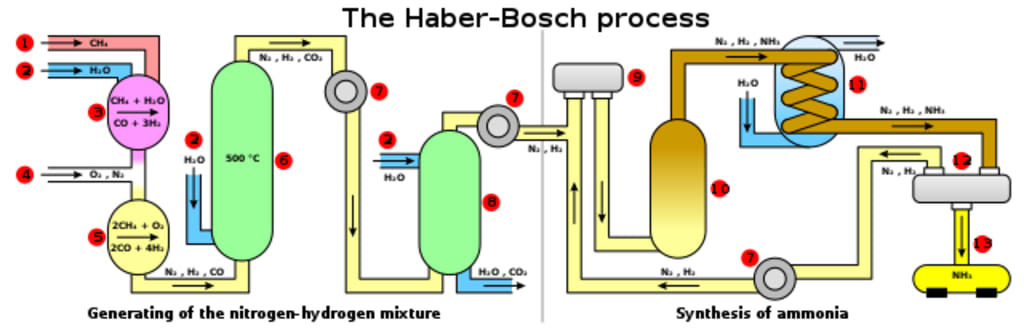
The Haber Process, also known as the Haber-Bosch process, is a method used to produce ammonia on a large scale. Ammonia (NH₃) is an essential chemical used in fertilizers, which help plants grow. Without this process, it would be difficult to grow enough food to feed the world's population.
This method was developed by a German scientist named Fritz Haber in the early 20th century, and later improved by Carl Bosch. The Haber Process has been a significant breakthrough in chemistry and agriculture because it allows us to produce ammonia efficiently.
Why is Ammonia Important?
Ammonia is a key ingredient in fertilizers. Fertilizers provide nutrients that plants need, such as nitrogen. Nitrogen is crucial for plant growth because it helps in making proteins and other important compounds in plants. Even though nitrogen is abundant in the air, plants cannot use it directly. The Haber Process converts nitrogen from the air into ammonia, which plants can use after it’s turned into fertilizers.
Ammonia is also used in other industries, like cleaning products and refrigeration, but its main use is in agriculture.
The Chemistry Behind the Haber Process
The main reaction in the Haber Process is combining nitrogen (N₂) from the air with hydrogen (H₂) to form ammonia (NH₃). The chemical equation looks like this:
N₂ (g) + 3H₂ (g) → 2NH₃ (g)
This reaction may look simple, but it's not easy to make happen. Nitrogen molecules (N₂) are very stable and don’t easily combine with hydrogen (H₂). The process requires specific conditions to work effectively.
Conditions Needed for the Haber Process
1. High Pressure: To make ammonia efficiently, the reaction must happen under high pressure. In the Haber Process, the pressure used is usually around 200 atmospheres. High pressure forces the nitrogen and hydrogen molecules together, increasing the chances of them reacting.
2. High Temperature: The reaction also needs high temperatures, usually around 450-500°C. At lower temperatures, the reaction happens too slowly. However, if the temperature is too high, the ammonia breaks down again. So, the temperature must be just right for a good balance.
3. Catalyst: To speed up the reaction, a catalyst is used. A catalyst is a substance that helps the reaction happen faster without being consumed itself. In the Haber Process, iron is used as the catalyst, with small amounts of other materials like potassium or aluminum to make it work better.
4. Recycling the Gases: In the Haber Process, not all of the nitrogen and hydrogen react the first time. To make sure nothing is wasted, the gases are recycled. The unreacted nitrogen and hydrogen are sent back through the system to react again.
How the Process Works Step-by-Step
1. Obtaining the Gases: The nitrogen used in the process is taken from the air, which is 78% nitrogen. The hydrogen is usually obtained from natural gas (methane, CH₄) through a process called steam reforming. In this process, methane reacts with steam to produce hydrogen and carbon dioxide.
2. Mixing and Compressing: The nitrogen and hydrogen gases are mixed in the correct ratio (1 part nitrogen to 3 parts hydrogen). The mixture is then compressed to a high pressure, about 200 times normal atmospheric pressure.
3. Heating and Reacting: The compressed gases are heated to around 450-500°C and passed over the iron catalyst. Under these conditions, the nitrogen and hydrogen react to form ammonia.
4. Cooling and Collecting: Once the gases have reacted, the mixture is cooled. As it cools, the ammonia condenses into a liquid and is separated from the unreacted nitrogen and hydrogen. The leftover gases are recycled back into the system to react again.
Efficiency and Environmental Impact
The Haber Process is highly efficient, but it does have some downsides. It requires a lot of energy to maintain the high pressure and temperature. Most of the hydrogen used in the process comes from fossil fuels like natural gas, which contributes to carbon dioxide emissions. This makes the Haber Process a significant contributor to climate change.
Scientists are working on finding more sustainable ways to produce ammonia, such as using renewable energy sources to obtain hydrogen from water instead of natural gas. This could reduce the environmental impact of the Haber Process in the future.
Conclusion
The Haber Process is one of the most important industrial processes in history. By turning nitrogen from the air into ammonia, it has revolutionized agriculture and helped feed billions of people. While it has some environmental challenges, ongoing research aims to make the process more sustainable. Without this method, the world would struggle to produce enough food for everyone.
er.
About the Creator
Enjoyed the story? Support the Creator.
Subscribe for free to receive all their stories in your feed.
Comments
There are no comments for this story
Be the first to respond and start the conversation.