
Greedy Algorithms in Python: Advantages, Examples & Uses
Programming | Algorithms
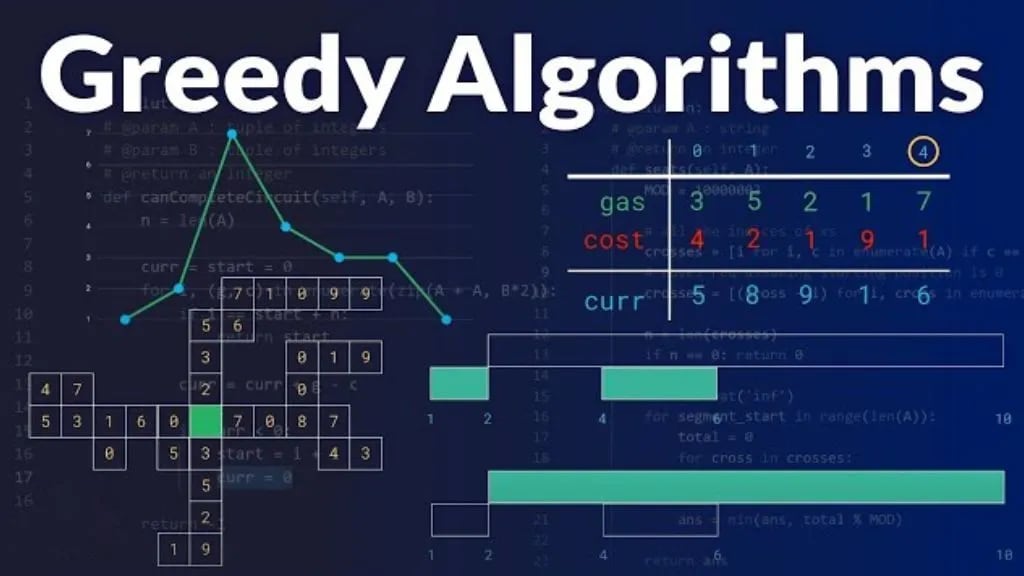
The Article is Originally published at mbloging.com on January 24, 2025.
As programmers, we are often tasked with solving problems as efficiently as possible. One of the simplest yet powerful problem-solving approaches is the greedy algorithm. While not universally applicable, greedy algorithms shine in scenarios where local decisions can lead to globally optimal solutions. They are especially useful in solving optimization problems, streamlining workflows, and tackling real-world challenges.
In this blog, we’ll explore what greedy algorithms are, how they work, their limitations, and where to use them effectively. Through detailed explanations and examples in Python and JavaScript, you’ll gain a deeper understanding of this essential algorithmic paradigm.
Table of Contents
- What is a Greedy Algorithm?
- Characteristics of Greedy Algorithms
- Advantages and Limitations
- When to Use Greedy Algorithms
- Common Types of Problems Solved with Greedy Algorithms
- Real-World Applications of Greedy Algorithms
- Examples of Greedy Algorithms
- Greedy Algorithms vs. Dynamic Programming
- Practical Tips for Implementing Greedy Algorithms
- Conclusion
- FAQs
What is a Greedy Algorithm?
A greedy algorithm is an approach to solving problems where decisions are made step-by-step, with each decision aimed at achieving the best possible outcome at that moment. Unlike other techniques, such as dynamic programming or backtracking, Greedy Algorithms do not look ahead or reconsider previous choices. They focus solely on local optimization, hoping to achieve a globally optimal solution.
Key Steps in Greedy Algorithms:
- Initialization: Start with an empty or partial solution.
- Greedy Choice: At each step, choose the most promising option.
- Repeat: Continue making greedy choices until the problem is solved.
Characteristics of Greedy Algorithms
1. Greedy Choice Property
The solution is built incrementally, choosing the option that appears best at each step.
2. Optimal Substructure
The problem can be divided into subproblems, and the optimal solution to the whole problem depends on the optimal solutions to its subproblems.
3. Irrevocable Decisions
Once a choice is made, it cannot be reversed.
Advantages and Limitations
Advantages
Simplicity: Greedy Algorithms are straightforward to comprehend and implement.
Efficiency: They typically run faster than exhaustive methods, with time complexity often around O(n log n) or O(n).
Real-Time Usage: Ideal for solving problems requiring immediate decisions.
Heap-based optimization: In Python, the heapq module can be leveraged to efficiently implement the greedy choice property by managing priority queues.
Limitations
Suboptimal Solutions: Greedy Algorithms do not always yield the optimal result, especially when the problem lacks the greedy choice property or optimal substructure.
Problem-Specific: Not all problems can be solved using a greedy approach.
When to Use Greedy Algorithms
Greedy Algorithms are most effective in problems that satisfy these conditions:
Greedy Choice Property: Making the best local decision at each step ensures an overall optimal solution.
Optimal Substructure: Breaking down the problem into smaller subproblems doesn’t affect the overall solution.
Examples of Problems:
Scheduling Problems: Activity selection, job sequencing.
Graph Problems: Minimum spanning trees, shortest paths.
Optimization Problems: Fractional knapsack problem.
Common Types of Problems Solved with Greedy Algorithms
1. Optimization Problems
These involve finding the best solution under given constraints. Examples include the knapsack problem and coin change problem.
2. Graph Problems
Greedy Algorithms are used in graph traversal and optimization, such as Prim’s algorithm and Kruskal’s algorithm for finding minimum spanning trees. For efficiency, Python’s heapq module is often utilized to maintain and extract the minimum weight edges.
3. Data Compression
Algorithms like Huffman Encoding use a greedy approach to minimize data size. The heapq module is crucial in implementing the priority queue required for building the Huffman tree.
Real-World Applications of Greedy Algorithms
- Networking: Optimizing bandwidth usage and routing data packets.
- Resource Allocation: Assigning resources efficiently in scheduling tasks or jobs.
- File Compression: Huffman coding in zip files or MP3 compression. The heapq module in Python aids in constructing the frequency-based priority queues for this purpose.
- Navigation Systems: Algorithms like Dijkstra’s are used in GPS systems to find the shortest path. Here, heapq can efficiently manage the priority queue for unvisited nodes.
- Financial Systems: Calculating the minimum number of coins or bills for transactions.
To dive deeper on this topic and get your hand's dirty then visit HERE
About the Creator
Muhaymin Mehmood
Solution-oriented Software Engineer with a strong foundation in the MERN stack, with a proven ability to build and maintain high-performance web applications.
Enjoyed the story? Support the Creator.
Subscribe for free to receive all their stories in your feed.
Comments
There are no comments for this story
Be the first to respond and start the conversation.