
"Glimpsing the Universe's Artistic Side"
Unraveling the Enigmatic Mysteries of the Northern Lights
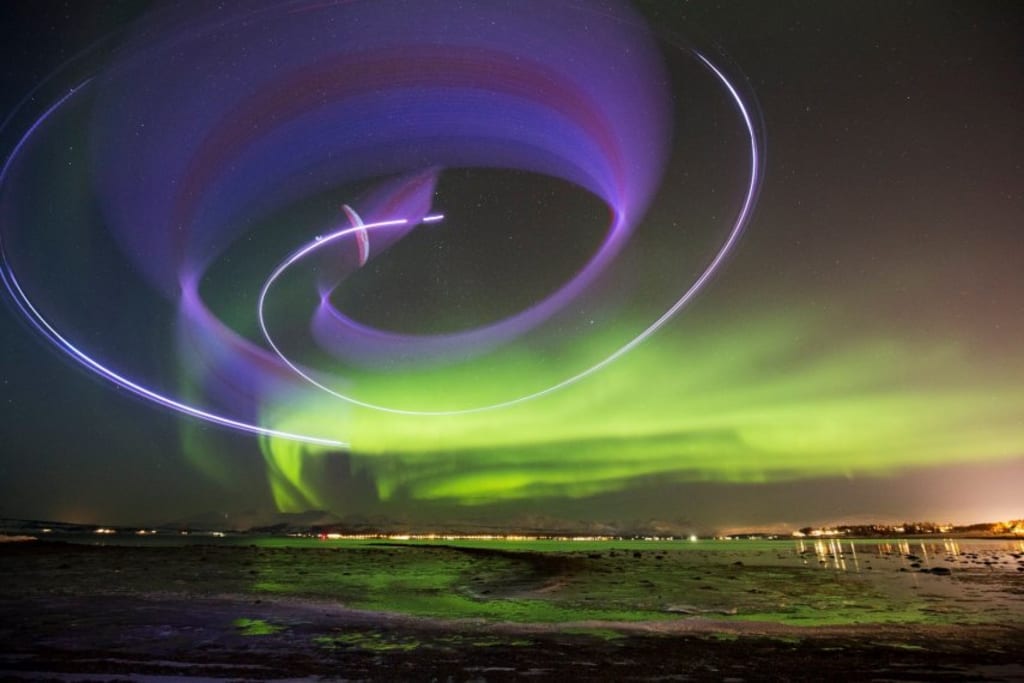
The Northern Lights, also known as Aurora Borealis, is one of the most spectacular natural phenomena that occurs in the polar regions of the Earth. It has fascinated humans for centuries, and yet, much of its mystery remains unsolved.
The Northern Lights occur when charged particles from the sun, also known as solar wind, collide with the Earth's magnetic field. As these charged particles enter the Earth's atmosphere, they collide with atoms and molecules of oxygen and nitrogen, releasing energy in the form of light. The colors of the Northern Lights depend on the type of atoms and molecules that the charged particles collide with. Oxygen atoms produce green and red colors, while nitrogen atoms produce blue and purple colors.
The Northern Lights have been observed and recorded by humans for thousands of years. In ancient times, people believed that the Northern Lights were a sign from the gods, a message from the spirits of the dead, or even a harbinger of war. Today, scientists have a better understanding of the physics behind the Northern Lights, but there are still many unanswered questions.
One of the most intriguing mysteries surrounding the Northern Lights is why they appear in the shapes and patterns that they do. The Northern Lights can take on many different forms, from swirling curtains to shimmering arcs, to spiraling rays. Scientists believe that the shape and movement of the Northern Lights are influenced by the strength and direction of the solar wind, as well as the shape of the Earth's magnetic field.
Another mystery of the Northern Lights is why they appear to be more active during certain times of the year. The Northern Lights are most visible in the winter months in the polar regions, but they can also be seen in the summer months. Scientists believe that this is due to the tilt of the Earth's magnetic field, which is tilted towards the sun during the summer months, and away from the sun during the winter months.
Scientists are also interested in studying the Northern Lights because of the impact they have on our planet. The charged particles that create the Northern Lights can disrupt communication systems, power grids, and satellite operations. By studying the Northern Lights, scientists hope to better understand how to protect our technology from the effects of solar storms.
The intensity of the Northern Lights ‘dancing’ in the skies is dependent on how big the sun’s solar flares are, which are enormous explosions on the surface of the sun that occur when a build-up of magnetic energy in the sun’s atmosphere is suddenly released. These solar flares occur near sunspots, which are areas on the sun’s surface that appears dark because they are cooler than the surrounding areas. The sunspots can be enormous in size with one particular one measured to be around 62,000 kilometres across, about five times the width of Earth. Meanwhile, the level of solar activity varies along with the amount of magnetic flux rising to the sun’s surface with the average cycle taking around 11 years. At times of high solar activity there can be up to a 100 or more solar spots on the sun’s surface releasing solar flares and particles out into space.
Lights can take on many different forms, from swirling curtains to shimmering arcs, to spiraling rays. Scientists believe that the shape and movement of the Northern Lights are influenced by the strength and direction of the solar wind, as well as the shape of the Earth's magnetic field.
In conclusion, the Northern Lights remain one of the most fascinating and mysterious natural phenomena on Earth. While scientists have made great strides in understanding the physics behind the Northern Lights, there is still much to learn. The Northern Lights remind us of the wonder and beauty of the natural world and inspire us to continue exploring and discovering the mysteries that surround us.
About the Creator
Enjoyed the story? Support the Creator.
Subscribe for free to receive all their stories in your feed.
Comments
There are no comments for this story
Be the first to respond and start the conversation.