
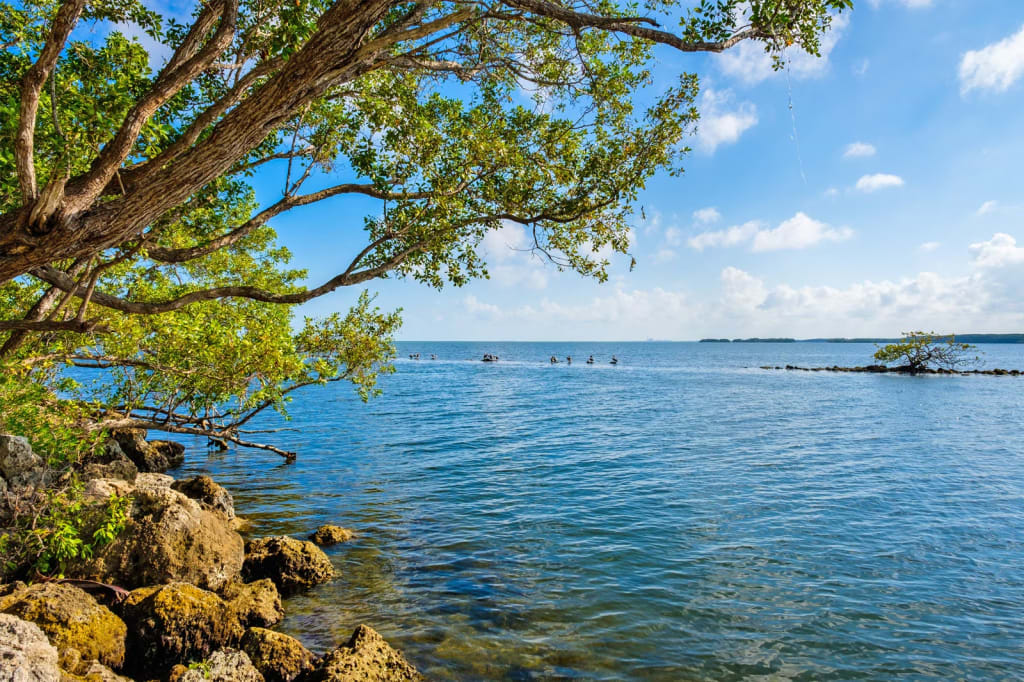
The Florida coast is home to one of the largest animal gatherings in the U.S. Millions of mullet swim south, past Miami Beach, toward a very special national park—a journey full of danger. They have ten miles to go before they reach Biscayne National Park, but first, they must survive a gauntlet of predators.
Biscayne National Park sits right on Miami's doorstep. Its inviting waters are home to one of Florida's most iconic creatures: the manatee. These gentle giants thrive here, thanks to one of the planet's most vital habitats: seagrass meadows, the rainforests of the sea. Seagrasses provide oxygen, store carbon, and help protect our natural world.
For a manatee mom and her calf, the park is a perfect place to find what they need: warm, shallow water and an abundance of seagrass. A manatee needs to eat about 66 pounds of seagrass a day, and nearly half of the park’s waters are covered in seagrass. Once full, the mother can relax and nurse her calf. The family spends the summer grazing, traveling past the park’s tropical mangrove forests and islands.
However, finding good grazing spots is becoming more challenging. Pollution and algal blooms are choking Florida's seagrass meadows, blocking sunlight and causing the grasses to die. Since the 1950s, Florida has lost half of its seagrass beds, contributing to the decline of manatee populations. Yet, Biscayne’s seagrass meadows remain a crucial sanctuary, offering a lifeline to the manatees.
Biscayne’s seagrass also supports one of its smallest residents: the dwarf seahorse. At just an inch long, these tiny creatures are surprisingly poor swimmers. To avoid being swept away, they use their tails to anchor themselves to seagrass. They feed by rapidly sucking in passing plankton—so fast that if you blink, you might miss it. But what makes them truly fascinating is their reproduction. In the seahorse world, it’s the males that carry the babies. After the female lays her eggs in his pouch, he carries them until they hatch, around 11 days later.
When the babies emerge, they’re on their own, but some are reluctant to leave their father’s protective pouch. Seahorse dads can give birth to up to 16 young at once, and while they have a relatively high survival rate, their future is tied to the health of the seagrass beds. Thankfully, Biscayne’s waters are a safe haven for these tiny creatures.
Ninety-five percent of Biscayne National Park is underwater, with its seagrass and resident seahorses protected by the third-largest coral reef in the world. This coral barrier, stretching 360 miles, provides a vital shield from the Atlantic Ocean, protecting the park’s wildlife and shielding the six million people who live nearby from storm surges.
The coral reef is one of the park's unsung heroes, but it also marks the boundary where another formidable predator roams: the American crocodile. Weighing 400 pounds and measuring up to 10 feet long, these crocodiles are expert ambush hunters. Although they have a fearsome reputation, American crocodiles are not man-eaters. They are a success story of conservation—by the early 1970s, fewer than 300 American crocodiles remained in Florida, but thanks to efforts like the creation of Biscayne National Park and the nearby Turkey Point nuclear plant, their numbers have risen into the thousands.
One crocodile mom has recently buried about 30 eggs in a shallow nest. As she checks on her clutch, she listens for the chirping sounds of the eggs. The hatchlings are about a foot long, equipped with sharp teeth, but breaking free from the tough eggshells is no easy task. If they’re lucky, they’ll make it out in time for their mom to help them reach the water, where she’ll protect them until they’re strong enough to fend for themselves.
Biscayne’s mangrove forests are another key part of the park’s ecosystem. These saltwater-loving trees absorb the power of storm surges, protecting the coastline from erosion. They also store carbon, playing a crucial role in combating climate change. Beneath the tangled roots of the mangroves, a hidden world thrives—a perfect nursery for fish, providing shelter and safety before they venture out to the reef.
Even predators like juvenile lemon sharks use the mangroves as a hunting ground, learning how to stalk their prey. In this world of constant movement, patience is key, and the sharks will hunt here until they’re old enough to move to the open waters of Florida’s coastal shallows.
Biscayne’s shores also host returning visitors from far away, like the female loggerhead turtles. After traveling thousands of miles, they return to the very beach where they hatched to lay their eggs. Once she’s dug a deep hole for over 100 eggs, her job is done. The hatchlings will emerge on their own, starting their own perilous journey toward the sea. But predators like ghost crabs can be a threat, and one hatchling is nearly caught, until a lucky flick of sand helps her escape.
Once free, the young turtle faces an epic journey across the ocean. She’ll head toward the Sargasso Sea, where she’ll feed until she’s big enough to survive the vast ocean. As these hatchlings head out to sea, they might pass by Stiltsville, a historic collection of wooden houses built during the Prohibition era. Today, these structures are home to cormorants that dry off between fishing trips, but in the past, they were a hub for drinking and gambling.
Biscayne National Park’s 4,000 acres of offshore islands include Elliott Key, home to a rare and ancient ecosystem—the hammock forest. This dense, damp habitat once spanned much of the Florida Keys but has become one of North America’s rarest environments. Elliott Key was used by the Tequesta people for thousands of years and later by fishermen. In the 1960s, plans to develop the island were halted by public opposition, and the park was established in 1968.
Today, Elliott Key is home to the Schaus’ swallowtail butterfly, a species nearly driven to extinction. In 2012, only four butterflies were found in the wild, but thanks to conservation efforts, more than 1,600 butterflies have been released into the wild. Today, 53 more are being released, and they will mate, lay eggs, and die, helping to establish the next generation.
Meanwhile, on the beaches of Biscayne, loggerhead hatchlings are making their way to the sea, except for one. This little turtle is all alone, vulnerable to predators. As she struggles to escape a ghost crab, she’s lucky enough to survive and make it to the water, but the dangers are far from over. She now begins her journey to the Sargasso Sea, where she will grow strong enough to navigate the open ocean.
Biscayne National Park isn’t just about marine life. The sun’s powerful rays can trigger reactions in the park’s coral communities, which have developed their own form of sunscreen. Inside the coral’s cells live tiny algae called zooxanthellae, which photosynthesize, providing the coral with its vibrant color. These algae are sensitive to ultraviolet light, so they produce a protein that absorbs harmful rays and re-emits them as colorful light, protecting themselves from the sun.
As summer thunderstorms roll in, Biscayne National Park faces the challenges of rising tides. Even the fire ants, an invasive species, have developed a clever survival strategy: when their nests are flooded, the colony forms a living raft, keeping the queen and larvae dry in the center. The ants can survive like this for weeks, waiting for the waters to recede.
Biscayne’s wildlife follows the changing seasons. In early fall, millions of mullet travel south along the coast toward Biscayne National Park to spawn. The fish face numerous predators, from sharks and tarpon to birds waiting for an opportunity to strike. But the mullet's enormous numbers give them a fighting chance, and when the time comes to spawn, they do so in massive schools, ensuring the survival of the next generation.
Biscayne National Park stands at the forefront of efforts to combat climate change, supported by dedicated scientists and volunteers. In doing so, it continues to protect both the human and wildlife inhabitants of Southeast Florida, reminding us all of the vital importance of preserving our national parks.
About the Creator
Enjoyed the story? Support the Creator.
Subscribe for free to receive all their stories in your feed.
Comments