
Fearful Avoidant vs Dismissive Avoidant: How to Tell
Fearful avoidant vs dismissive avoidant: one is hot and cold, the other stays cold. Here's how to tell which you're dating and what it means next.

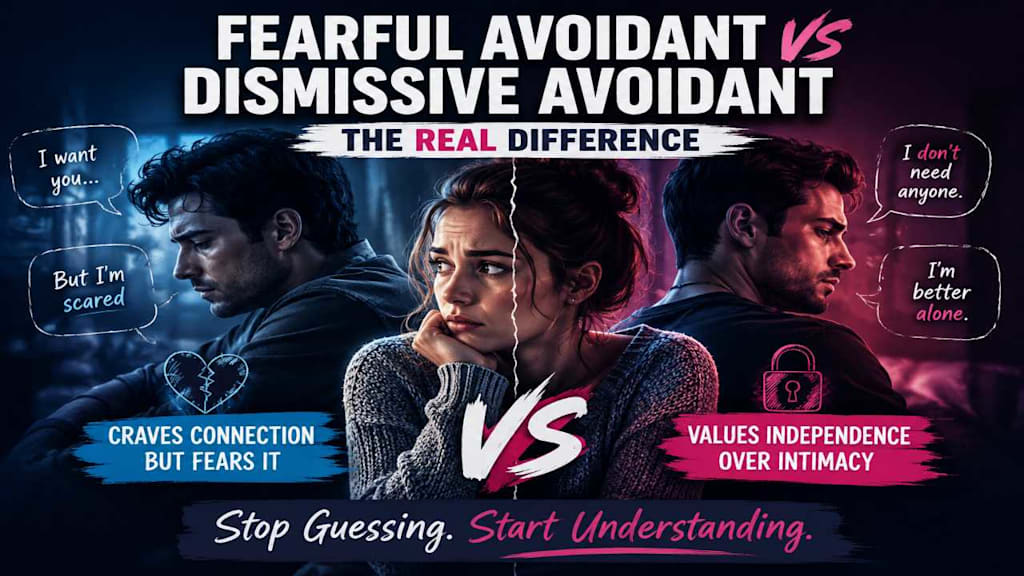
She sent the text while he was in the room. Something about the weekend. He looked at his phone, set it down, kept scrolling. She watched his face, waiting for a reaction that never came. The silence grew until it felt like a third person on the couch.
Later she stared at her phone, re-reading where he called her beautiful. She hunted for proof she hadn't imagined it all. Her chest tightened in a way she now recognized. She already knew the word avoidant. What she needed was the difference between fearful avoidant vs dismissive avoidant not for a label, but to know if the man she loved could actually stay.
She had read two other articles already. Both explained attachment theory in clean paragraphs that made sense on paper and dissolved the moment she closed the tab. She didn't need a lecture. She needed someone to describe the moment she just lived through. She needed to know if the confusion was in her head or in the dynamic. She needed language that fit her life, not her search history.
I spent months of our separation convinced I was the problem. I replayed conversations in my head, looking for the sentence where I'd gotten it wrong. It took a long time to understand that I wasn’t looking for what I’d done wrong. I was looking for a way to feel in control of something I couldn't control. That need to find the error in myself is what every woman in this situation understands before she understands anything else.
Why Does He Go Cold Right When Things Feel Good?
Maya had been seeing Daniel for four months. The opening weeks felt like something out of a movie. He texted her constantly, remembered the name of her childhood dog, and once drove a long way to bring her soup when she was sick. He talked about the future in a way that made her believe he meant it. Then, without warning, he stopped initiating plans.
When she asked if everything was okay, he said he was just busy. But his eyes looked different. Distant, like he was watching her from behind glass. She felt the shift in her body before her mind could name it.
Then he showed up at her apartment with flowers and an apology. He said he didn't know why he pulled away. He missed her. He wanted to try again. Maya felt relief flood through her chest, followed immediately by dread.
Because she knew, even as she let him in, that he would leave again. And he did. The third time it happened, she stopped telling her friends. She was too embarrassed to say out loud that she was still hoping.
This is the push-pull relationship dynamic that defines dating a fearful avoidant man or woman. They want closeness desperately, but closeness triggers a fear of intimacy that makes them run. According to the Attachment Project, fearful avoidants score high on both avoidance and anxiety scales. They crave connection and are terrified of it at the same time. That inner conflict doesn’t look like a steady withdrawal.
It looks like hot and cold behavior that keeps you spinning. You never know which version of him you will get. The loving one feels real. The distant one feels real too. That is what makes it so hard to trust your own perception.
The question "why does he pull away then come back" isn't about you. It's about a disorganized attachment pattern where the same person who offers safety also feels like a threat. John Bowlby attachment theory, developed in the 1960s, and the Mary Ainsworth Strange Situation experiments described how early bonds with caregivers create internal working models that shape adult relationships.
For someone with a fearful avoidant attachment style, those early experiences taught them that love is unpredictable sometimes nurturing, sometimes dangerous. Their adult relationships become rehearsals of that same confusion. They are not trying to hurt you. They are trying to survive a feeling they never learned to name.
The Difference Nobody Explains Clearly Enough
Most articles describe fearful avoidant vs dismissive avoidant in parallel columns, as if the only difference is the degree of anxiety. That isn’t the insight that helps you. Here is what actually matters. A dismissive avoidant's distance feels consistent. They are reliably cold.
You learn not to expect warmth, and in a strange way, that consistency becomes its own kind of stability. You know where you stand because you stand nowhere. A fearful avoidant's distance feels confusing. They themselves don't know what they want. That inconsistency is not mixed signals from him.
A war is happening inside him. When you look at fearful vs dismissive avoidant behavior side by side or dismissive vs fearful avoidant, depending on how you searched the consistency versus confusion pattern becomes obvious. Research from Wardecker and colleagues, published in the Encyclopedia of Personality in 2020, found that dismissive avoidants use a cognitive strategy called deactivation. They consciously suppress attachment-related thoughts to maintain distance.
It's not that they don't feel anything. It's that they have trained themselves to shut the feeling down before it reaches their face. You could cry in front of a dismissive avoidant and watch him become still and logical, not because he doesn’t care, but because he has already decided that feelings are problems to be managed rather than truths to be shared.
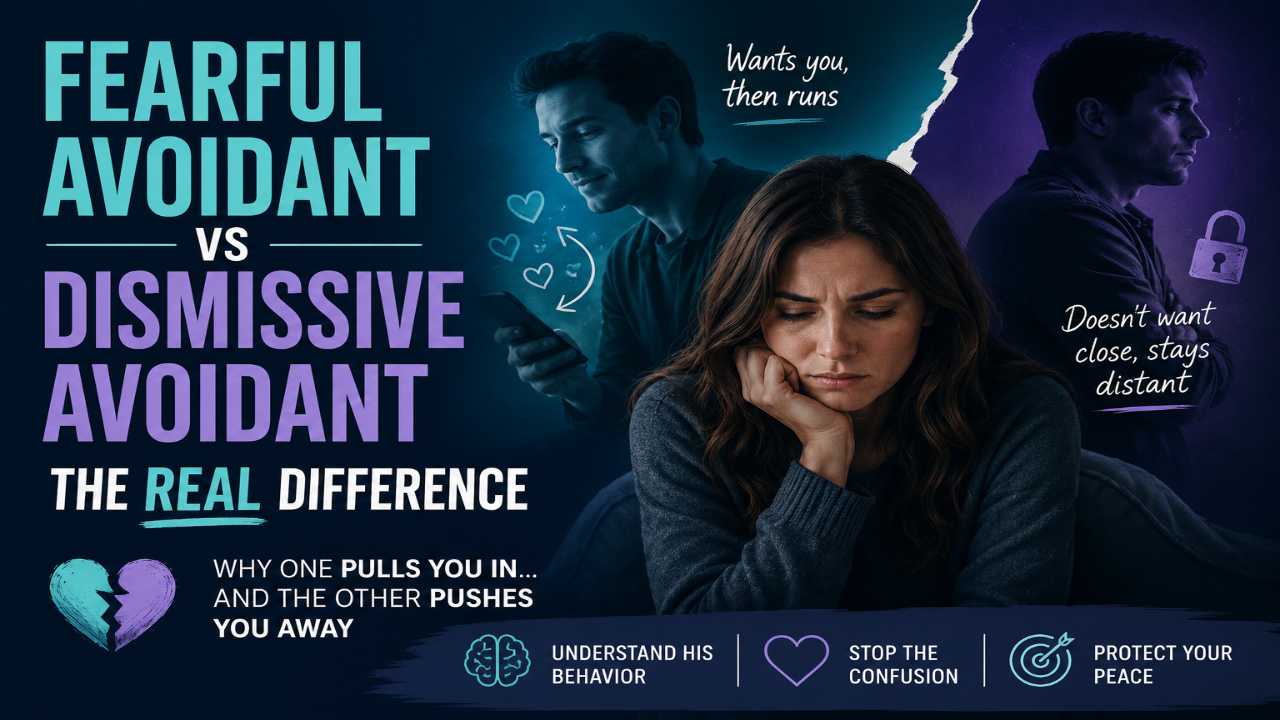
Chateau Recovery describes the core difference in self-view. Dismissive avoidants hold a high view of themselves and a low view of others. They genuinely believe they don't need anyone. Fearful avoidants carry low self-esteem but still crave closeness. They need you desperately and believe they will ruin it.
This is why dating a fearful avoidant woman or man feels so different from dating a dismissive avoidant. With a dismissive partner, you learn to read the absence. With a fearful partner, you learn to read the contradictions. The dismissive avoidant's emotional withdrawal is a strategy. The fearful avoidant's emotional withdrawal is a panic response.
Both are forms of emotional unavailability, but they require different responses from you. You cannot love a dismissive avoidant into softness by being patient. You cannot love a fearful avoidant into stability by being understanding. Both need something you cannot give them, which is their own willingness to look inward.
Mission Connection Healthcare estimates that roughly 20% of American adults have a dismissive-avoidant attachment style, while 7 to 25% exhibit fearful-avoidant patterns. You are not imagining the difference. It is real, and it matters for what you do next. The man who is consistently absent requires a different conversation than the man who is present and absent in turns. One has chosen his wall. The other is still building his, and he keeps tearing it down to let you in, then rebuilding it when you get too close.
What His Behavior Is Actually Telling You
Let's look at the avoidant partner signs through a different lens. Priya had been with her partner for two years. She kept asking herself, "does he love me or is he avoidant?" She made lists of his good moments to balance against the bad ones. She told herself that if she just found the right way to ask for what she needed, he would finally hear her.
She practiced her requests in the mirror. She softened her tone. She made herself smaller and smaller, until she realized she had disappeared and he still hadn't moved toward her.
Self-reliance vs fear of closeness is the tension at the heart of every avoidant attachment style. Dismissive avoidants solve it by deciding they don't need anyone. Fearful avoidants solve it by wanting someone and then punishing themselves for the wanting. When you understand this, you stop looking for the magic sentence that will make him stay. You start looking at whether he has the capacity to stay, and whether he is doing anything to build that capacity.
That shift is subtle but enormous. It moves you from trying to fix the relationship to trying to see it clearly. The American Psychological Association has noted that attachment patterns are not fixed. They can shift with therapy and consistent emotional safety. But they do not shift because you loved him hard enough.
This is a painful truth, and it is the one that will set you free. If you're still trying to figure out which pattern you're facing, our free relationship psychology quiz can help you name what you're seeing without having to diagnose him yourself. Sometimes clarity starts with understanding your own reactions to the chaos, not just his role in creating it.
Understanding this doesn’t fix anything overnight. But it does change the first thing that needs to change which is how you see yourself in this. You're not too sensitive. You're not imagining it. You're a person who learned to love in a way that made sense given what you were taught. So was he.
The difference is that you are here, reading this, trying to understand. That matters. It means you are no longer willing to live inside a confusion that he may never name. The question is no longer whether he will change. The question is whether you can tolerate the truth of who he is right now, and what that truth means for the future you want.
That is a different kind of power. It doesn’t feel like power at first. It feels like grief. But grief is honest, and honesty is what moves you forward.
If You're Still Trying to Figure Out What This Means for You
Look. You've been trying to sort this out alone for a while. You've read the articles. You've made the lists. You've had the conversations in your head that you can't quite have out loud. There is a difference between understanding attachment theory and understanding your specific situation.
One gives you vocabulary. The other gives you a path. You need both, but you especially need the one that tells you what to do on the days when he doesn’t text back and you are trying not to spiral.
You don't need to have all the answers yet. You don't need to know whether to stay or go. What you need is a starting point that isn’t just more searching when you can't sleep. A way to see your own patterns clearly, so you can decide what you actually want instead of just reacting to what he does.
Sometimes it helps to step back and look at the relationship as a whole rather than focusing on one behavior or one conversation. If you're curious about that perspective, I put together a relationship psychology quiz that explores some of these dynamics in more detail.
Questions Women Ask About Avoidant Partners
Why does he pull away then come back?
He pulls away because closeness triggers his fear of intimacy, and he comes back because he genuinely misses you. For someone with a fearful avoidant attachment style, these two truths exist at the same time. He is not manipulating you. He is caught between wanting connection and being terrified of what connection might cost him. Until he addresses that internal conflict, the cycle will repeat regardless of how understanding you are.
Does he love me or is he avoidant?
He can be avoidant and still love you. Those two things are not mutually exclusive. The real question is whether his love translates into the safety and consistency you need, because love without capacity is its own kind of heartbreak. An avoidant partner signs checklist might tell you what he feels, but it cannot tell you whether what he feels is enough to build a life on. That answer lives in his actions over time, not in his words during the good moments.
Can two people with avoidant attachment be together?
Two avoidant people can be together, but the relationship often becomes a silent agreement to never need each other too much. There is little conflict and even less closeness. According to the American Psychological Association, attachment patterns can shift with therapy and consistent emotional safety, but both people have to want that shift. Without that mutual willingness, the relationship functions more like a partnership of isolation than a marriage of connection.
How do I know if I'm dating a fearful avoidant man or a dismissive avoidant man?
Dating a fearful avoidant man feels like standing in a room where the temperature keeps changing. Dating a dismissive avoidant man feels like standing in a room where the thermostat is broken in one direction. The fearful avoidant gives you just enough warmth to keep you hoping, then withdraws in confusion. The dismissive avoidant withdraws with intention, using a deactivation strategy to keep you at a distance he has already decided is necessary. One is a war inside him, and the other is a wall he built long ago.
AUTHOR BIO
I'm Kiran. I spent seven months separated from my husband Mehul after fifteen years of marriage, and I started UnderstandShe because I remember exactly what it felt like to search for answers at midnight and find nothing that actually helped. I write for the woman who is still hoping and for the one who is finally ready to stop hoping and start seeing.
About the Creator
Understandshe
I write about healing, self-growth, and the messy but beautiful journey of becoming. Honest lessons, real stories, and gentle insights you’ll also find on UnderstandShe.
Enjoyed the story? Support the Creator.
Subscribe for free to receive all their stories in your feed.
Comments
There are no comments for this story
Be the first to respond and start the conversation.