
Farthest Man-made Miracle
nasa's extraordinary discoveries about space
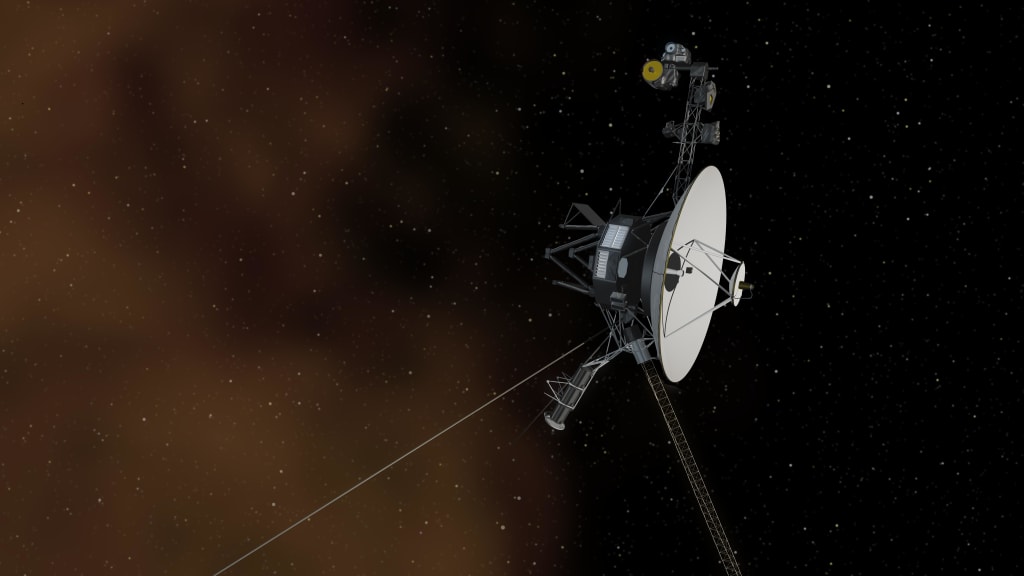
Voyager 1
Voyager 1 is a space probe launched by NASA on September 5, 1977. It is currently in interstellar space, which is the region beyond the outer boundary of our solar system. The probe has been traveling through space for more than four decades and is now approximately 22 billion km away from Earth.
It is the first human-made object to leave the solar system and it is still sending data back to Earth even though it is out of the range of the sun's energy, it is still operating on its secondary power source, a radioisotope thermoelectric generator (RTG), which converts the heat from the decay of radioactive plutonium-238 into electricity.
Voyager 1 is still operational and continues to send data back to Earth, providing new insights into interstellar space and the environment surrounding our solar system. It has been used to study interstellar magnetic fields, plasma, and cosmic rays, among other things. The Voyager spacecraft is roughly the size of a small car and is composed of three main parts: the bus, the instruments, and the RTG power source. The bus is the main structural component of the spacecraft and provides support for the other systems. It also houses the computer, communication equipment, and control systems.
The instruments are housed in a cylindrical section mounted on top of the bus. These include a variety of scientific instruments designed to study the solar system and interstellar space. Some of the instruments include cameras, spectrometers, and magnetometers.
The RTG power source is a cylindrical section mounted on the bottom of the bus. It contains the radioisotope thermoelectric generators (RTGs) that provide power for the spacecraft. The RTGs convert the heat from the decay of radioactive plutonium-238 into electricity.
The spacecraft also have two large, golden, phonograph-record-shaped covers, each encasing a 12-inch gold-plated copper disk containing a variety of information about Earth and its inhabitants, including sounds and images selected to portray the diversity of life and culture on Earth, and a message from President Jimmy Carter.
Top 17 facts about Voyager 1
1. Voyager 1 is a space probe launched by NASA on September 5, 1977.
2. It is the first human-made object to leave the solar system, crossing the heliosphere and entering interstellar space on August 25, 2012.
3. Voyager 1 carries a golden record that contains images and sounds of Earth, along with a message from humanity, in the event that it comes into contact with extra-terrestrial life.
4. The probe is powered by three radioisotope thermoelectric generators (RTGs) that convert the heat from the decay of radioactive plutonium-238 into electricity.
5. Voyager 1 has studied Jupiter, Saturn, and their moons, and has also been used to study interstellar magnetic fields, plasma, and cosmic rays.
6. The probe has been traveling for more than 43 years and is now more than 22 billion km away from Earth.
7. Voyager 1's mission was originally planned to last five years, but it continues to operate to this day and is expected to continue sending data back to Earth until around 2025.
8. The spacecraft's last planetary encounter was Saturn in 1980, after that its primary mission was completed and it has been flying in interstellar space since 2012.
9. Voyager 1's twin probe, Voyager 2, was also launched in 1977 and has also been used to study the outer planets and interstellar space.
10. In March 2020, NASA announced that Voyager 1 had detected a new type of radio signal, known as a "continuum" signal, in interstellar space. This is the first time such a signal has been detected, and it is providing new insights into the nature of the interstellar medium.
11. Voyager 1's instruments are still in good working order, despite being well beyond their design life.
12. The spacecraft's original mission was to study Jupiter and Saturn, but after the successful completion of its primary mission, it was sent to study the outer planets and interstellar space.
13. Voyager 1's golden record is a 12-inch gold-plated copper disk that contains a variety of information about Earth and its inhabitants, including sounds and images selected to portray the diversity of life and culture on Earth, and a message from President Jimmy Carter.
14. Voyager 1's cameras have taken thousands of images of Jupiter, Saturn, and their moons, as well as of the interstellar medium.
15. The probe's magnetometer has been used to study the magnetic field of the heliosphere and the interstellar medium.
16. Voyager 1's cosmic ray subsystem has been used to study galactic cosmic rays and energetic particles in the heliosphere and interstellar space.
17. The probe's plasma science experiment has been used to study the solar
Voyager 2
Voyager 2 is a space probe launched by NASA on August 20, 1977, as part of the Voyager program to study the outer Solar System. The probe, along with its twin Voyager 1, was designed to study the gas giants Jupiter and Saturn and their moons, as well as the outer planets Uranus and Neptune. The Voyager 2 probe is still active and continues to transmit data back to Earth, making it the longest-operating spacecraft to date.
One of the most significant discoveries made by Voyager 2 was the existence of active volcanoes on Jupiter's moon Io. The probe also discovered the rings of Uranus and revealed the planet's complex atmosphere and weather patterns. In addition, Voyager 2 revealed the existence of previously unknown moons and ring systems around Uranus and Neptune.
Like its twin Voyager 1, Voyager 2 also carries a golden record that contains images and sounds of Earth, along with a message from humanity, in the event that it comes into contact with extra-terrestrial life. The probe is powered by three radioisotope thermoelectric generators (RTGs) that convert the heat from the decay of radioactive plutonium-238 into electricity.
Voyager 2 has been traveling for more than 43 years and is now more than 18 billion km away from Earth. The probe's mission was originally planned to last five years, but it continues to operate to this day and is expected to continue sending data back to Earth until around 2025.
In 1986, Voyager 2 became the first spacecraft to visit Uranus and in 1989, it became the first spacecraft to visit Neptune, providing the first close-up images of the planet and its moons.
Top 20 facts about Voyager 2
1. Voyager 2 is a space probe launched by NASA on August 20, 1977, as part of the Voyager program to study the outer Solar System.
2. The probe, along with its twin Voyager 1, was designed to study the gas giants Jupiter and Saturn and their moons, as well as the outer planets Uranus and Neptune.
3. Voyager 2 is still active and continues to transmit data back to Earth, making it the longest-operating spacecraft to date.
4. One of the most significant discoveries made by Voyager 2 was the existence of active volcanoes on Jupiter's moon Io.
5. Voyager 2 discovered the rings of Uranus and revealed the planet's complex atmosphere and weather patterns.
6. The probe revealed the existence of previously unknown moons and ring systems around Uranus and Neptune.
7. Like its twin Voyager 1, Voyager 2 also carries a golden record that contains images and sounds of Earth, along with a message from humanity.
8. The probe is powered by three radioisotope thermoelectric generators (RTGs) that convert the heat from the decay of radioactive plutonium-238 into electricity.
9. Voyager 2 has been traveling for more than 43 years and is now more than 18 billion km away from Earth.
10. The probe's mission was originally planned to last five years, but it continues to operate to this day and is expected to continue sending data back to Earth until around 2025.
11. In 1986, Voyager 2 became the first spacecraft to visit Uranus and in 1989, it became the first spacecraft to visit Neptune, providing the first close-up images of the planet and its moons.
12. Voyager 2's cameras have taken thousands of images of Jupiter, Saturn, Uranus and Neptune, as well as of the interstellar medium.
13. The probe's magnetometer has been used to study the magnetic field of the heliosphere and the interstellar medium.
14. Voyager 2's cosmic ray subsystem has been used to study galactic cosmic rays and energetic particles in the heliosphere and interstellar space.
15. The probe's plasma science experiment has been used to study the solar wind and the interstellar medium.
16. Voyager 2's ultraviolet spectrometer has been used to study the atmospheres of Jupiter, Saturn, Uranus and Neptune, as well as the interstellar medium.
17. Voyager 2's radio science experiment has been used to study the atmospheres of Jupiter, Saturn, Uranus and Neptune, as well as the interstellar medium.
18. The probe's instruments are still in good working order, despite being well beyond their design life.
19. Voyager 2's mission was to study Jupiter, Saturn, Uranus and Neptune, but after the successful completion of its primary mission, it was sent to study the interstellar medium.
20. Voyager 2's golden record is a 12-inch gold-plated copper disk that contains a variety of information about Earth and its inhabitants, including sounds and images
Voyager 1 and 2 missions and objectives:
The Voyager 1 and 2 missions were launched by NASA in 1977 as part of the Voyager program, with the primary objective of studying the outer planets Jupiter and Saturn, as well as their moons and rings. The probes were also designed to study the outer planets Uranus and Neptune, which had not been visited by a spacecraft before.
Some of the specific objectives of the Voyager mission were to:
• Investigate the atmosphere, magnetic fields, and moons of Jupiter and Saturn
• Study the ring systems of Jupiter and Saturn
• Investigate the atmosphere and moons of Uranus and Neptune
• Study the magnetic fields and particles in the interplanetary medium
• Measure the solar wind and its interaction with the outer planets
• Search for evidence of a heliopause (the boundary between the solar wind and the interstellar medium)
• Study the interstellar medium using the probes' instruments after they pass beyond the solar system.
• In addition to these scientific objectives, the Voyager probes also carried a Golden Record, which contains a message and images from humanity in the event that the probes are intercepted by extra-terrestrial life. The Voyager mission has provided a wealth of scientific data and discoveries, and the probes continue to transmit data back to Earth as they explore interstellar space.
Discoveries made by Voyager 1 and 2:
Voyager 1 and 2 have made a wealth of scientific discoveries during their missions. Some of the most significant discoveries made by the two probes include:
Active volcanoes on Jupiter's moon Io: Voyager 1 and 2 were the first spacecraft to study Io in detail, and they discovered that the moon has several active volcanoes that spew molten Sulphur and other materials.
The rings of Uranus: Voyager 2 was the first spacecraft to visit Uranus and it discovered that the planet has a complex system of rings, some of which were not known to exist before.
The Great Dark Spot on Neptune: Voyager 2 discovered a giant storm system on Neptune, known as the Great Dark Spot, which was similar in size to Earth.
The magnetic field of Uranus: Voyager 2 discovered that Uranus has a tilted magnetic field that is inclined at a large angle relative to the planet's rotation axis.
The existence of new moons and ring systems around Uranus and Neptune: Voyager 2 discovered several previously unknown moons around Uranus and Neptune, as well as ring systems around both planets.
The solar wind and its interaction with the outer planets: Voyager 1 and 2 have provided detailed measurements of the solar wind and its interaction with the outer planets, which has helped scientists understand how the solar wind affects the heliosphere and the interstellar medium.
The interstellar medium: The Voyager probes are the first spacecraft to enter interstellar space and they have provided the first direct measurements of the interstellar medium, including the density, temperature, and magnetic field of the interstellar gas.
The Voyager Golden Record, a 12-inch gold-plated copper disk, contains sounds, images and messages representing Earth, its inhabitants and culture were sent to extra-terrestrial life, in case any intelligent life intercepts the probe.
These discoveries have greatly expanded our understanding of the outer Solar System and have provided valuable information for future missions to these regions of space.
Voyager 1 and 2's current location and distance from Earth:
As of my knowledge cut-off in 2021, Voyager 1 and 2 are both currently located in interstellar space, which is the region of space beyond the boundary of the solar system, known as the heliopause.
Voyager 1 is currently the farthest human-made object from Earth, located about 22.4 billion miles (36 billion km) away from Earth, or about 141.8 astronomical units (AU) away. It entered interstellar space in 2012, and continues to travel in the general direction of the star Gliese 445, in the constellation Camelopardalis.
Voyager 2 is also located in interstellar space, but is currently slightly closer to Earth than Voyager 1. As of my knowledge cut-off, Voyager 2 was located about 18.8 billion miles (30.2 billion km) away from Earth, or about 125.8 astronomical units (AU) away. It entered interstellar space in 2018, and is also traveling in the general direction of the star Gliese 445.
It's worth noting that both of the Voyager spacecraft are still operational and continue to communicate with NASA's Deep Space Network, transmitting valuable scientific data and information about the interstellar medium.
The Golden Record and its message to extra-terrestrial life:
The Golden Record is a phonograph record that was included on both the Voyager 1 and 2 spacecraft, as a message to any extra-terrestrial life that might intercept the spacecraft. The record is a 12-inch gold-plated copper disk that contains a collection of sounds, images, and greetings from humanity.
The record was curated by a team led by Carl Sagan, and contains a wide variety of information about Earth and humanity, including:
• Greetings in 55 different languages, including a message from the President of the United States at the time of launch
• Sounds of nature, such as thunder, birds, and whales
• Music from a variety of cultures and historical periods
• Images of Earth, as well as diagrams showing the location of the solar system, the position of the probe, and the location of Earth relative to the galaxy
• The idea behind the Golden Record was to create a message that could potentially be understood by an intelligent extra-terrestrial life form, even if they were not familiar with human languages or cultures. The record also includes instructions for playing the record, as well as information on the location and approximate time of the probe's launch, in the hopes that any extra-terrestrial life that receives the message will be able to locate and understand it.
It's worth noting that the probability of the Voyager probes being intercepted by an extra-terrestrial civilization is considered to be extremely low, but the Golden Record serves as a reminder of the human desire to explore and understand the universe around us.
The power source and technology used on Voyager 1 and 2:
Voyager 1 and 2 are powered by radioisotope thermoelectric generators (RTGs), which convert the heat generated by the decay of radioactive isotopes into electrical power. The RTGs used on the Voyager probes are known as General Purpose Heat Source-RTGs (GPHS-RTGs)
Each Voyager spacecraft is equipped with three GPHS-RTGs, which provide a total of about 470 watts of power at launch. The heat generated by the decay of the isotopes is used to power the spacecraft's instruments and systems, as well as to charge the spacecraft's batteries.
The technology used on the Voyager spacecraft is incredibly advanced for its time, and the probes have been able to continue operating despite being well beyond their original mission design life. The spacecraft are equipped with a number of scientific instruments, including:
Imaging Science Subsystem (ISS): This is a camera that takes high-resolution images of the planets and their moons.
• Infrared Interferometer Spectrometer (IRIS): This instrument measures the temperature and composition of the planets' atmospheres and surfaces.
• Ultraviolet Spectrometer (UVS): This instrument measures the composition of the planets' atmospheres.
• Photopolarimeter (PPS): This instrument measures the intensity and polarization of light from the planets and their moons.
• Plasma Science Experiment (PLS): This instrument measures the properties of the solar wind and the magnetic fields of the planets.
• Cosmic Ray Subsystem (CRS): This instrument measures the flux and energy of cosmic rays in the outer solar system.
• The spacecraft are also equipped with a number of engineering systems, including propulsion systems, power systems, and communication systems, which allow the probes to operate autonomously and communicate with Earth.
The Voyager mission has been an engineering and scientific success, and it continues to send valuable scientific data and information about the interstellar medium. The spacecraft are expected to continue operating until at least 2025, when their power source will likely be exhausted.
Comparison of Voyager 1 and 2's scientific findings:
Voyager 1 and 2 are identical twin spacecrafts that were launched in 1977 with the main goal of conducting flybys of Jupiter and Saturn and make observations of the outer planets, their moons and rings, and the surrounding environment. Both spacecrafts were also designed to continue operating in the interstellar space after the completion of the primary mission, and they are still communicating with Earth as of my knowledge cut-off in 2021.
Both Voyager spacecrafts have made many scientific discoveries during their mission, but their observations and findings have some differences as well.
Voyager 1 conducted flybys of Jupiter and Saturn, as well as observing Saturn's rings, and made the first close-up images of the planet's largest moon, Titan. It also discovered active volcanoes on Jupiter's moon Io and the first direct observations of lightning in the atmosphere of Jupiter. After completing its primary mission, Voyager 1 continued on to study the heliosphere and interstellar space, making the first direct observations of the boundary of the solar system, known as the heliopause, and entering interstellar space in 2012.
Voyager 2, on the other hand, conducted flybys of Jupiter, Saturn, Uranus, and Neptune. It discovered new moons and rings around Uranus and Neptune and made the first close-up images of Uranus and Neptune's largest moons. It also discovered that Uranus has tilted magnetic field and that Neptune has a surprisingly active atmosphere. After completing its primary mission, Voyager 2 continued on to study the heliosphere and interstellar space, entering interstellar space in 2018.
Both spacecrafts also made measurements of cosmic rays, interstellar dust and magnetic fields, and they continue to send valuable data that is helping scientists to understand the interstellar medium and the outer reaches of our solar system.
In summary, both Voyager 1 and 2 have made important discoveries during their missions, but Voyager 2 has the distinction of being the only spacecraft to visit all four giant planets in the solar system, Uranus and Neptune, and also Voyager 2 has spent more time observing Uranus and Neptune than Voyager 1 did observing Jupiter and Saturn.
The status of Voyager 1 and 2's instruments and communication systems:
As of 2021, both Voyager 1 and 2 spacecrafts are still active and communicating with Earth, although some of their instruments have been turned off to conserve power.
The spacecrafts' primary means of communication with Earth is through the Deep Space Network (DSN), which is a network of antennas located around the world that are used to communicate with spacecrafts beyond the orbit of Mars. Both Voyager spacecrafts communicate with the DSN using low-power, low-data-rate transmissions, which take several hours to transmit a single message.
Voyager 1, as it is farther away from Earth than Voyager 2, takes about 22 hours for a round-trip communication, while Voyager 2 takes about 13 hours for the same task.
The power source for both spacecrafts is the radioisotope thermoelectric generators (RTGs), which have been providing power to the spacecrafts for more than four decades, but the power output is gradually decreasing as the isotopes in the RTGs decay. The power output on both spacecrafts is currently around 300 watts, and it is expected to continue decreasing until the power source is exhausted.
The spacecrafts are still able to communicate with Earth and send back valuable scientific data, but some of the instruments have been turned off to conserve power. For example, the photopolarimeter (PPS) on Voyager 2 has been turned off, while on Voyager 1, the ultraviolet spectrometer (UVS) and the infrared interferometer spectrometer (IRIS) have been turned off.
In summary, both Voyager 1 and 2 spacecrafts are still active and communicating with Earth, but some of their instruments have been turned off to conserve power. The spacecrafts are expected to continue operating until at least 2025, when their power source will likely be exhausted. The valuable scientific data that they continue to send back is helping scientists to better understand the interstellar medium and the outer reaches of our solar system.
The impact of Voyager 1 and 2 on our understanding of the outer Solar System:
The Voyager 1 and 2 missions have had a significant impact on our understanding of the outer solar system. The spacecrafts have made many discoveries and observations that have greatly expanded our knowledge of the outer planets, their moons, and the surrounding environment. Some of the most notable discoveries and observations made by the Voyager spacecrafts include:
• The discovery of active volcanoes on Jupiter's moon Io by Voyager 1
• The first close-up images of Saturn's rings and its largest moon, Titan, by Voyager 1
• The discovery of new moons and rings around Uranus and Neptune by Voyager 2
• The first close-up images of Uranus and Neptune and their largest moons by Voyager 2
• The discovery that Uranus has a tilted magnetic field and that Neptune has a surprisingly active atmosphere by Voyager 2
• The discovery of the first direct observations of the boundary of the solar system, known as the heliopause, and the first direct observations of interstellar space by Voyager 1
• The Voyager missions have also helped to increase our understanding of the solar wind and the heliosphere, which is the region of space that is affected by the solar wind. The spacecrafts have measured the solar wind and the interstellar medium, which has helped scientists to better understand the dynamics of the solar wind and the interstellar medium.
The Voyager spacecrafts also carry a Golden Record, which is a phonograph record containing a message from humanity to any extra-terrestrial intelligence that might find it. The record contains a variety of images, sounds, and music from Earth, and it was intended to serve as a message of peace and goodwill from humanity.
In summary, the Voyager 1 and 2 missions have greatly expanded our understanding of the outer solar system and have made many important discoveries about the outer planets, their moons, and the surrounding environment. The spacecrafts have also helped to increase our understanding of the solar wind and the heliosphere and provided humanity with a message to extra-terrestrial intelligence. The data collected by Voyager 1 and 2 is a valuable resource for scientists for many years to come.
The longevity and extended mission of Voyager 1 and 2
The Voyager 1 and 2 missions were initially planned as a five-year mission to study the outer planets and their moons. However, both spacecrafts have far exceeded their original mission lifetime and continue to operate to this day.
Voyager 1 was launched on September 5, 1977, and it flew by Jupiter and Saturn before leaving the solar system. Voyager 2 was launched on August 20, 1977, and it flew by Jupiter, Saturn, Uranus, and Neptune before also leaving the solar system.
The spacecrafts were designed with a power source that was expected to last for about five years. However, the power source, the radioisotope thermoelectric generators (RTGs), has lasted much longer than expected. The RTGs convert the heat from the decay of plutonium-238 into electrical power. The power output of the RTGs is gradually decreasing as the isotopes decay, but both spacecrafts continue to operate and send valuable scientific data.
As of my knowledge cut-off in 2021, both Voyager 1 and 2 spacecrafts are still active and communicating with Earth. However, some of their instruments have been turned off to conserve power. The spacecrafts are expected to continue operating until at least 2025, when their power source will likely be exhausted.
The longevity and extended mission of the Voyager spacecrafts are a testament to the engineering and design of the spacecrafts. The spacecrafts have been able to operate for more than four decades, far beyond their original mission lifetime, and they continue to send valuable scientific data that is helping scientists to better understand the interstellar medium and the outer reaches of our solar system.
In summary, the Voyager 1 and 2 missions were initially planned as a five-year mission to study the outer planets, but both spacecrafts have far exceeded their original mission lifetime and continue to operate to this day. The power source, the radioisotope thermoelectric generators (RTGs), has lasted much longer than expected and is expected to last until 2025. The longevity and extended mission of the Voyager spacecrafts are a testament to the engineering and design of the spacecrafts and the data collected by Voyager 1 and 2 is a valuable resource for scientists for many years to come.
The potential future discoveries and studies by Voyager 1 and 2 as they continue to explore interstellar space:
As the Voyager 1 and 2 spacecrafts continue to explore interstellar space, they have the potential to make new and exciting discoveries. The spacecrafts are currently in a region of space known as the heliosheath, which is the outermost layer of the heliosphere, the region of space that is affected by the solar wind. The Voyager spacecrafts are expected to cross the heliopause, the boundary between the heliosphere and interstellar space, and enter interstellar space in the next few years.
Once the Voyager spacecrafts cross the heliopause and enter interstellar space, they will continue to study the interstellar medium, which is the material that exists between stars. The Voyager spacecrafts will measure the density, temperature, and magnetic field of the interstellar medium, which will help scientists to better understand the dynamics of this region of space.
The Voyager spacecrafts will also continue to study the magnetic field and the cosmic rays that are present in interstellar space. These measurements will help scientists to better understand the origins and behaviour of the magnetic field and the cosmic rays, and how they are affected by the interstellar medium.
The Voyager spacecrafts will also continue to study the interstellar dust, which is the tiny particles that are present in interstellar space. The Voyager spacecrafts will measure the composition, size, and distribution of the interstellar dust, which will help scientists to better understand the origins and behaviour of this material.
In summary, as the Voyager 1 and 2 spacecrafts continue to explore interstellar space, they have the potential to make new and exciting discoveries about the interstellar medium, magnetic field, cosmic rays and interstellar dust. These discoveries will help scientists to better understand the dynamics of this region of space and the origins and behaviour of the various phenomena that are present in interstellar space. The data collected by Voyager 1 and 2 is a valuable resource for scientists for many years to come.
About the Creator
Bala
The author has knowledge in diverse fields from science, space to humanitarian, arts, culture of various countries. He travels across different cities and tries to learn new culture and help people of their needs.
Enjoyed the story? Support the Creator.
Subscribe for free to receive all their stories in your feed.
Comments
There are no comments for this story
Be the first to respond and start the conversation.