
Explosive Ordnance Disposal (EOD): Why Safe Construction Begins Below the Surface
Understanding Explosive Ordnance Disposal, modern detection methods, and why EOD is essential for safe construction and infrastructure projects.
When people think about construction projects, they usually picture cranes, excavators, concrete, and architectural plans. What many do not realize is that one of the most important stages of a successful project happens before construction even begins—examining what lies beneath the ground.
Across many parts of Europe, and particularly in Germany, unexploded ordnance (UXO) from past conflicts remains buried underground. These hidden hazards make Explosive Ordnance Disposal (EOD) an essential part of modern construction, infrastructure development, environmental protection, and public safety.
What Is Explosive Ordnance Disposal (EOD)?
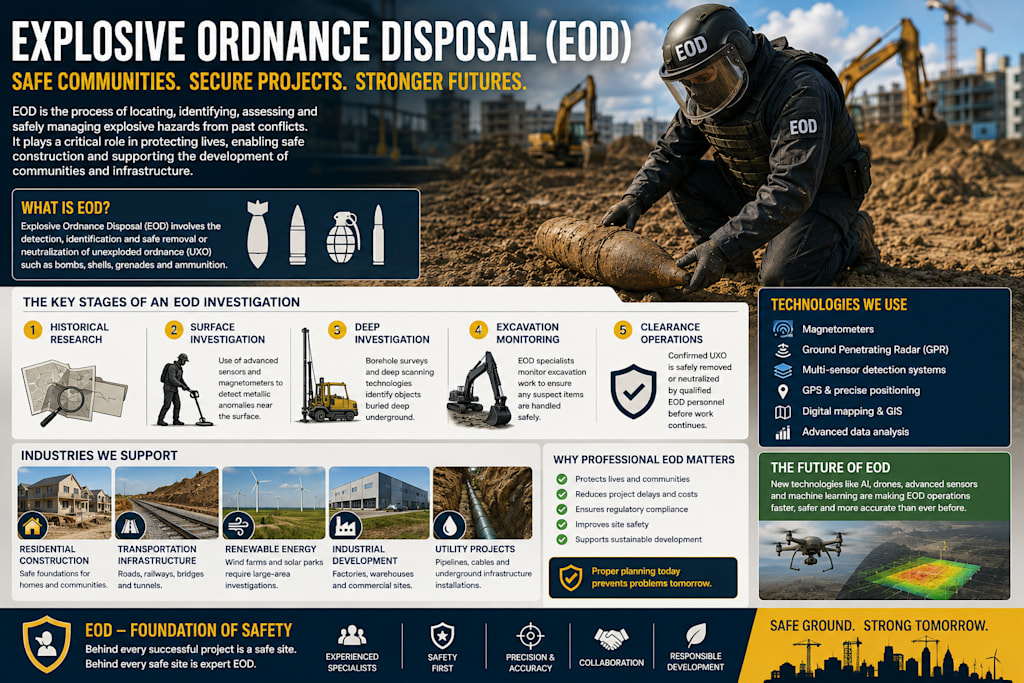
Explosive Ordnance Disposal (EOD) is the specialized process of locating, identifying, assessing, and safely managing explosive hazards. These hazards may include:
- Unexploded aerial bombs
- Artillery shells
- Mortar rounds
- Hand grenades
- Military ammunition
- Explosive remnants of war (ERW)
The primary objective of EOD is to ensure that construction sites, transportation projects, industrial developments, and public spaces remain safe for workers and surrounding communities.
Why Is EOD Still Important Today?
Although decades have passed since World War II, thousands of unexploded munitions are still discovered every year during excavation work. Urban redevelopment, railway construction, utility installations, renewable energy projects, and residential developments often require excavation at locations that may have experienced wartime bombing. Without proper investigation, buried explosives can pose serious risks including:
- Injury or loss of life
- Major construction delays
- Property damage
- Environmental hazards
- Increased project costs
For this reason, many projects begin with a comprehensive risk assessment before any earthmoving starts.
The Main Stages of an EOD Investigation
Modern EOD operations involve several specialized disciplines that work together to reduce risks efficiently.
Historical Research
The first step often involves reviewing historical aerial photographs, military archives, and wartime records. This research helps specialists identify areas that may have experienced bombing or military activity and determines whether further investigation is necessary.
Surface Investigation
If a site is considered potentially contaminated, technicians conduct a surface survey using sensitive detection equipment. Modern magnetic sensors can detect metallic anomalies hidden beneath the ground while minimizing unnecessary excavation.
Deep Investigation
Large infrastructure projects often require deeper investigations because explosive objects may be buried several meters below the surface. Borehole investigations and deep scanning technologies allow specialists to examine these underground layers accurately.
Excavation Monitoring
Even after surveys have been completed, trained professionals may supervise excavation activities. Continuous monitoring ensures that any suspicious object discovered during construction is handled safely and according to established procedures.
Clearance Operations
If unexploded ordnance is confirmed, qualified EOD personnel carry out clearance operations following strict safety regulations before construction resumes.
Technologies Used in Modern EOD
Today's EOD industry relies heavily on advanced technology.
Common systems include:
- Magnetometers
- Multi-sensor detection platforms
- Ground Penetrating Radar (GPR)
- GPS-based positioning systems
- Digital mapping software
- Geographic Information Systems (GIS)
These technologies improve detection accuracy while reducing unnecessary excavation and project delays.
Industries That Depend on EOD
Explosive ordnance disposal supports a wide variety of sectors, including:
Residential Construction
Housing developments often require land investigations before foundations are built.
Transportation Infrastructure
Roads, highways, railways, bridges, and tunnels frequently pass through historically affected areas.
Renewable Energy
Wind farms and solar parks require extensive ground investigations because of their large footprints.
Industrial Development
Factories, logistics centers, and commercial sites depend on safe ground conditions before construction begins.
Utility Projects
Pipeline installation, cable routes, and underground infrastructure projects regularly involve excavation where unexploded ordnance may exist.
Why Professional Planning Matters
EOD is much more than removing dangerous objects. It combines historical research, geophysical surveying, engineering, risk assessment, environmental awareness, and project management.
Proper planning allows developers to:
- Improve site safety
- Reduce project interruptions
- Meet regulatory requirements
- Minimize financial risk
- Protect construction teams
- Keep projects on schedule
Every location presents unique challenges, making professional assessment an essential part of responsible project planning.
The Future of Explosive Ordnance Disposal
Technology continues to transform the EOD industry.
Artificial intelligence, machine learning, drone surveying, improved geophysical sensors, and advanced data processing are making investigations faster and more accurate than ever before. These innovations not only improve safety but also help construction companies reduce costs and complete projects more efficiently.
Final Thoughts
Explosive Ordnance Disposal is a vital yet often overlooked part of modern infrastructure development. By combining historical research, advanced detection technologies, careful planning, and specialist expertise, EOD professionals help make construction sites safer for workers, communities, and future generations. As cities continue to grow and infrastructure expands, the importance of thorough ground investigations and professional EOD services will only continue to increase. Understanding the role of EOD is therefore not only valuable for construction professionals but also for anyone interested in how safe and sustainable development begins beneath the surface.
About the Creator
Enjoyed the story? Support the Creator.
Subscribe for free to receive all their stories in your feed.
Comments
There are no comments for this story
Be the first to respond and start the conversation.