
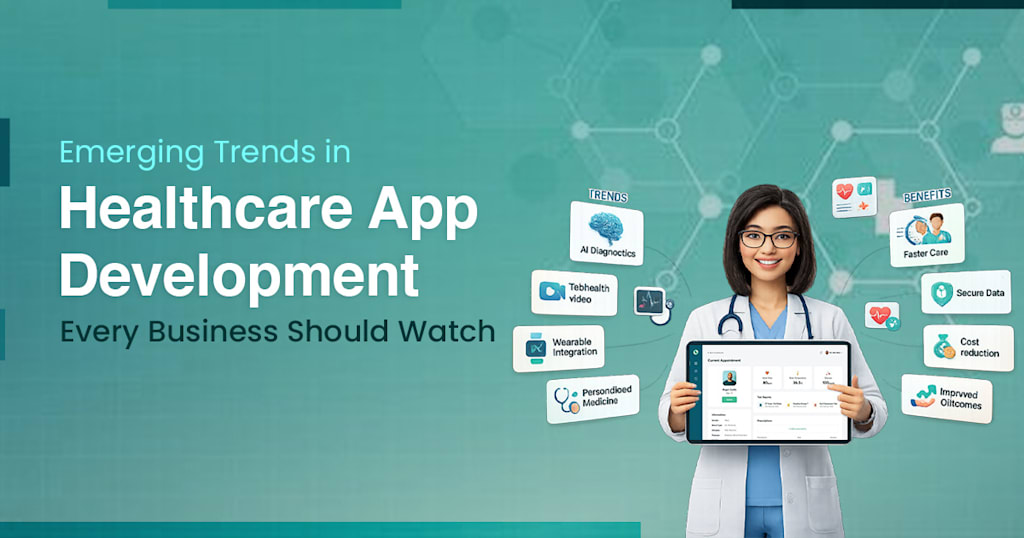
Emerging Trends in Healthcare App Development Every Business Should Watch
Explore top healthcare app development trends 2026, including AI in healthcare, security, costs, and future innovations shaping healthcare mobile apps for businesses.

Let’s start with a reality check.
Healthcare is no longer confined to hospitals, clinics, or even doctors’ offices; it’s now living inside smartphones. And the numbers make that crystal clear.
- The global mHealth app market is expected to grow from $43.13 billion in 2025 to over $154 billion by 2034.
- Over 65% of new healthcare apps already integrate AI-driven features
- Around 70% of healthcare providers now offer virtual consultations as a standard service
- Yet, more than 60% of healthcare apps are abandoned within 30 days due to poor user experience
That last stat matters the most.
Because it tells us something important: success in healthcare apps is no longer about just building functionality, it’s about building meaningful, usable, compliant, and intelligent digital health experiences.
This is exactly why businesses, whether startups, hospitals, insurers, or health-tech enterprises, need to stay ahead of healthcare app development trends in 2026.
In this blog, we’ll break down the most important shifts shaping the future of healthcare mobile apps, backed by real data, practical insights, and more.
Why Healthcare Apps are Now Business-Critical?
Healthcare apps are no longer “nice-to-have.”
They are becoming core infrastructure for care delivery, patient engagement, and revenue generation.
From remote diagnostics to chronic disease management, apps are enabling:
- Continuous care beyond hospitals
- Real-time decision-making
- Scalable healthcare delivery
This shift is also driving demand for every company that develops apps for healthcare to rethink how apps are designed, built, and maintained.
1. AI Is No Longer Optional (It’s Foundational)
Let’s address the biggest transformation first: AI in healthcare.
In 2026, AI is not a feature; it’s the backbone of modern healthcare apps.
What’s happening:
- AI-powered diagnostics and symptom checkers
- Predictive analytics for early disease detection
- Personalized treatment recommendations
- Automated clinical documentation
More than 80% of healthcare executives expect AI to drive measurable value in 2026
Why it matters for businesses:
AI reduces operational costs, improves accuracy, and enhances patient outcomes.
This is one of the most important emerging technologies in healthcare mobile apps and ignoring it is no longer an option.
2. Rise of Continuous Care Through Remote Monitoring
Healthcare is shifting from reactive to proactive.
Remote Patient Monitoring (RPM) is becoming a core feature in digital health app development trends.
Key capabilities:
- Real-time tracking via wearables
- Chronic disease management
- Alerts for abnormal health patterns
This aligns with a broader shift toward preventive healthcare, which is increasingly emphasized globally.
Business takeaway:
Apps that enable continuous monitoring create long-term engagement and long-term revenue streams.
3. Telehealth Is Evolving Into Full Digital Care Platforms
Telemedicine used to mean video calls.
Not anymore.
Modern apps now include:
- AI-assisted triage
- E-prescriptions
- Follow-up care workflows
- Integrated patient records
Healthcare apps are transforming into end-to-end care ecosystems.
This is one of the most impactful healthcare app trends for businesses aiming to build scalable digital health platforms.
4. Hyper-Personalization Is Replacing Generic Experiences
One-size-fits-all healthcare apps are becoming obsolete.
Apps now personalize:
- Treatment plans
- Notifications
- Health insights
Based on:
- Patient history
- Behavioral patterns
- Wearable data
This shift is powered by AI and big data, two major pillars of emerging technologies in healthcare mobile apps.
Why it matters:
Personalization directly impacts:
- Patient engagement
- Retention
- Clinical outcomes
5. User Experience Is Now a Competitive Advantage
Here’s a harsh truth: most healthcare apps fail because they’re hard to use.
With over 60% uninstall rates within 30 days, usability is now critical.
Modern UX expectations:
- Simple interfaces
- Voice-enabled navigation
- Minimal data entry
- Accessibility compliance
Key insight:
The best apps don’t just work, they feel effortless.
That’s why popular healthcare app features for patient engagement now focus heavily on UX rather than just functionality.
6. Voice and Conversational Interfaces Are Going Mainstream
Typing is no longer the default.
Voice-enabled healthcare apps are rapidly growing, with 40% of users preferring voice interactions
Use cases:
- Symptom reporting
- Appointment booking
- Medication reminders
Business value:
Voice improves accessibility, especially for:
- Elderly users
- Non-tech-savvy populations
7. Interoperability Is Becoming Non-Negotiable
Healthcare systems are fragmented.
Apps must now integrate seamlessly with:
- EHR/EMR systems
- Labs
- Pharmacies
- Wearables
Interoperability enables:
- Better care coordination
- Reduced duplication
- Faster decision-making
This is one of the most critical, secure, and compliant healthcare app development trends.
8. Data Security and Compliance Are Driving Architecture
Healthcare apps deal with highly sensitive data, and attacks are rising.
Cyber threats targeting healthcare have increased by 45% year-over-year
Key compliance priorities:
- End-to-end encryption
- Audit logs
- Consent management
- Regulatory compliance (HIPAA, GDPR, etc.)
Business implication:
Security is no longer a backend concern; it’s a core product feature.
9. Blockchain Is Emerging for Trust and Transparency
Blockchain is gaining traction for:
- Secure patient data storage
- Transparent data sharing
- Fraud prevention
It ensures tamper-proof records and stronger trust, key to scaling digital health platforms.
10. Cloud-Native and Scalable Architectures Are Essential
Healthcare apps are now built like enterprise systems:
- Cloud-native infrastructure
- Microservices architecture
- High availability systems
This ensures:
- Scalability
- Reliability
- Faster updates
Apps are evolving from tools into mission-critical platforms.
Benefits and Real-World Use Cases of Healthcare Apps
Understanding the benefits and use cases of healthcare apps helps businesses align strategy with real-world value.
Key benefits:
- Improved patient engagement
- Reduced hospital visits
- Faster diagnosis and treatment
- Cost efficiency
Better data-driven decisions
Real-world use cases:
- Chronic disease management
- Mental health support apps
- Fitness and wellness tracking
- Teleconsultation platforms
Even users report improved health awareness, 91% say health apps help them understand their health better
Healthcare App Development Cost: What Businesses Should Expect
Let’s talk numbers, because strategy without cost clarity is incomplete.
The healthcare app development cost depends on:
1. App complexity
- Basic app: $50,000–$20,000
- Mid-level: $25,000–$40,000
- Advanced (AI, IoT, integrations): $50,000+
2. Features
- AI integration
- Real-time monitoring
- Data security layers
3. Compliance requirements
Healthcare apps require strict regulatory adherence, which increases cost.
4. Development team
Choosing experienced healthcare Android app developers or specialized teams impacts both cost and quality.
Choosing the Right Development Partner
A reliable company that develops apps for healthcare should offer:
- Domain expertise
- Compliance knowledge
- Scalable architecture design
- Security-first approach
They don’t just build apps, they build healthcare ecosystems.
Final Thoughts
The rapid evolution of healthcare app development trends 2026 makes one thing clear: businesses can no longer afford to treat digital health as a secondary channel. From AI in healthcare to secure and compliant healthcare app development trends, every advancement is pushing the industry toward more intelligent, connected, and patient-centric solutions.
Organizations that actively invest in emerging technologies in healthcare mobile apps, prioritize usability, and collaborate with a reliable company that develops apps for healthcare will be better positioned to meet growing patient expectations and regulatory demands. As the future of healthcare mobile apps continues to unfold, success will depend on building solutions that are not only innovative but also scalable, secure, and truly impactful in improving care delivery and outcomes.
About the Creator
Sarah Wilson
Project Manager at Microsoft | 8+ years in tech Sharing insights on projects, careers, and building impactful products
Enjoyed the story? Support the Creator.
Subscribe for free to receive all their stories in your feed.
Comments
There are no comments for this story
Be the first to respond and start the conversation.