
Einstein’s special relativity
The “afterlife” according to Einstein’s special relativity

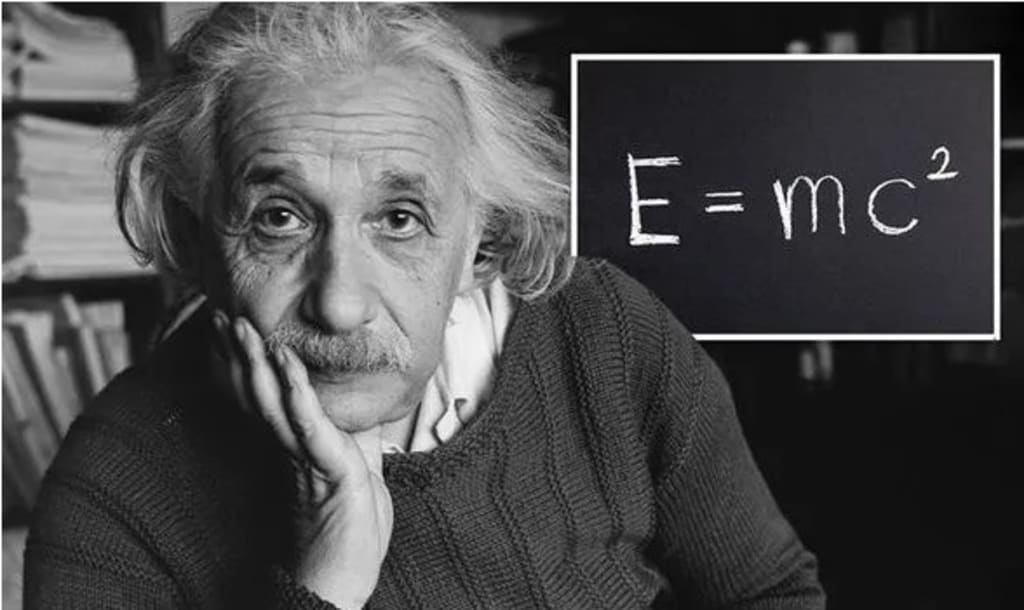
Before Einstein, time was this universal parameter.
We all shared the same moment of time;
the same moment of now that we could all agree on.
But then Einstein came and he said,
"Well, it's not that simple."
And the major reason for this
is that the speed of light is finite,
and nothing can go faster than the speed of light-
it's the same for all observers.
And this sounds like a really innocent assumption,
but it has a truly fundamental consequence,
which is fairly easy to understand actually.
If you ask yourself whether you know
if the screen in front of you is actually there right now,
naiveLy we would say, "Yes, of course it's there,
I mean, I'm holding it my hand,
or I see it directly in front of me."
But, we just learned that the speed of light is finite,
and nothing can go faster than the speed of light.
So everything that you experience, everything that you see,
you see it as it was a tiny little amount
of time in the past.
So how do you know that anything exists right now?
What do you even mean by "now?"
So this is the problem that comes up
in Einstein's theory of special relativity.
And Einstein tried to construct a notion
of "now" in this new theory, and he failed.
So, imagine you're looking straight ahead,
and there's a train going through to your line of sight,
say, from the left to the right.
And on the train, there's your friend,
and let's call her Alice.
Now, let's also imagine
that at the exact moment that Alice,
who's standing in the middle
of the train, is looking straight at you,
there are light flashes going off on both ends of the train.
And the question is:
Did these light flashes happen at the same time?
Now, if you want
to answer this question looking at the train,
that's pretty straightforward.
There are those light flashes going off.
They both come
from sources that are the same distance from you.
So of course you see them at the same time.
But how does the same thing look from Alice's perspective?
The light flashes go off,
but while the light travels towards her, she's moving
towards one of the light sources and away from the other,
so that one path
of the light is shorter and the other one is longer.
So from Alice's perspective, the light flash from the front
of the train arrives earlier than the one from the back.
So she would say,
"No, they did not happen at the same time."
And now the important point is that this is relativity.
Neither of them is right, and neither of them is wrong.
They both have an equally valid perspective.
And what do we conclude from this?
Well, we conclude from this
that there is no unambiguous notion
to define what happens now:
It depends on the observer.
So they're both right.
And if you follow this logic to its conclusion,
then the outcome is that every moment
could be now for someone.
And that includes all moments in your past,
and it also includes all moments in your future.
So this impossibility to define one notion
of now that we all agree on is called
the 'relativity of simultaneity.'
And it's super important
because it tells us that fundamentally,
this experience of now that we all share is meaningless.
So the mathematical framework that Einstein came up
with to make sense of this absence of now and the finiteness
of the speed of light and the relativity of simultaneity,
is that he combined space
with time to one common entity, which is called spacetime.
And more specifically,
because the present moment has no fundamental significance,
this entire spacetime exists in the present moment,
and it's become known as the block universe.
In the block universe,
the past, the present,
and the future exists in the same way.
There's just no way
that you can single out one particular time as special.
So, the past in which your grandma is still alive exists
the same way as this present moment.
Now, there's another way to look at this idea
that people who have sadly deceased
do in some sense still exist-
and it's because of the way that all the fundamental laws
of nature that we know work.
They don't destroy information.
The only thing that they do
is that they rearrange the matter and radiation
and everything that's in the Universe;
they just give you the rules for how to put them
in different places with different velocities.
But you can apply those rules forward and backward.
And this means if you had a really, really good computer,
you can in principle always find out what happened earlier.
So in this sense, information cannot get destroyed.
It can, however, become for practical purposes,
impossible to retrieve.
There are two cases that physicists have considered
where information might get destroyed
that have so far not been resolved:
One of them is the information that falls into a black hole.
We don't actually know what happens with it.
And the other one is the mysterious measurement process
in quantum mechanics,
which is also an unresolved problem.
So if someone you knew dies, then of course we all know
that you can no longer communicate with this person.
And that's because the information
that made up their personality, it disperses
into very subtle correlations in the remains of their body,
which become entangled with all the particles around them.
And slowly, slowly they spread
into radiation that disperses throughout the solar system,
and eventually throughout the entire Universe.
But this is a very anthropomorphic thing:
It's very tied to our own existence,
and who knows what's going to happen
in a billion years or something to the nature of humans.
Maybe there'll be some cosmic consciousnesses,
which will also be spread out,
and this information will become accessible again.
So, I know it sounds crazy,
but for all we know about the fundamental laws of nature
about Einstein's theories,
and about the way that our current theories work,
it seems that our existence actually transcends
the passage of time.
There is something timeless about the information
that makes up us and everything else in the Universe.
And I think that's a really deep spiritual insight
that we get directly
from studying the foundations of physics.
And I have to admit that I personally
find it really hard to make intuitive sense of it.
It's one way to look at the maths and say,
"Okay, this is how it works."
These are the conclusions that we draw
from our observations,
and the mathematics describes it correctly.
It's another thing entirely to make sense
of this in your everyday life.
About the Creator
Enjoyed the story? Support the Creator.
Subscribe for free to receive all their stories in your feed.
Comments
There are no comments for this story
Be the first to respond and start the conversation.