
EFT in Ukraine: Scott Fox on Coaching and Wartime Support
Why did American coach Scott Fox bring EFT to Ukraine, and how did his Ukrainian family roots shape that decision?

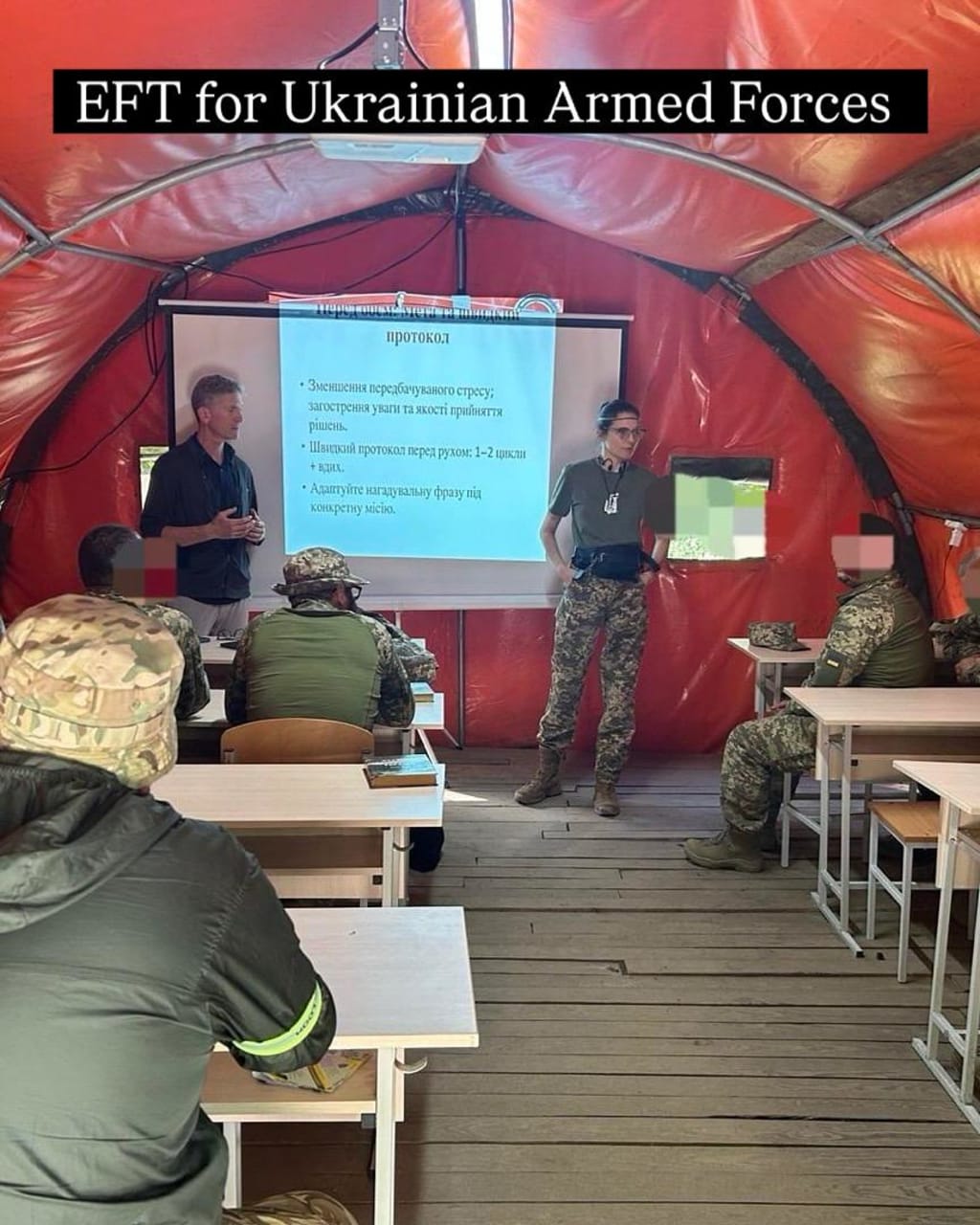
Scott Douglas Jacobsen interviews Scott Fox about bringing Emotional Freedom Techniques to wartime Ukraine. Fox discusses his Ukrainian ancestry, sports coaching background, the creation of PURE, and his approach to teaching tapping techniques to children and adults experiencing war-related stress.
Scott Fox is an American sports coach, certified Emotional Freedom Techniques practitioner, and cofounder and director of PURE. He teaches EFT in Ukraine, working with children, veterans, and psychologists through online sessions, workshops, and community partnerships during Russia’s ongoing war.
Scott Douglas Jacobsen: All right, so, well, I guess the first question is more personal. How did an American get to Ukraine? Why would someone choose to go from one of the wealthiest countries in the world, and safe, that has two big, great defensive shields called the Atlantic and the Pacific, all the way to the other hemisphere of the world to a place actively getting bombed?
Scott Fox: Yeah, I've had that same question. I've asked that same question to other people who are American and expats in Ukraine. And usually the answer is similar to mine, which is that I had a calling.
It was really kind of a, let's call it a semi-mystical type event where I was reading The Washington Post. And, old-school, I actually had the paper, and they had those big block headlines that, you know, are only used for assassinations and wars and that kind of thing. And it said something, I don't know, “Invasion of Ukraine.”
And I just started to weep. And I didn't have any contact with Ukraine before that. You know, and I'll get to the second response to that question that I always use.
And I just, I was weeping at my table. And my wife at the time said, “Well, you know, why are you so moved by this?” I said, “I don't know.”
And she said, “There's tragedy down the street. You could go down.” I live in the DC suburbs. “You could go down in our own city.” I was living in Alexandria, Virginia, at the time. And, you know, there's drug wars and all sorts of issues that are happening.
So I felt like there was something that I wanted to do, or I at least cared about it. And I didn't really know what to do. And then maybe a month later, there was another article in the Post where they were interviewing a US veteran who, like a lot of them, went over there to fight alongside the Ukrainians to defend the country.
And the reporter said something like, “Why are you doing this? Isn't it kind of crazy?” And the veteran said, “I'm trained to do this. It would be crazy for me not to be here.” And that got me. And I was like, “I'm trained for things too. And I know they can help.”
And so my training has been in, we'll call it psychological support techniques. There's one in particular I got certified in and I've been practicing for about 18 years called EFT, or Emotional Freedom Techniques. And they're really good for resolving PTSD, as well as sport performance, which is how I got into it. And I'll get back to that in a moment.
But the other reason that I think I'm here is to reconnect with family roots, because I do have Ukrainian family roots, but that was not disclosed to me until about 10 years ago, nothing to do with Crimea, 2014 or anything like that.
Just one day, my mother said that her father was from Ukraine. That's the first time in my life that either of my parents had uttered that word. And prior to that, it was always something amorphous, “We don't really know, Russia somewhere.”
And so I was like, “Wow, Ukraine.” And so as I got into this, I started to realize that maybe my other part of being here is to rediscover my family roots. And I've enjoyed that immensely.
When I was telling my parents, “I'm going to come over here to help,” and they knew I was already doing work online starting in 2022, my dad answered the phone, and he was still alive at the time. And I said, “Dad, I'm gonna have time to go visit Mom's father, my grandfather's village.” And I thought that was going to be super cool, which it was. I have gone there.
But he said something that shocked me, which was that he said, “Don't forget about my family.”
“What are you talking about?”
He said, “Yeah, my grandparents.”
So my great-grandparents from my dad's side are from northwest Ukraine. So I got Ukrainian blood, all through me. And I didn't know.
So I'm here because I resonate at some level, for whatever reason, with what's happening here. Look, I've got my own programming of America, which is, you know, we like to help freedom, the cause of freedom. And, you know, while our government may not be acting like that at all times, that is what I had inside of me.
And that plus kind of this compassion for human suffering got me to start doing something online in 2022. And then in 2024, I wanted to increase the number of people that my team could help. And I made my first trip.
And since then, I've probably lived, well, this year, eight months of the year in Ukraine, four months in the States. And in '24, '25, probably, it was like six months. And I'll do the same eight or nine months next year.
So, long-winded answer, multiple reasons.
Jacobsen: Can you dive into EFT? You've been practicing this for 18 years. You were involved in high performance. How does high performance track or map onto wartime issues in psychology?
Fox: Yes, it's interesting. The technique comes out of the world of psychology. I learned it when I was trying to be the best.
So the technique, EFT, stands for Emotional Freedom Techniques. It is really good at resolving trauma. Right now, I've got about 120-plus peer-reviewed journal entries on it. So it's been through many randomized controlled trials, many meta-analyses, and it just flat out works.
And so how does it track? So in the world of sports, I discovered that it was really good for helping athletes be their best. And that could be, the most dramatic is when somebody is in a slump. They're physically okay, but for some reason, they can't play the way they want to play.
And I was coaching Little League at the time, and I was ostensibly looking for something that was going to give the kids I was coaching, and my daughter was one of those girls who was playing baseball with the boys. I wanted to give them a competitive edge, and I basically wanted to give them what I didn't have when I played sports.
And I played baseball at university level, and I wanted to be a professional baseball player, but I lacked the consistency, and the consistency was really about the non-physical stuff, so mental, emotional. And I dove in.
It happened to be roughly, what was that, 2008. We had the mortgage meltdown happening, and I had a lot of time on my hands because corporately, we weren't doing a whole lot because the world just came to a grinding halt. So I dove in. I found some cool stuff.
I found myself really enjoying learning about the world of, you know, call it psychology, neuro-based science, all sorts of interesting things. And I don't have any background in that. I just got curious. And I started to read. I started to find things.
There's a lot of cool things out there that are helpful, and I kind of skip around a little bit. I want to bring some of those other things that I've found to Ukraine eventually.
But this technique, I saw very quickly how, I saw how it could quickly help young athletes at the time, these are like nine-, 10-year-olds, go from being emotionally out of control to quickly, I mean, like within a minute or two, getting back into playing mode, and then playing even better than they did before.
And I was very skeptical. I was raised by a physicist and a biologist and, you know, a very traditional scientific approach to things, and psychology is not really in that, was not really in their, you know, way of living.
So after two years of using this technique with little kids, I was convinced it was working. And so then I got certified in it. I got deeper into it. I got a really great certification through a group called EFT Universe. I've since brought them into a partnership with one of my MOU groups here in Ukraine, to try to really elevate the education of Ukrainian psychologists here and other people.
And again, long-winded answer here, the technique quickly rewires the system, the brain-body system, so that we're no longer being blocked by unresolved trauma, we'll call it.
And so, yeah, these kids, guess what, they're humans. They have unresolved trauma. And I didn't have to do any therapy. I'm not a therapist.
And that's really why I saw that it could be very, very helpful for Ukraine in that anybody, myself, I'm a great messenger of this because I'm not a psychologist, I don't have any formal education in it, can take a technique, use this very mechanical technique to help somebody feel better in the moment, bomb shelter kind of stuff in Ukraine. Or it can be used in a therapeutic way to help resolve those things that may have been created by the traumas of war.
So I pieced that together, or it came to me, and I went with it. And I found that I was not the only one in the world who was thinking like this. I networked around through social media, and I didn't know anybody in Ukraine. I only knew a couple people in Europe.
And I called one of my friends in Poland. And I said, “Can you help me help these people?” And through, hop, skip and jump, maybe six degrees of separation, I got to a group in the UK. And they were similar to me in that they were not psychologists, but they were trained in certain techniques.
And I started to join, I joined their group. And then very quickly, that group dissolved. I said, “I'll take over the online piece.”
And that's when I created, with my, I'll call them my cofounders, this group called PURE, which uses EFT to, we'll just say, help people process all the stressors of war.
Jacobsen: Does the EFT approach differ when dealing with kids and adolescents versus adults?
Fox: So the technique is very flexible. I do it in a different way, just like you would talk to a child differently than you would talk to an adult. But the technique is very mechanical, meaning we're not doing talk therapy. We're not even doing cognitive behavioral therapy. We're getting somebody to recognize how they feel, usually an undesirable feeling.
And then we do this technique. And the technique is using the body, and we're tapping. We're literally tapping on certain designated spots that have been associated with the world of acupuncture. We're obviously not using needles, but we're tapping on certain spots.
And evidently, what the science shows on this is that it stimulates a little electrical signal in the body. And that tends to soothe that part of our brain that's associated with the undesired or unwanted or overload of emotions.
Jacobsen: Thank you very much for the opportunity and your time, Scott.
Scott Douglas Jacobsen is the Founder and Publisher of In-Sight Publishing (ISBNs: 978–1–0692343, 978–1–0673505) and Editor-in-Chief of In-Sight: Interviews (ISSN: 2369–6885). An accomplished journalist, his portfolio includes over 10,000 publications across 200+ outlets, including International Policy Digest, The Humanist, Basic Income Earth Network, Humanist Perspectives, and rabble.ca. He has served in leadership and board roles across global media and humanist organizations and holds memberships with the Canadian Association of Journalists, PEN Canada, and Reporters Without Borders.
Image Credit: Scott Fox.
About the Creator
Scott Douglas Jacobsen
Scott Douglas Jacobsen is the publisher of In-Sight Publishing (ISBN: 978-1-0692343) and Editor-in-Chief of In-Sight: Interviews (ISSN: 2369-6885). He is a member in good standing of numerous media organizations.
Enjoyed the story? Support the Creator.
Subscribe for free to receive all their stories in your feed.
Comments
There are no comments for this story
Be the first to respond and start the conversation.