
E-Stamp Paper vs Physical Stamp Paper 2026
Physical stamp paper can be described as a printed document offered by licensed merchants of stamps (franking agents and stamp sellers who are part of the Treasury system). They print it on paper issued by the government with a unique identifier the amount of stamp duty paid, and a government stamp or seal.

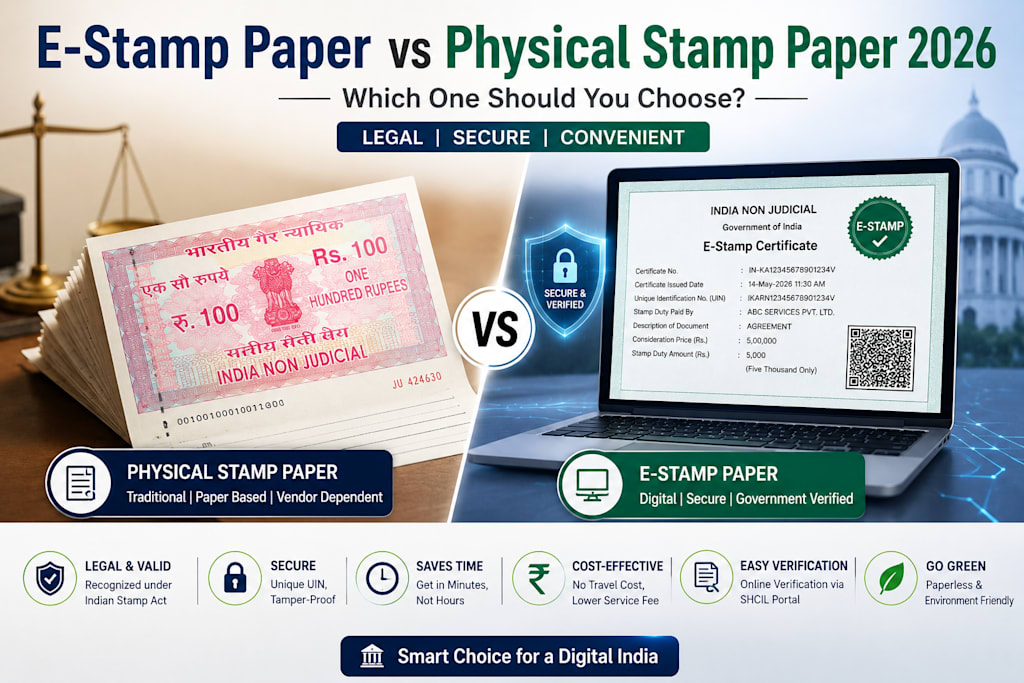
E-stamp paper is a computer produced, government-issued stamp document that has the same legal status as physical stamp paper in the Indian Stamp Act 1899. The choice between them is based on the state you reside in as well as the type of document, and the urgency you require it.
Both types of stamp paper exist to collect stamp duties which is a tax that is levied by the state government on specific legal documents. Stamp duty is the same regardless of whether you choose to use an electronic stamp or physical paper. What is different is how you can get them, what costs it in terms of both time and ease, as well as the state that has allowed an electronic option.
What Is Physical Stamp Paper
Physical stamp paper can be described as a printed document offered by licensed merchants of stamps (franking agents and stamp sellers who are part of the Treasury system). They print it on paper issued by the government with a unique identifier the amount of stamp duty paid, and a government stamp or seal.
To purchase physical stamp paper, go to a registered stamp vendor usually located in the vicinity of districts courts and sub-registrar offices or in designated markets. The stamp fee is paid in in cash or by demand draft and the vendor will provide the paper. Your document is then written or typed on that paper, or you can attach it to the document you are submitting.
Physical stamps have been used in India since the time of the colonial period and is accessible and widely accepted throughout all union territories and states.
What Is E-Stamp Paper ?
E-stamp papers are generated by SHCIL Stock Holding Corporation of India (SHCIL) or other state-authorized collection centers. SHCIL is the Government of India designated SHCIL as the Central Record Keeping Agency for electronic stamping in 2008. States which have adopted the program allow customers to purchase e-stamping certificates online or at authorized centers, that have a unique Certificate Number (UIN) which can be verified through SHCIL's portal. SHCIL portal.
The e-stamp certification contains the exact same information as the physical stamp papers states The state of the stamp, its denomination, the purpose as well as buyer/seller's details. It is printed on white paper and its authenticity is confirmed by using the UIN at the official website.
E-stamping was introduced in order to stop the widespread counterfeiting of physical stamps which was most prominently discovered by the 2003 Abdul Karim Telgi case, where counterfeit stamp paper valued at more than Rs20,000 crore was distributed throughout India.
State-Wise Availability of E-Stamp Paper
E-stamping isn't available in a uniform manner across India. At the time of 2026, states and union territories listed below have implemented e-stamping via SHCIL or their state portals:
States with full e-stamping availability: Karnataka, Maharashtra, Delhi (NCT), Gujarat, Tamil Nadu, Rajasthan, Uttar Pradesh, Andhra Pradesh, Telangana, Himachal Pradesh, Uttarakhand, Jharkhand, Puducherry, Dadra & Nagar Haveli, Daman & Diu, Chandigarh, Bihar, Odisha, Chhattisgarh, Haryana, Punjab
States in which physical stamps remain the sole or most important choice: West Bengal, Kerala, Assam, Manipur, Meghalaya, Mizoram, Nagaland, Tripura, Sikkim, Arunachal Pradesh, Jammu & Kashmir, Goa (partial)
Always check the status of your state's revenue department's website, or SHCIL's portal. SHCIL website (shcilestamp.com) to ensure that the E-stamping is expanding.
How to Obtain Each
Physical stamp paper
- Identify a licensed stamp vendor near your Sub-Registrar Office or district court
- The denomination must be specified (determined by the type of document and the state schedule)
- Make sure you pay for stamp duties Cash is accepted by many vendors, and some will accept UPI.
- You will receive the pre-printed stamp paper
- Type your document either on paper, or the document is attached to it Execute (sign) the document.
- Time needed from 30 minutes or more, based on the queue of vendors and their location.
E-stamp paper:
- Check out on the SHCIL site (shcilestamp.com) or the e-stamp portal of your state or visit an authorized collection center
- Complete the details of the buyer and the details of the property/document
- Pay for stamp duty online using online banking, debit card UPI, NEFT or
- Get the e-stamp certification (UIN generated instantly to enable online payments)
- Print the certificate of e-stamp using plain A4-sized paper
- Write or attach your document's text, then run.
- Time required: 10-30 mins online, or a trip to an authorized centre (which might be faster than locating a stamp vendor).
For documents that carry a stamp duty of no more than Rs100 such as short-term rental agreements in certain states, indemnity bonds, affidavitsthe cost difference is not significant. The time savings from electronic stamping will be the main argument.
for transactions that are high-value such as business contracts, property sales that have stamp duty of at least Rs5,000 E-stamping removes the possibility of receiving counterfeit papers, which can cause legal issues when it comes to property dispute.
Legal Validity: Is E-Stamp Paper Legally Valid?
E-stamps issued by SHCIL or through state-authorised portals is legal under the Indian Stamp Act 1899 and the amendments made by state governments in order to permit electronic stamping. The courts all over India have recognized e-stamped documents as legal and valid documents.
About the Creator
Akhil Sharma
I'm Akhil sharma, a dedicated digital marketer at SurePass, a leading provider of API and background verification solutions. With a passion for leveraging technology to streamline processes and enhance security.
Enjoyed the story? Support the Creator.
Subscribe for free to receive all their stories in your feed.
Comments
There are no comments for this story
Be the first to respond and start the conversation.