
Does Singing the ABC Song Help Reading? What Most Parents Don't Realize
The ABC song teaches letter names and alphabet order, but reading depends on completely different skills that many children never learn from the song alone.

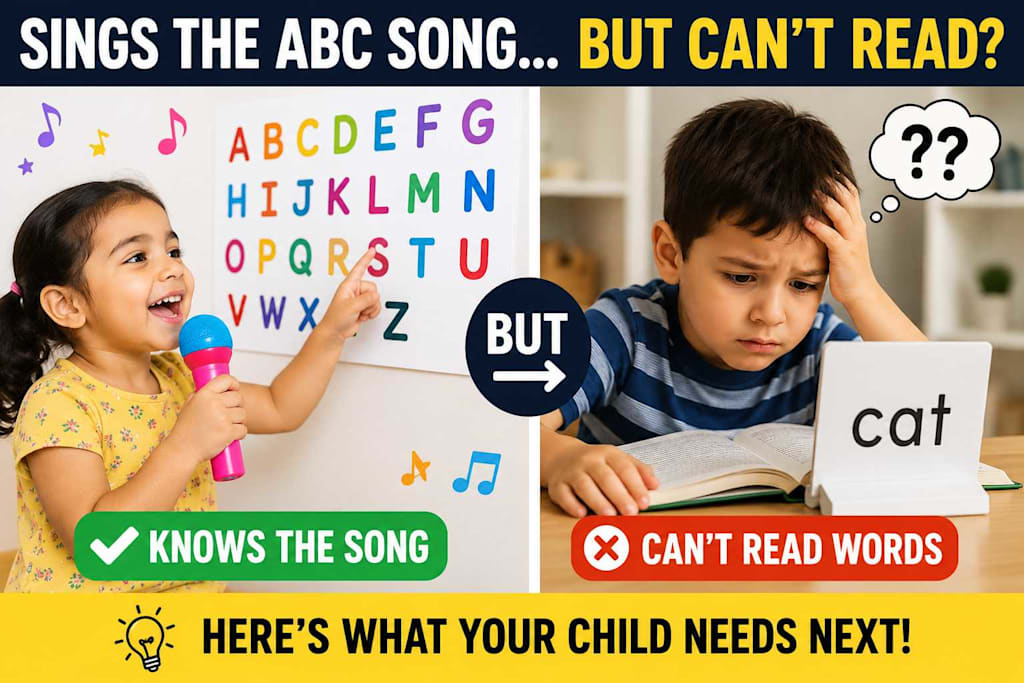
My daughter sang the ABC song at two and a half. Every letter. Perfect pitch. She'd run around the living room shouting "L-M-N-O-P" like it was one word. I thought we were ahead of the curve. Then at four, she looked at the word "cat" on a cereal box and had no idea what it said. None. She knew C. She knew A. She knew T. But "cat" might as well have been a barcode.
Does singing the ABC song help reading? Yes, but not in the way most parents think. The song builds early literacy skills. It does not teach a child to read. That gap between singing letters and reading words trips up almost every parent I know. This article breaks down why that gap exists, what the song actually teaches, and what your child needs next.
Why So Many Parents Think the ABC Song Should Lead to Reading
We all heard the same logic growing up. Learn your ABCs, then you read. The alphabet song sits at the center of toddler learning. Daycares sing it. TV shows sing it. Grandparents sing it. Parents naturally assume the next step is reading. When a child knows the alphabet song by heart, the assumption goes, they must be close to reading.
That confusion runs deep. Parents hear "child knows ABCs but can't read" and feel like something went wrong. They bought the right books. They sang the song nightly. They drilled flashcards. The child performed. But reading did not follow. That disconnect creates real anxiety. You start wondering if your kid has a learning problem, if you missed a window, if other parents figured out something you didn't.
The truth is simpler. The alphabet song teaches one thing. Reading requires several things. Most of us never learned the difference.
What the ABC Song Actually Teaches
The ABC song teaches letter names. It teaches alphabetical order. It builds memory through rhythm and repetition. Those benefits of the ABC song are real and worth something. A child who can sing the alphabet has exercised their memory, absorbed language patterns, and gained familiarity with the shapes and names of twenty-six letters.
Learning letter names matters. It gives children a way to talk about letters. It helps them organize information. It creates a foundation they will use later when they sort words or look things up. Alphabet song early literacy is a legitimate starting point. But it is only a starting point.
The song does not connect those letter names to sounds. It does not show how letters work inside words. It is a memory exercise dressed up as a song. Useful? Yes. Sufficient? No.
What the ABC Song Does NOT Teach
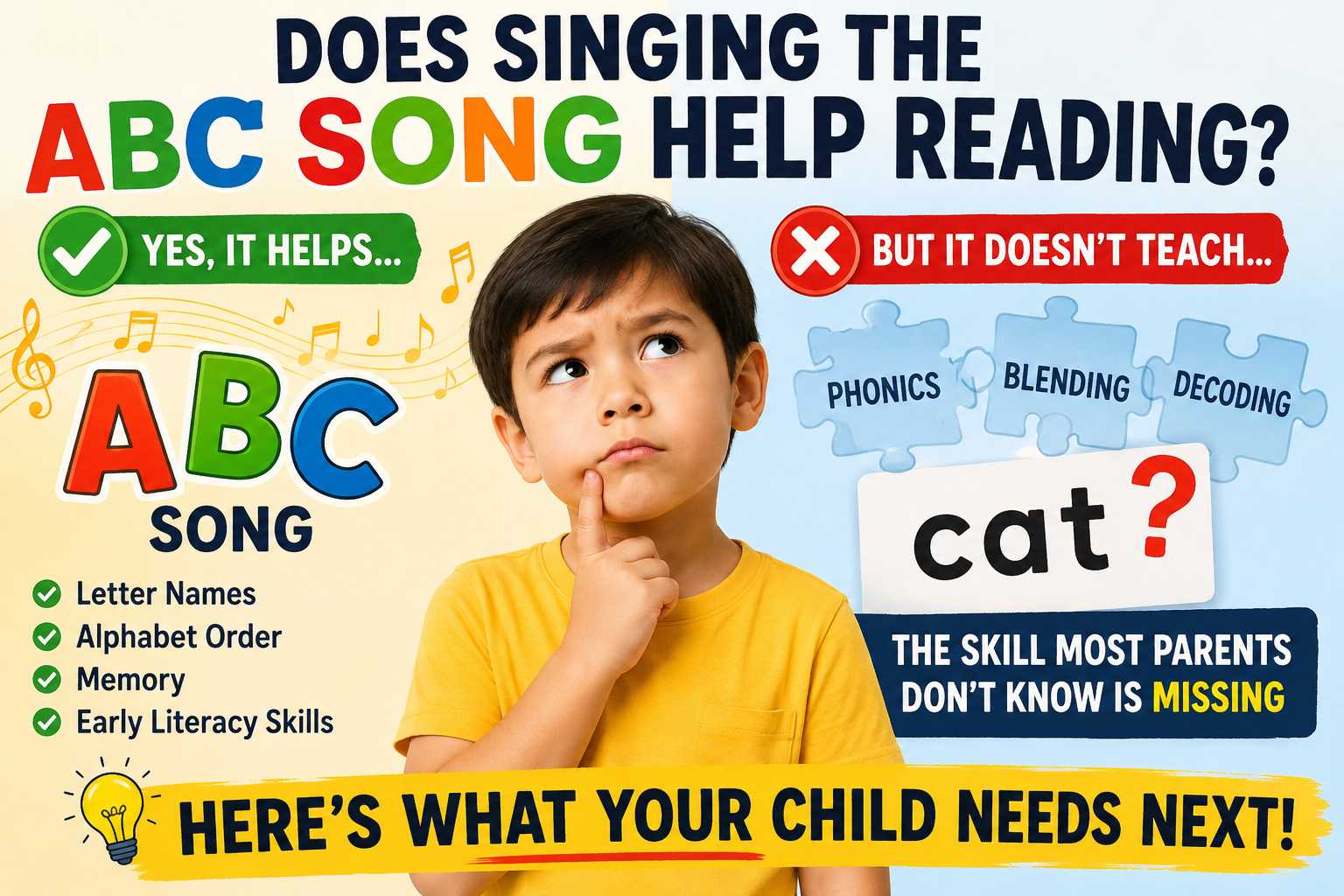
This is where most parents get stuck. The ABC song does not teach letter sounds. It does not teach phonics. It does not teach blending or decoding. Your child sings "A, B, C" but has no idea that A says "ah" or "ay" depending on the word. They do not know that B says "buh." They know the name. The name and the sound are two different things.
Letter names vs letter sounds is the single biggest misunderstanding in early reading. A child sees the word "dog" and thinks "Dee, Oh, Gee." Those are letter names. Reading requires hearing "duh, ah, guh" and pushing them together into "dog." That jump from names to sounds is not automatic. It has to be taught.
Phonics and reading go hand in hand because phonics is the system that connects sounds to symbols. Without phonics, the alphabet is just a song. Without sounds, letters are just characters in a parade.
The Missing Skill Most Parents Never Hear About: Blending
Blending is the skill nobody warned me about. You can know every letter sound and still not read until you learn to blend. Blending means hearing individual sounds and merging them into a word. C-A-T becomes cat. D-O-G becomes dog. S-U-N becomes sun. Blending sounds together is the bridge between knowing letters and reading words.
My son knew all his letter sounds by kindergarten. He could tell you M said "mmm" and I said "ih" and L said "lll." But put them together and he froze. M-I-L-K. He said "mmm." Then "ih." Then "lll." Then "kuh." Four separate sounds. No word. Phonemic blending does not happen by accident. Children need practice squishing sounds together.
That explains why so many kids know the alphabet song but can't read. They memorized a sequence. They did not learn to manipulate sounds. Reading is sound manipulation. The alphabet song is sequence memorization. Those are different muscles.
Why Some Children Can Sing the ABC Song but Struggle With Reading
Rote memorization is powerful but narrow. A child who memorizes the alphabet song has built sequential memory. They know what comes after Q. They do not necessarily know what Q looks like on a page out of order. They cannot pick Q from a lineup of letters unless they sing up to it. Reading readiness requires more than sequence.
Some children also hit the "LMNOP" wall. The alphabet song crams those five letters into two seconds. Kids hear it as one blob. They memorize the blob. They do not process five distinct letters. That quirk alone can slow down letter recognition.
Other kids sing perfectly but cannot recognize letters out of order. Ask them to find K on a scattered page and they draw a blank. The song gave them a linear track. Real reading is non-linear. Letters jump around. Words do not follow alphabetical order.
Can Singing Still Help Reading Development?
Singing still matters. Songs and literacy development have a real connection. Singing builds phonological awareness, which is the ability to hear and play with sounds in language. Rhymes, rhythms, and repetition train a child's ear. That ear training supports reading later.
Does singing help reading? Indirectly, yes. A child who sings nursery rhymes learns to hear that "cat" and "hat" share an ending. They feel rhythm. They hear syllables break apart. Those skills feed into reading development. The ABC song contributes to that environment. It is not useless. It is simply incomplete.
Do not throw out the song. Sing it. Enjoy it. But do not stop there.
Simple Ways to Connect the ABC Song to Real Reading Skills
You can bridge the gap without turning your home into a classroom. Point to letters while you sing. Stop at C and say "cuh" instead of "see." Match sounds to names. Play games where you say a sound and your child finds the letter. Build simple CVC words with magnets or blocks. Cat. Dog. Sun. Hat.
Phonics activities at home do not need worksheets. Say a word slowly. Ask your child what sound they hear at the start. Read books together and point to words as you say them. Let your child see that print carries meaning. How to teach letter sounds starts with you making sounds normal and playful, not academic and stressful.
Reading activities for preschoolers work best in small moments. The grocery store. The car. A sign on the street. Point out the letter M on the McDonald's sign and say "mmm." No flashcards required.
The Moment I Realized Reading Is a Sequence, Not a Single Skill
I used to think reading happened after the alphabet. You learn ABCs, then you read. That is how it looked from the outside. Then I watched my daughter stall. She had the song. She had the names. She had nothing else.
Reading is actually a sequence. Alphabet song leads to letter names. Letter names lead to letter sounds. Letter sounds lead to blending. Blending leads to decoding. Decoding leads to reading. Each step is separate. Each step needs time. Parents who skip steps wonder why their child stalls.
That progression changed how I saw everything. My kid was not behind. She was simply missing the middle steps. Once I filled those in, reading started clicking.
How Different Reading Approaches Organize These Skills
Different educators sequence literacy instruction in different ways. Some programs hammer letter sounds before names. Others teach blending alongside the alphabet. Some use whole-word sight reading early. Others stay strictly phonics-first. The variety confused me at first.
While researching how reading instruction is typically organized, I spent time looking at different literacy frameworks and educational guides that break down the progression from alphabet knowledge to reading. One reading instruction sequence guide I came across mapped the steps clearly: alphabet knowledge, phonemic awareness, phonics, fluency, comprehension. Seeing it laid out helped me understand where my kids were stuck. I found that guide while browsing through a reading instruction sequence guide that walked through how structured programs build each skill in order.
Structured literacy approaches tend to be explicit and sequential. They do not assume children figure out sound patterns on their own. They teach each skill deliberately. That method clicked with me because it matched what I saw at home. My kids needed explicit steps, not hopeful exposure.
What I Learned While Comparing Different Structured Reading Approaches
I looked at a few different systems out of curiosity. Some moved fast. Some moved slow. Some used games. Some used repetition. The similarities mattered more than the differences. Every effective approach taught letter sounds. Every one taught blending. None assumed the alphabet song alone was enough.
In my comparison notes and research observations, I noticed that reviewing different approaches helped me see what my own children actually needed. One resource I found during that digging was a set of reviews and observations about structured reading programs. I was not shopping. I was trying to understand how other parents and educators framed the same questions I had. I came across some comparison notes and research observations that broke down how different programs handle the same sequence of skills.
That research phase settled something for me. Reading is teachable. It is not a mystery. It is not luck. It is a set of skills taught in order. Once you see the order, the stress drops.
When Should Parents Actually Worry?
Most kids learn to read between five and seven. Some earlier. Some later. That range is normal. But certain signs deserve attention. If your child cannot recognize any letters by age five, struggles to rhyme, or cannot break words into sounds by first grade, extra support may help. If reading causes tears and avoidance daily, that is worth investigating.
Reading difficulties in children show up in different ways. Some kids mix up letters constantly. Some cannot hear that "bat" and "cat" sound similar. Some know sounds but cannot blend them. Trust your gut. You know your child. If something feels off, talk to a teacher or specialist. Early screening beats late guessing.
Signs of reading problems are not always obvious. A child who seems fine but avoids books might be struggling silently. A child who memorizes stories but cannot read new words might be hiding a gap. Pay attention to patterns, not single moments.
The Bottom Line
The ABC song is helpful. It is one step in a much larger reading journey. It gives your child letter names, order, and musical memory. It does not give them sounds, blending, or decoding. That is not a failure of the song. That is simply the limit of what a song can do.
Your child knows the alphabet song but can't read? They are not broken. You did not fail. They just need the next steps. Teach sounds. Practice blending. Read together. Give it time.
Reading is a sequence. Start at the beginning. Do not skip the middle. The ABC song is a fine beginning. It was never meant to be the whole story.
About the Creator
Understandshe
I write about healing, self-growth, and the messy but beautiful journey of becoming. Honest lessons, real stories, and gentle insights you’ll also find on UnderstandShe.
Enjoyed the story? Support the Creator.
Subscribe for free to receive all their stories in your feed.
Comments
There are no comments for this story
Be the first to respond and start the conversation.