
Difference Between MA and MSc: Which One to Choose?
Confused Between MA and MSc? Discover Key Differences & Choose the Right Degree for Your Future!

Introduction
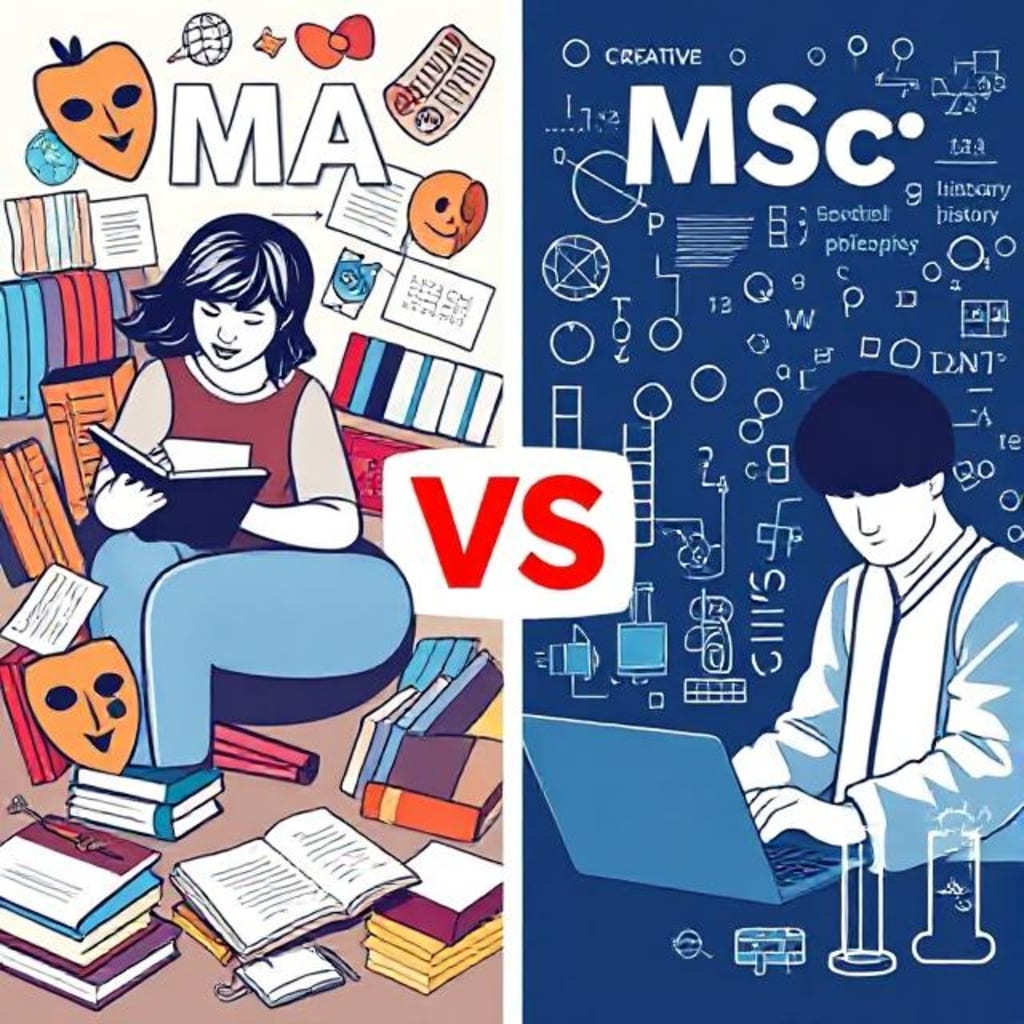
Choosing between a Master of Arts (MA) and a Master of Science (MSc) is a significant decision for students and professionals looking to further their education. With the vast number of postgraduate programs available, it's essential to research accredited universities and courses to find the best fit. Many students face confusion when deciding which degree to pursue, as both have distinct structures, methodologies, and career prospects.
The right choice can impact your future job opportunities, earning potential, and skill development. If you are wondering whether an MA or MSc is better suited for your goals, this guide will help break down their key differences and provide actionable insights to help you make an informed decision.
What is an MA?
A Master of Arts (MA) is a postgraduate degree primarily focused on humanities, social sciences, and liberal arts subjects. Explore top MA programs to find the best universities for your field of interest. This degree emphasizes theoretical knowledge, research methodologies, and critical analysis rather than practical applications. It nurtures creativity, interpretation, and communication skills, making it ideal for individuals who enjoy discussions, debates, and exploring complex concepts.
Common Fields of Study for MA:
Literature and Linguistics: Advanced studies in English, foreign languages, and literary theory.
History and Political Science: In-depth research into historical events, governance, and policies.
Psychology and Sociology: Theoretical frameworks of human behavior, society, and mental health.
Journalism and Media Studies: Understanding of media ethics, reporting, and digital communications.
Education and Fine Arts: Teaching methodologies, pedagogy, and artistic disciplines.
Key Features of an MA:
Focuses on Theoretical and Conceptual Learning: Coursework involves analyzing texts, exploring philosophies, and understanding social structures rather than conducting technical experiments.
Requires Essays, Research Papers, and Dissertations: Students are expected to develop strong writing and analytical skills to convey complex ideas effectively.
Ideal for Careers in Academia, Research, Media, and Education: Graduates often pursue roles in education, publishing, public relations, cultural institutions, and journalism.
What is an MSc?
A Master of Science (MSc) is a postgraduate degree that emphasizes scientific, technical, and analytical disciplines. This degree focuses on empirical research, quantitative analysis, and hands-on practical applications. It is designed for students who prefer working with data, experiments, and structured methodologies to solve real-world problems.
Common Fields of Study for MSc:
Engineering and Technology: Advanced studies in mechanical, civil, electrical, and software engineering.
Computer Science and IT: Specializations in artificial intelligence, cybersecurity, and software development.
Economics and Finance: Data-driven analysis of financial markets, banking, and economic theories.
Medicine and Life Sciences: Research in pharmaceuticals, biotechnology, and healthcare advancements.
Mathematics and Statistics: Application of complex calculations and statistical modeling in various industries.
Key Features of an MSc:
Focuses on Empirical Research and Technical Skills: The degree is designed to develop problem-solving abilities, numerical analysis, and scientific expertise.
Requires Lab Work, Experiments, and Data Analysis: Unlike MA programs, MSc students engage in laboratory research, computational modeling, and case studies.
Ideal for Careers in Science, Technology, Healthcare, and Business Analytics: Graduates often work in IT, engineering, medical research, finance, and industrial research sectors.
Key Differences Between MA and MSc
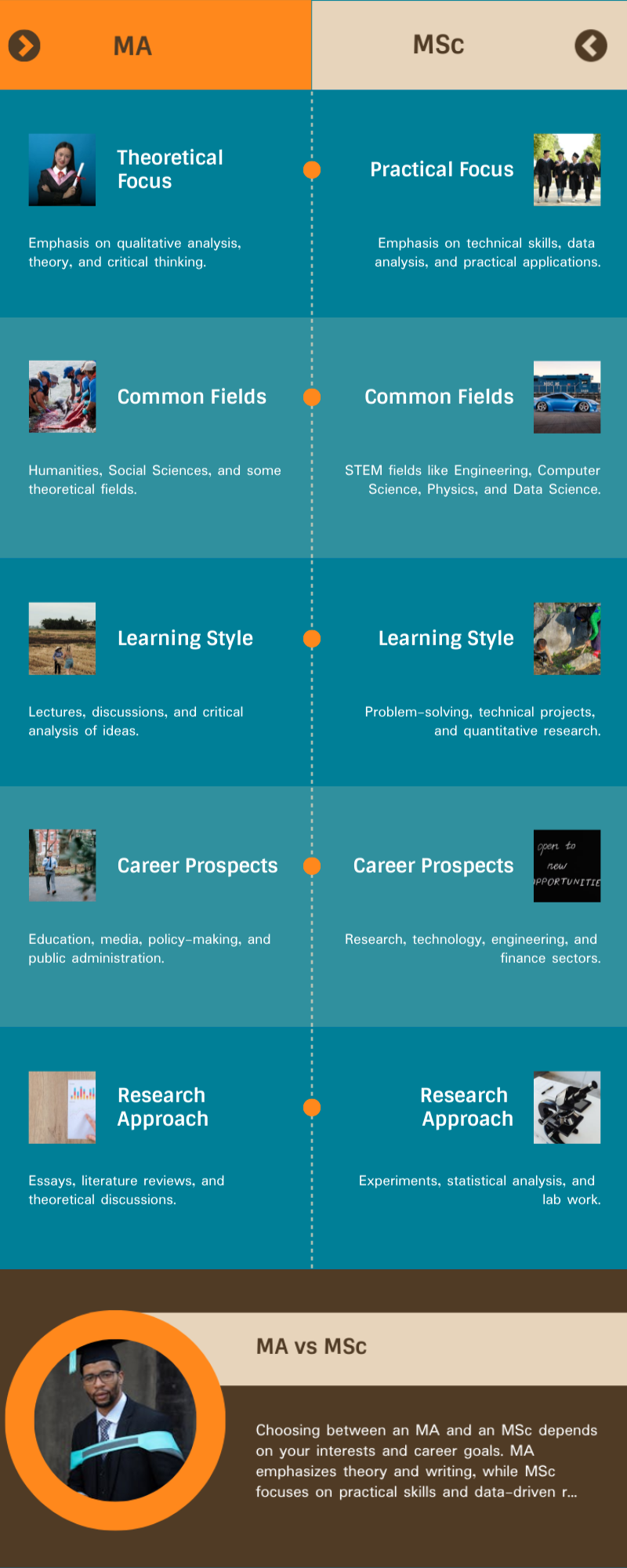
The primary difference between an MA and an MSc lies in their subject focus, research methods, coursework, career paths, and skill development. An MA is oriented toward humanities and social sciences, involving qualitative research and theoretical analysis, while an MSc is centered on scientific and technical fields, emphasizing quantitative research and empirical studies.
1. Subject Focus:
MA: Concentrates on humanities, arts, and social sciences, developing expertise in subjects like literature, history, and communication.
MSc: Focuses on science, technology, engineering, and mathematics (STEM) disciplines, emphasizing logical reasoning and technical proficiency.
2. Research Type:
MA: Involves qualitative research, theoretical exploration, and critical thinking.
MSc: Requires quantitative research, data analysis, and hands-on experimentation.
3. Coursework:
MA: Students complete essays, case studies, and conceptual research, focusing on interpretation and argumentation.
MSc: Involves lab work, experiments, and data-driven analysis, developing technical expertise.
4. Career Paths:
MA Graduates typically pursue careers in academia, media, public policy, and education.
MSc Graduates find opportunities in IT, engineering, healthcare, and finance, where technical skills are in high demand.
5. Skill Development:
MA: Enhances critical thinking, communication, and creativity.
MSc: Strengthens analytical skills, problem-solving abilities, and technical expertise.
How to Choose the Right Degree for You?
Consider Your Academic Interests
If you enjoy writing, research, critical analysis, and conceptual discussions, an MA might be the right fit for you. Subjects like literature, political science, and philosophy require interpretive skills and argumentation.
If you prefer logical reasoning, experiments, problem-solving, and working with data, an MSc would be a better option. Fields like engineering, medicine, and data science emphasize factual accuracy and quantitative research.
Evaluate Career Prospects
MA Graduates: Suitable for jobs in education, journalism, social work, government organizations, and creative industries such as publishing and advertising.
MSc Graduates: More likely to find roles in research labs, IT firms, engineering companies, healthcare institutions, and business intelligence sectors.
According to the Bureau of Labor Statistics , STEM-related fields (which typically require an MSc) have a higher projected job growth rate and better salary prospects than humanities-based careers.
Consider University Requirements & Accreditation
Some universities offer both MA and MSc in the same subject but with different curricula. Check the official websites of recognized institutions like QS World University Rankings .
Ensure your chosen program is accredited by UGC or AICTE if you plan to study in India, as accreditation affects degree recognition and employability.
Think About Further Studies
If you plan to pursue a PhD, check which degree aligns better with your research interests. Some PhD programs may require an MSc due to their emphasis on quantitative research.
Some professional certifications and licensing exams may require an MSc, especially in healthcare, finance, and engineering fields.
Conclusion
Choosing between an MA and MSc depends on your interests, career goals, and industry requirements. Research your field thoroughly, check university accreditations, and evaluate job market trends before making a decision. If you need guidance, consult university advisors or professionals in your desired industry.
By making an informed choice, you can maximize your career prospects and academic growth while ensuring your postgraduate education aligns with your long-term aspirations.
FAQs (Frequently Asked Questions)
1. Can I switch from an MA to an MSc or vice versa?
Switching between MA and MSc is uncommon but possible in interdisciplinary fields like psychology, economics, or business studies. You may need to take prerequisite courses or gain relevant experience.
2. Which degree has better job opportunities?
It depends on your chosen field. MSc graduates generally have higher demand in technical sectors, while MA graduates excel in creative, educational, and research-based careers.
3. Is an MA or MSc better for an MBA?
Both degrees are acceptable for an MBA. However, an MSc in business-related fields (like finance or data science) may provide a stronger quantitative background, which can be beneficial for analytical roles in business.
4. What are the salary differences between MA and MSc graduates?
Salary varies by field, location, and experience. According to the Bureau of Labor Statistics, STEM-related MSc jobs tend to have higher earning potential compared to MA-related roles in humanities.
5. Do employers prefer one degree over the other?
Employers value skills and experience more than the degree type. However, in technical fields such as finance, IT, and healthcare, an MSc is often preferred due to its practical and analytical focus.
About the Creator
Aman Rana
Aman Rana is a passionate writer who loves exploring new ideas & sharing knowledge. He enjoys reading, traveling, and discovering different perspectives on life. When he's not writing, you can find him deep in a book, enjoying music
Enjoyed the story? Support the Creator.
Subscribe for free to receive all their stories in your feed.
Comments
There are no comments for this story
Be the first to respond and start the conversation.