
Clear Learning Begins with Thoughtful Design
The ADDIE Model & DEI in Instructional Design

Think about the last time you were expected to learn something new without clear directions. Maybe someone handed you a manual, rushed through a demonstration, or assumed you already understood the basics. That experience can leave you questioning your ability when the real issue is how the information was presented. For me, thoughtful instructional design begins with recognizing that people need a clear starting point and support as they move forward.
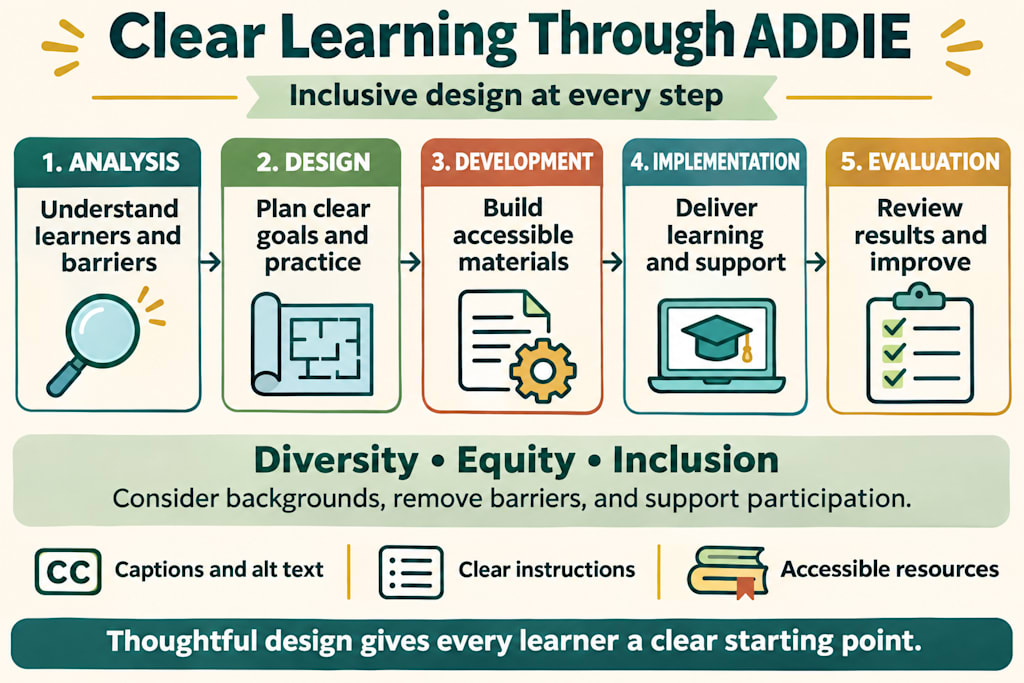
The ADDIE model gives that thinking a practical structure. Its five phases are Analysis, Design, Development, Implementation, and Evaluation. Together, they help designers move from identifying a learning need to examining whether instruction worked. Brown and Green (2024) describe instructional design through connected decisions about learners, goals, activities, and assessment. I appreciate this organized approach because each decision has a purpose beyond simply filling a course with information.
Analysis begins with understanding the situation. What should learners be able to do? What can they already do? What is getting in their way? Imagine employees repeatedly making mistakes while completing an unfamiliar process. Before creating another presentation, I would want to know whether they need instruction, clearer directions, or easier access to an existing resource. Listening to the people doing the work helps keep assumptions from becoming the foundation of training.
Design turns those findings into a plan. Learning objectives establish the destination, while activities and assessments give learners opportunities to work toward it. If someone must perform a procedure, I would want the learning experience to include a demonstration followed by supported practice. Asking that person only to memorize definitions would leave an important gap. Clear expectations also help learners understand what successful performance actually looks like.
Development makes the plan usable. This is where outlines become lessons, job aids, videos, or practice activities. My presentation emphasizes captions, readable text, and alternative text for meaningful images as examples of accessibility considerations. I also value instructions that explain both the steps and the reason behind them. A learner should be able to focus on the task without spending unnecessary energy trying to interpret confusing directions or navigate disorganized materials.
These decisions connect directly to diversity, equity, and inclusion. People arrive with different experiences, language backgrounds, abilities, and access to resources. Gamrat et al. (2022) argue for integrating inclusive considerations throughout instructional design. Their discussion encourages attention to representation, technology barriers, and the support learners need to participate. To me, that means asking who might struggle with a design choice before treating that choice as suitable for everyone. EDUCAUSE Review
Implementation reveals how the learning experience functions in practice. A course may be carefully planned, yet learners can still encounter unclear navigation or difficulty accessing materials. Facilitators also need preparation. I would want participants to know where to begin, how to ask for help, and what resources remain available afterward. Support should feel like an expected part of learning, especially when someone is working through unfamiliar information.
Evaluation creates room to make better decisions. Assessment results can show where learners need more practice, while feedback can uncover obstacles that scores alone miss. Gamrat et al. (2022) encourage using evidence and reflection to improve inclusive teaching. If several participants misunderstand the same direction, I see that as a reason to examine the instruction. Their confusion provides useful information about what may need to change. EDUCAUSE Review
What draws me to ADDIE is the connection between structure and care. There is a process to follow, but there are also real people behind every objective and activity. Combining that structure with inclusive decisions creates opportunities to make learning clearer and more accessible. I want learners to leave with a stronger understanding of what to do next and enough support to begin doing it with confidence in everyday situations.
References
Brown, A. H., & Green, T. D. (2024). The essentials of instructional design: Connecting fundamental principles with process and practice (5th ed.). Routledge. https://doi.org/10.4324/9781003404835
Gamrat, C., Tiwari, S., & Bekiroglu, S. O. (2022, March 10). INCLUSIVE ADDIE: Initial considerations for DEI pedagogy. EDUCAUSE Review. https://er.educause.edu/articles/2022/3/inclusive-addie-initial-considerations-for-dei-pedagogy
About the Creator
Learning by Design
Instructional Design & eLearning educational articles.
Enjoyed the story? Support the Creator.
Subscribe for free to receive all their stories in your feed.
Comments