
China’s Postgrad Exam Is Cooling—and the Smartest Kids Are Aiming Lower
A 120-second decision. A box of stomach medicine. Inside the cold math driving the “reverse graduate applications” wave.
I. A Seemingly Contradictory Decline
The registration numbers for China’s 2026 national postgraduate entrance exam have been released: 3.88 million. That marks a second consecutive year of decline, with a cumulative drop of over 800,000 candidates.
The numbers point to a straightforward conclusion: the once white-hot “exam fever” is cooling. Yet buried in the same report is an inverse trend — even as the total has shrunk, the proportion of applicants targeting non-“Double First-Class” institutions has risen. Many of them hold undergraduate degrees from Project 985 or Project 211 universities. The phenomenon the media has labelled “reverse graduate applications” has reached a new peak in 2026. At a second-tier engineering college in Zhejiang province, applications for its professional master’s in electronic information surged 31% year-on-year, with candidates from “Double First-Class” universities breaking the 15% threshold for the first time.
On one side, those abandoning the exam; on the other, those aiming lower. Both groups are heading toward the same endpoint, but for reasons that are not the same.
II. One Applicant’s 120 Seconds
Chen Luo (pseudonym) is a graduating senior at a Project 211 university in Wuhan, ranked in the top 30% of his class. During the pre-registration window in September 2025, he stayed on the exam board’s webpage for 120 seconds.
He first opened his original target: an academic master’s spot at a Project 985 university. The program listed 10 slots, 6 of which were already filled by recommended students. Then he switched to a professional master’s program at a non-“Double First-Class” institution: 42 slots, specialization subjects that heavily overlapped with what he had already studied, and a clear note stating “co-cultivated with leading enterprises in the industry.” He toggled between the two pages three times. After 120 seconds, he deleted the 985 registration and entered the code for the other school.
He did not consult his parents. He ran the numbers: the former had an applicant-to-admission ratio of 37:1, the latter 4.7:1. There was another, more important calculation, one he didn’t write down but held clearly in his mind. Even if he got into that 985 university, a lab senior had told him the median starting salary for graduates of that master’s program was 8,500 yuan. His classmate who had gone straight to work last year with just a bachelor’s started at 7,200 yuan. Three years, for a monthly difference of 1,300 yuan, gambling another year inside a rapidly shrinking pipeline for academic master’s slots.
He didn’t dare do the math on that one too closely.
III. Pulled by Three Gravitational Fields
Public opinion often frames “reverse graduate applications” as a shift in young people’s mentality toward “playing it safe.” But beneath that emotional reading, three stronger, more solid gravitational fields are at work.
First field: The marginal return on academic degrees is collapsing. Data from the 2025 MyCOS Employment Blue Book shows the starting salary gap between master’s and bachelor’s graduates has narrowed from roughly 35% five years ago to 18%. In certain humanities and business fields, the opportunity cost of a three-year postgraduate degree — lost wages, delayed promotion, deferred accumulation of work experience — now exceeds the premium the degree carries. Education is no longer an investment; it looks more like consumption.
Second field: “First-degree” screening in the job market has been institutionalized. Analysis of 2025 autumn recruitment data across multiple hiring platforms shows that positions explicitly requiring a “first degree from a Project 985/211 university” have risen by 7 percentage points year-on-year in technical R&D categories. This means that applicants from ordinary undergraduate backgrounds may not break through the resume barrier even with a master’s from a top-tier university. Meanwhile, those who already hold an elite bachelor’s degree have little need for a graduate degree to verify their educational pedigree. The exam has thus become an asymmetric game: those who most need it benefit the least; those who need it less look downward, seeking certainty in “employment-oriented” programs.
Third field: Direct diversion into the public sector pipeline. Registrations for the 2026 national civil service examination surpassed 3.7 million, an increase of nearly 1.2 million over three years. For a vast number of humanities and social science students, if the ultimate goal is a government post with lifetime tenure, preparing directly for the civil service exam is a more efficient path than “grad school first, then the exam.” Three years of graduate study is enough time to sit the national and provincial exams six times. Someone on Zhihu laid out the equation: one master’s degree from a non-“Double First-Class” university equals six shots at landing a public-sector job. In front of that equation, the balance quietly tilts.
IV. This Isn’t Awakening, It’s Cost-Benefit Analysis
The “reverse graduate application” trend has been celebrated in certain quarters as a “disenchantment with academic credentials” and a sign that “young people are no longer blindly following the herd.” But that romanticized reading obscures the cold texture of the facts.
This is not a value awakening; it’s a mathematically optimal solution under constraints. When a rational individual faces a fork between a high-probability job and a high-risk degree premium, choosing the former is an economic inevitability. It has nothing to do with passion or giving up. When a master’s degree can no longer send a sufficiently strong market signal, the market spontaneously seeks new filtering mechanisms — the rising weight placed on “first degrees” and the hardening label of “ordinary undergraduate” are results of the market correcting its own logic. “Reverse applications” are simply the least-bad choice young people make inside a script that has already been written.
V. A Still Frame
Chen Luo officially confirmed his registration on October 25, 2025. He didn’t tell his roommates or post about it on social media.
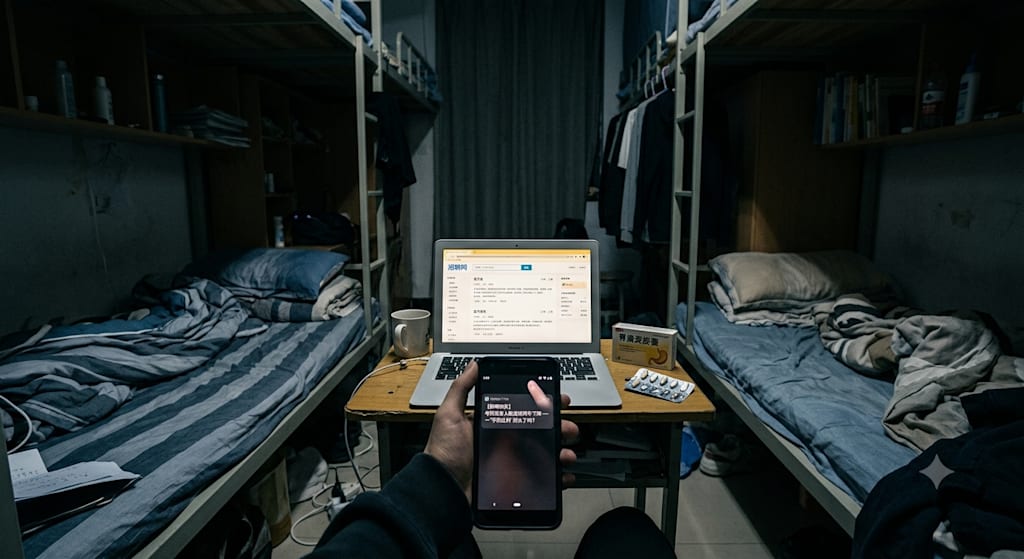
The moment he clicked “confirm,” the first thing he did was close the exam board’s webpage and immediately open another window, a job recruitment site. He typed the name of the city where that non-“Double First-Class” university is located into the search bar, then added the word “internship.” He said nothing to himself and did not sigh. The light from the screen fell on a box of stomach medicine sitting between two beds in his dorm room.
What he was thinking was: If I arrange things this way, I should be able to meet that city’s residency permit policy for fresh graduates in three years.
His phone screen lit up with a push notification: “Grad Exam Numbers Drop for a Second Straight Year — Is the ‘Degree Dividend’ Over?” He didn’t open it. He swiped it away.
About the Creator
Jin
Writer of reamstories
https://reamstories.com/jin
Enjoyed the story? Support the Creator.
Subscribe for free to receive all their stories in your feed. You could also become a paid subscriber, letting them know you appreciate their work.
Comments
There are no comments for this story
Be the first to respond and start the conversation.